Axios Markets

February 15, 2024

1 big thing: Strike surge
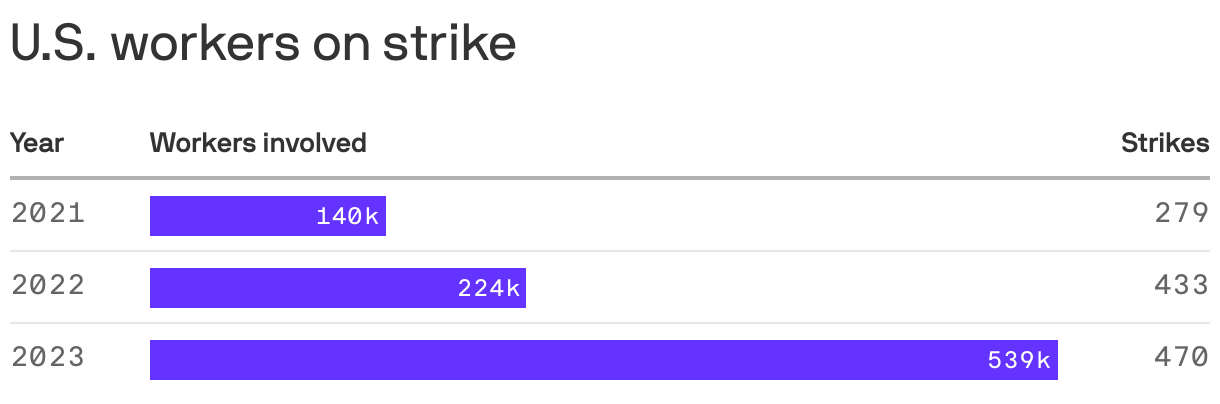
Forget the "summer of strikes," 2023 was a full year of walkouts: The number of workers who walked off the job surged by 141% last year from 2022, per a report out this morning, Emily writes.
Why it matters: The strong labor market of the past few years fueled a rise in support for unions and worker organizing, emboldening organizers to take a harder line — pushing folks to the picket lines.
- The results were great for these workers — especially in the four biggest walkouts of the year, where they scored big double-digit raises, bonuses, better benefits, and other assorted goodies.
Driving the news: The action continues this year. Yesterday drivers for Uber and delivery workers from DoorDash refrained from working.
Zoom in: While the overall number of strikes only ticked up a bit in 2023, many more workers were involved in stoppages.
- This was mainly due to four big strikes across a range of industries — health care (Kaiser Permanente workers), manufacturing (United Auto Workers), media (actors and writers), and education (L.A. school workers).
- These four actions alone involved a total of 350,100 workers, out of a total of 539,000 out on strike in 2023, according to the tally from Cornell's School of Labor & Employment Relations.
The top three demands among striking workers are better pay; improved health and safety; and increasing staffing (those latter two were both a big concern for Kaiser Permanente employees who said understaffing negatively affected patient care).
Another notable trend: Workers went on strike simply to push for a first contract. That's the first order of business for any new union — hammering out salary and benefit terms.
- The contract is a big deal. "Workers do not see a benefit, unless they get a contract," notes Alex Colvin, dean of Cornell's ILR school. U.S. labor law doesn't have a mechanism to compel companies to negotiate with unionized employees.
- So far a first contract has proved elusive for workers from Starbucks, Trader Joe's and Amazon who recently voted to unionize.
- The 74 work stoppages over first-contract demands in 2023 were more than double the previous year.
Uber and Lyft drivers, meanwhile, aren't in a union. Gig workers and fast food employees have had more success outside of traditional union channels, notes Colvin. Gaining higher minimum wages in a few places.
- One of the most effective tactics of unions over the last decade has been efforts like "Fight for $15" that leverage labor power at the policy level, he says.
In the weeds: Cornell has only tracked this data since 2021 so it's hard to make historical comparisons. That said, the 2023 numbers are in line with the 21st-century highs of 2018 and 2019 that were reported by the Bureau of Labor Statistics — and nowhere near the highs seen in the 1970s.
What to watch: All eyes are on the UAW's efforts in the South — a notoriously hard place to organize. "If they win, that would be a really big victory for organized labor," Colvin says.
2. Catch up quick
3. Women's work
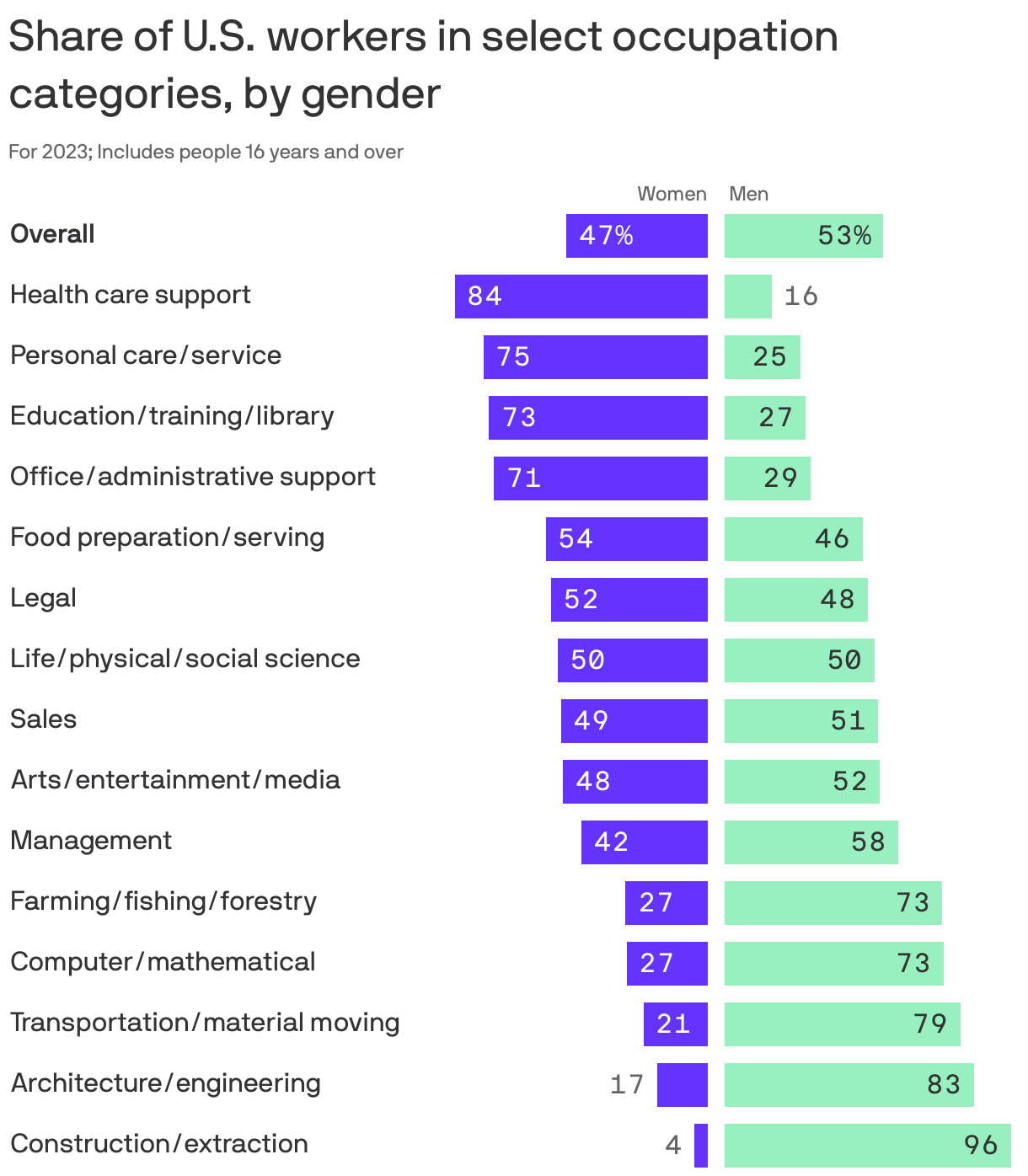
We've come a long way, sure. Women now make up 47% of all workers in the U.S. — nearly half. Back in 1950, the number was 30%, Emily writes.
- But not all occupations are so evenly split between men and women, as you can see from the data above, part of the BLS's annual look at workforce composition.
Zoom out: There is a lot of research explaining why the workforce is so pink- and blue-coded, as the WSJ recently noted. Some biggies...
Discrimination that serves to keep women and men out of certain occupations — firefighters hazing female recruits, say. Or sexual harassment in a male-dominated workplace.
Expectations that push women and men into certain roles.
- The assumption that men are supposed to be better at building stuff, for example, helps explain why they make up 96% of construction jobs and 84% of architects.
- Women are supposed to be better at caring for people. So, 87% of registered nurses are women — and if you do a Google image search for "nurse," you only see pics of ladies.
- (Though the "care" norm changes as you go up the pay scale. 62% of physicians, one of the highest paying roles in the U.S., are men, per a separate 2021 Pew analysis.)
Of note: These expectations can keep men and women from taking open job opportunities, as the NYT reported many years ago. Unemployed men weren't willing to take so-called pink-collar jobs because they were viewed as women's work.
Structural barriers mean women are more likely to be caring for children or others at home (part of the whole expectations thing) and often need greater flexibility — which often pushes them out of more demanding, less flexible (and often higher-paying) professions.
- That's started changing with the rise of remote work and has been a boon for getting more women into the workforce.
Axios Markets

Stay on top of the latest market trends and economic insights