
Axios Markets

April 27, 2023
Good morning, folks! Today's newsletter is 1,061 words, 4 minutes.
🏡 1 big thing: Builders rediscover first-time buyers
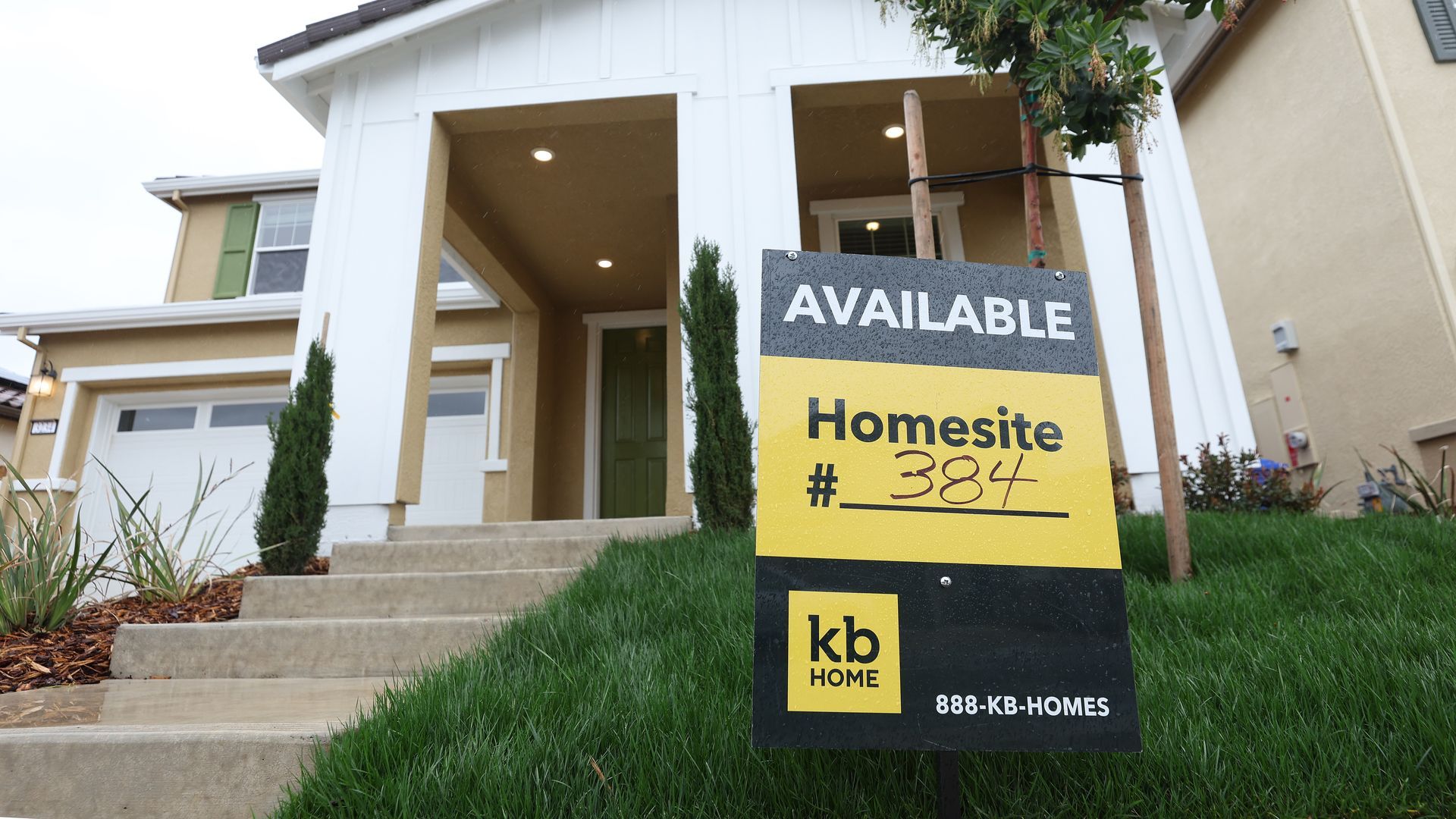
Photo: Justin Sullivan/Getty Images
The mortgage rate shock has refocused homebuilders' attention on an underserved segment — the first-time homebuyer, Matt writes.
Why it matters: Since the mid-2000s housing boom ended with a disastrous financial crisis in 2008, builders have mostly focused on larger, more expensive houses — the kind that are out of reach of entry-level buyers.
State of play: But now, sale activity in existing homes — the vast majority of houses — has slowed to nearly at a standstill.
- High prices and surging mortgage rates have hammered affordability — and made those who already own their homes leery of moving, a phenomenon known as "the lock-in effect."
- This is suppressing the inventory of existing homes on the market for sale.
Between the lines: At the risk of stating the obvious, first-time buyers don't already own a home — so they're not stuck in place by a sweet, low-rate mortgage.
- And with fewer than usual existing homes on the market for these entry-level buyers, builders see an opportunity.
- "It's a renewed focus, given the lack of inventory," Robert Dietz, chief economist at the National Association of Home Builders, tells Axios. "First-time buyers are going to play a key role in the order expansion for home builders going forward."
Driving the news: This week, executives at big builders like D.R. Horton and PulteGroup referenced the importance of first-time buyers on their earnings calls.
- "There is a higher likelihood of the entry-level buyer transacting at this point in time because they don't have a home to sell," said PulteGroup CEO Ryan Marshall. "They're not hampered by the low interest rate that they may be hanging on to."
- D.R. Horton also said it's taking steps that, reading between the lines, will appeal to entry-level homebuyers. "We have continued offering incentives and reducing the prices and sizes of our homes where necessary to provide better affordability to home buyers," said co-COO Paul Romanowski.
Zoom out: Builders’ rising interest in first-timers signals the industry’s need to find new customers as existing homeowners stay put.
- Case in point: New housing starts are down about 20% over last year.
The bottom line: While it’s good from an affordability standpoint that builders are renewing their interest in starter homes, there's little sign of a Levittown-style surge of modest-home construction to magically solve the inventory problem any time soon.
3. 📉 Charted: Regional bank stress


It's been a brutal month or so for regional banks, since the implosion of Silicon Valley Bank in March, Matt writes.
Why it matters: The chart above shows that while the broader regional banking sector has sold off in sympathy with seriously troubled lenders like SVB and First Republic, the downturn has been nowhere near as deep.
- On the other hand, big, diversified banks, like JPMorgan and Bank of America, have had an entirely different experience. Their perceived safety — and implied backing by the U.S. government — made them a magnet for jittery depositors.
Yes, but: The risk is that ongoing issues at First Republic — and whatever resolution the government ultimately devises — could reignite the panic.
- If First Republic is allowed to fail in a chaotic way, that could nudge depositors with uninsured funds at other regional banks to take their money and run.
4. Signs of a slowing job market for high earners

Illustration: Eniola Odetunde/Axios
Companies are posting fewer job listings, especially for white-collar roles in software, human resources, and banking and finance, per new data from Indeed, Emily writes.
Why it matters: It's a sign of how the job market is slowing down a bit for higher wage earners and the professional class.
By the numbers: Software development job listings saw the steepest drop, falling 55.4% in early April from the same time last year — that's what you'd expect as the tech sector keeps shedding workers.
- Listings in human resources are down 44.5%; no need to bulk up on recruiters if you're hiring fewer people.
- Banking and finance roles are down 41%. Insurance postings, 18.5%.
Zoom in: White-collar employers are making hiring decisions around expectations for the future — and the outlook includes some doom and gloom, said Nick Bunker, economic research director for North America at Indeed Hiring Lab.
- In contrast, employers in leisure and hospitality, restaurants, or retail are hiring to meet the strong demand of the here and now.
The big picture: The labor market overall is chugging along; unemployment is low and overall job listings are still up compared with before the pandemic.
- What to watch: We’ll get a more in-depth snapshot of overall job openings on Tuesday, when the government releases the Job Openings and Labor Turnover Survey (JOLTS) results for March.
5. Women CEOs outnumber men...named John

Illustration: Aïda Amer/Axios
Women chief executive officers finally — definitively — outnumber CEOs with the first name John among S&P 500 companies, per a new analysis from Bloomberg.
Why it matters: It's progress of a sort for women in corporate America.
Zoom in: Today there are 41 women leading S&P 500 companies — a new record, by the way — and 23 CEOs named John or Jon.
- Of note: Johns make up 3.27% of the U.S. population; women comprise more than 50%, as the New York Times pointed out back in 2018.
Catch up fast: Women first outnumbered Johns in 2018, but by the following year there was a new name-nemesis: women tied with CEOs named James, Bloomberg reports.
- It was only in the past year, after 10 new female CEOs joined the S&P 500, that women truly tore off the yoke of John. In an exciting twist, there are currently three CEOs named Jennifer.
Yes, but: When economist Justin Wolfers first noted that Johns outnumbered women CEOs back in 2015, he compiled what he called the Glass Ceiling index — looking at the ratio of men named James, Robert, John or William to all women CEOs.
- By that metric, women are still behind. There are 60 James/Robert/John CEOs compared to 41 women, by Bloomberg's count. (That's not even counting William.)
- The indicator isn't just about gender either, but also the dominance of "traditional" European and American names, Wolfers told Axios yesterday. "This is not an index that points to ethnic diversity."
The bottom line: Outnumbering Johns is nice, but men overall still have a huge lead here. Women only hold 8.2% of CEO roles at large companies.
Was this email forwarded to you? Subscribe here.
Axios Markets is edited by Kate Marino and copy edited by Mickey Meece.
Sign up for Axios Markets

Stay on top of the latest market trends and economic insights