Axios Markets

February 23, 2023

1 big thing: 🧐 Earnings learnings


Corporate America's gangbusters' profit growth has stalled out, Matt writes.
- With results in from virtually all of the S&P 500, the blue-chip index looks like it earned about $54 per share during Q4 2022, according to data provider Refinitiv.
The big picture: This drop of just under 1% marks the end of a remarkable run of post-pandemic profit growth for American corporations.
- Real talk: Even though growth has gone slightly negative compared to 2021's nosebleed levels, profits remain really high (see the chart below).
The backstory: Over the last couple of years, U.S. companies have made incredible amounts of money as inflation allowed them to raise prices, jacking up profit margins to levels not seen in over 70 years.
But, but, but: During the last few weeks, executives have warned that as inflation slows, they're having a harder time raising prices, meaning margins are now shrinking.
- Home Depot's stock got hammered Tuesday after reporting results and issuing just such a heads-up about margins in the coming year.
Be smart: This might sound like bad news. And for some shareholders, it might be. But the reality is, corporate profits don't actually say all that much about the health of the broader economy.
- That's because the most pertinent part of earnings reports for economy-watchers is the so-called top line — sales, or revenues, depending on what you want to call them.
- Revenues are more closely aligned with a country's GDP performance — or total economic output — than profits are.
What they're saying: "Corporate revenue trends are consistent with positive but below-potential economic growth," wrote Goldman Sachs analysts in a note published Tuesday. "The pullback in earnings and earnings expectations is not particularly concerning for the broader economic outlook."
The bottom line: The recent run of earnings reports basically told us the economy is exactly where we thought it was: growing but more slowly than last year. Go figure.
2. Charted: Profits are still pretty high


3. Catch up quick
4. 💰 Pay surges in energy patch, slumps in tech hubs


Two of the major storylines of the 2022 economy were the soaring energy sector and the retrenchment in tech, Matt writes.
Driving the news: New government data released yesterday shows just how that played out in the wages of workers based in energy and tech-heavy regions.
State of play: The detailed quarterly numbers on employment, wages, and job creation in local areas of the U.S. last year show that average wages surged in key oil and gas areas — like Midland County, Texas, a hub for the energy-rich Permian Basin, where average weekly wages jumped 14% year over year.
- On the flip side, Silicon Valley and the Bay Area suffered sharp drops in average wages, as the tech sector shed jobs.
- California's San Mateo County — where Facebook is headquartered — saw the steepest decline.
5. Worker strikes jumped 50% last year


The number of major worker strikes in the U.S. rose to its second highest level in two decades in 2022, per a government report out yesterday, Emily writes.
Why it matters: The strength of the labor market and the rise in popularity of unions drove up the numbers. COVID-era issues, like short-staffing, burnout, and pay that didn't keep up with inflation, also pushed workers to the picket lines.
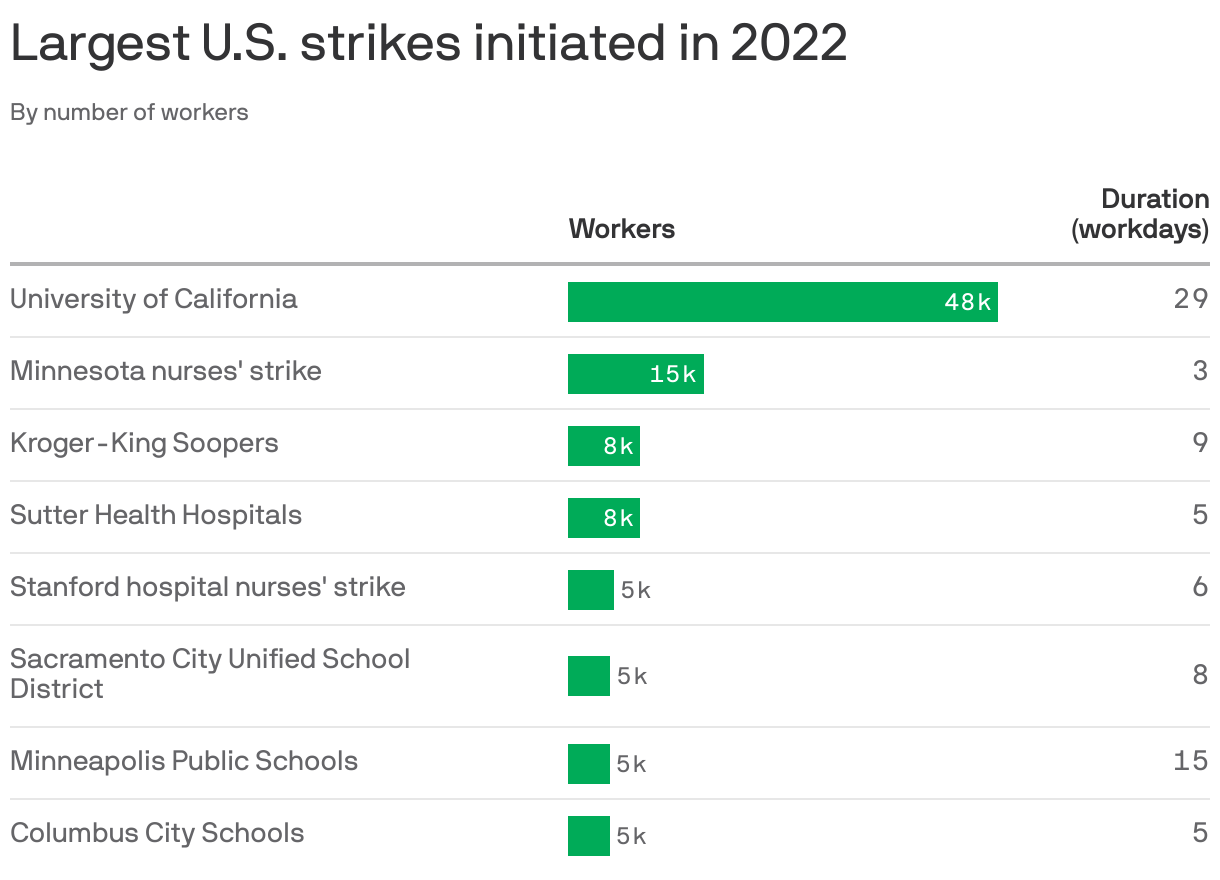
By the numbers: These aren't the blue-collar factory strikes of yore. There were 23 major work stoppages last year, involving a total of 120,600 workers, and 98% of the folks work in the service sector, specifically health care and education.
- The biggest strike of 2022 was the 40-day walkout of 48,000 graduate students at the University of California, followed by 15,000 nurses who walked out in Minnesota. Both ultimately reached contract agreements.
Context: The Bureau of Labor Statistics, which published the report, only tracks work stoppages that involve more than 1,000 workers — and that leaves out a lot of strikes.
- Per Cornell's ILR Labor Action Tracker, which examines the whole universe of work stoppages, 224,000 workers walked out in 2022 across 417 strikes and seven lockouts — an increase of more than 50% from 2021.
- The vast majority of these smaller walkouts involved Starbucks workers, Cornell reports.
Zoom out: Common demands from striking workers included higher pay, followed by health care, health and safety issues and staffing, according to Cornell's database.
What to watch: The shipping industry. Yesterday, 6,000 FedEx pilots, represented by Air Line Pilots Association, inched closer to the possibility of a strike, by unanimously authorizing a strike vote. (That clears one of several hurdles on the way to a walkout, put in place by federal labor law, as the union explains.)
- They've been in negotiations with the company for a new contract since 2021 — and for the past six months negotiations have been federally mediated.
- Meanwhile, all eyes are on the 350,000 Teamster members at UPS, the largest private sector union in the U.S. Their contract expires in July and tensions are rising ahead of those negotiations.
- Go deeper: UPS and the Package Wars (The New Yorker)
Bonus chart: Biggest walkouts
Axios Markets

Stay on top of the latest market trends and economic insights