Axios Markets

April 12, 2023

1 big thing: Unpacking the commercial real estate problem


If you're waiting for the commercial real estate apocalypse to hit, it might be a while — maybe forever, Emily writes.
Why it matters: Commercial real estate, particularly the office sector, is slumping — and the regional banks that lend to the space aren't looking so hot either — leading to concerns about a "doom loop."
- "There's definitely been an overreaction in the market about the relationship between banks and CRE [commercial real estate]," said Kevin Fagan, a senior director and head of CRE economic analysis at Moody’s Analytics.
Catch up fast: Market watchers were spooked by Federal Reserve data showing that the holders of commercial real estate loans are a highly concentrated group — with small and regional U.S. banks (those not in the top 25) collectively holding 67%.
Reality check: That eye-popping number turns out to be a bit misleading. Under the hood, the situation is more nuanced, as detailed in two reports from the Mortgage Bankers Association and Moody's Analytics.
- The 67% figure includes loans backed by traditional commercial real estate — apartment complexes, office buildings, retail space — but it also includes construction loans, loans backing farmland, or loans to owner-occupied properties like two-family houses.
- (You can read more in the footnotes to this report from the Fed if you want to nerd out on this.)
State of play: The traditional commercial real estate lending market is incredibly diverse. That means borrowers should have options when it comes time to refinance.
- Banks — large and small — account for 39% of outstanding loans, per Moody's Analytics.
- Regional banks hold just 14% of outstanding loans.
- Fannie Mae and Freddie Mac also make a lot of these loans as do life insurance companies. (The chart above has the breakdown.)
Zoom out: Regardless of the lender mix, there’s sure to be pain in the commercial real estate market in the coming years — likely driven by growing distress in the office building segment.
- Office loans represent about 17% of outstanding commercial real estate debt, as calculated by the MBA.
- Rents aren't what they used to be, and building values are going to fall.
- With a glut of loans coming due soon, some will surely default. Morgan Stanley estimates that $1.5 trillion in commercial real estate debt is set to mature over the next two years.
But, but, but: "They're not systemic risks to the overall economy," says Fagan. More on that below...
2. Charted: Lower leverage in the system


Commercial real estate underwriting standards improved after the global financial crisis — similar to what happened in the residential mortgage market.
State of play: Loan-to-value (LTV) ratios are much lower now, as the chart above shows.
What that means: Borrowers have more equity (and proportionally smaller loans) on their properties.
- That's going to help when it's time to refinance these loans. Borrowers may still have a shot at affording new loans, despite lower building values and higher interest rates.
- And when defaults do happen, lower LTVs should mean smaller losses for the lenders.
3. Catch up quick
4. 🇺🇸 🇨🇳 Conscious decoupling
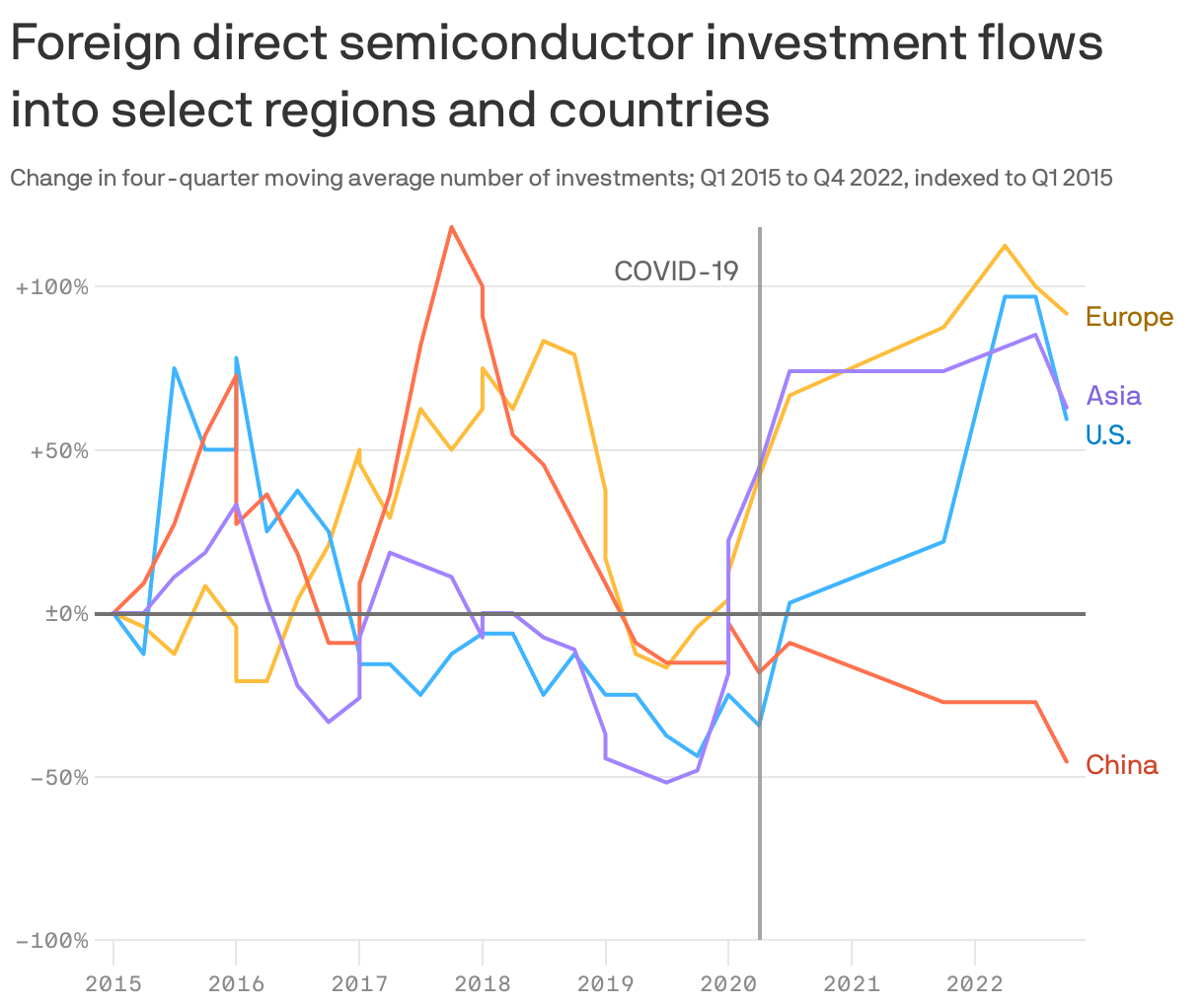
For a stark example of the decoupling dynamic that's reshaping the global economy, just look at the flows of money into semiconductor manufacturing, Matt writes.
Why it matters: In recent years, companies and political leaders have increasingly sought to move production to countries they are aligned with politically, in order to make their supply chains less vulnerable.
- This is especially true for strategically sensitive industries, like computer chip (aka semiconductor) manufacturing, that are crucial to national defense.
What they're saying: "When considering investment in strategic sectors, like semiconductors [foreign direct investment] flows are increasingly concentrated among countries that are geopolitically aligned," per the International Monetary Fund's World Economic Outlook released yesterday.
5. Thank goodness for hedge fund managers


Hedge fund managers get a lot of bad press, Matt writes.
- So, we here at Axios Markets wanted to point out an extremely generous gift that a top American financier recently made to a struggling New England nonprofit organization.
Driving the news: Ken Griffin, the head of the hedge fund and trading giant Citadel — not to mention a GOP super donor — just dashed off a $300 million unrestricted gift to Harvard University's Faculty of Arts and Sciences.
🤔 Between the lines: Harvard doesn't appear to be in desperate need of cash.
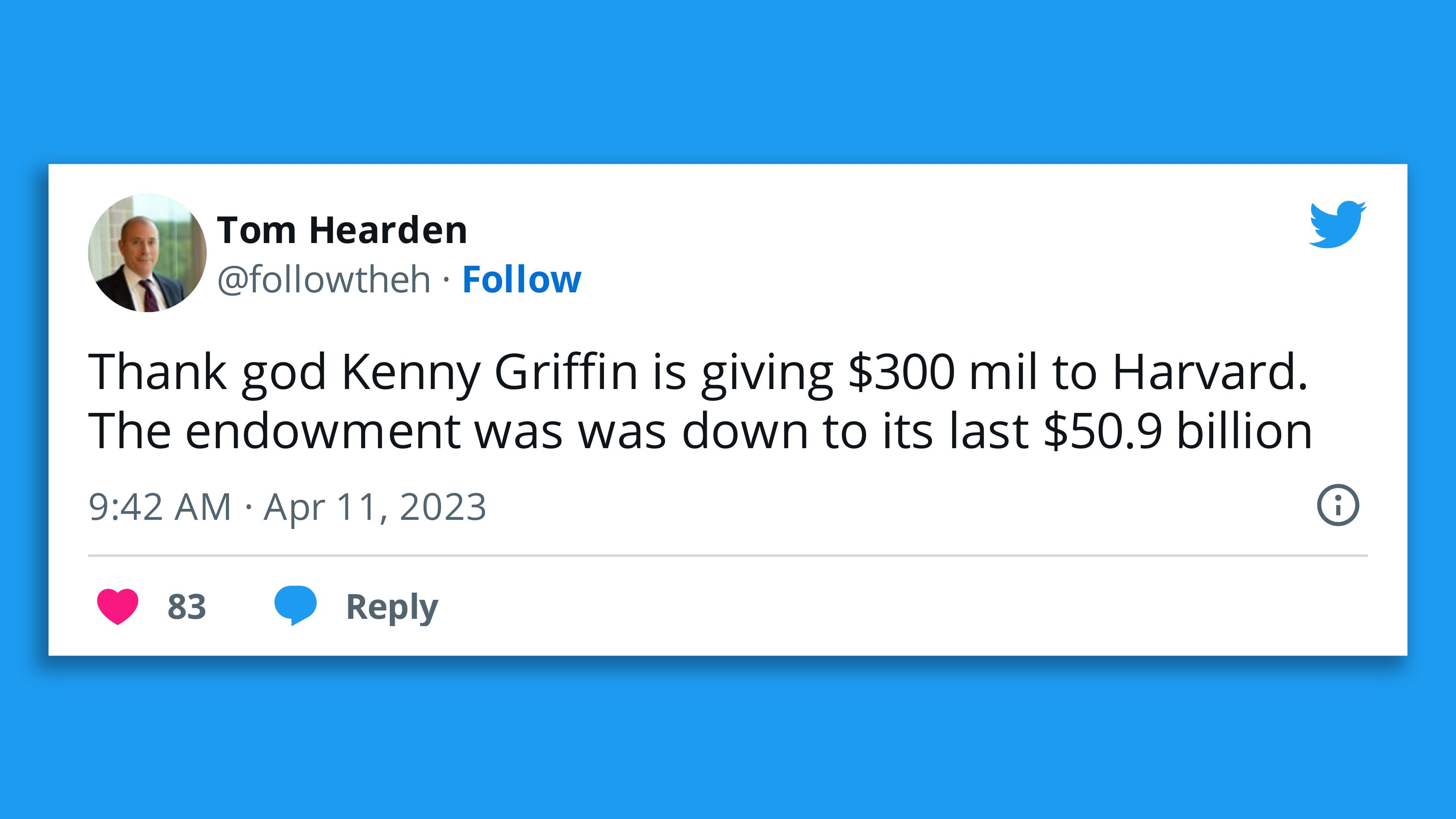
- Its endowment — the nation's largest among universities — weighs in at $51 billion.
- Or as trader and #fintwits personality Tom Hearden put it:
Where it stands: Griffin, a 1989 graduate of Harvard, has donated more than a half-billion to the university, including a gift of $150 million in 2014.
- And now his name will live on. The Graduate School of Arts and Sciences will be renamed the Harvard Kenneth C. Griffin Graduate School of Arts and Sciences.
Axios Markets

Stay on top of the latest market trends and economic insights