Axios Markets

July 05, 2023
🎇 Welcome back after a long — and for some, very hot — weekend. Today we dig into how the Texas power market is handling this heatwave.
Today's newsletter is TK words, TK minutes.
1 big thing: Power moves
Illustration: Natalie Peeples/Axios
Renewable energy is helping to keep electricity costs from skyrocketing in Texas, as the state sweats beneath a heat dome, Axios' Kate Marino writes.
The big picture: The heat dome is toppling records. Multiple locations in Texas set monthly and all-time temperature highs last week.
- And with air conditioners humming relentlessly, the state hit a new record for electricity usage on June 27.
- Meanwhile, Texas' renewable energy production also climbed to new highs amid outages from a large number of fossil-fuel plants
Why it matters: As states across the U.S. take steps to decarbonize, the role and reliability of renewable power are being closely watched in Texas. The Lone Star State has the second largest renewable capacity in the country (after California) — and is prone to extreme temperatures that can strain the grid.
- So far this year, Texas’ renewables have passed the test.
What they’re saying: "The market just kind of shrugged because there was so much wind and solar in the market ... It's another demonstration of the benefit for consumers that we see from wind and solar," says Doug Lewin, author of the Texas Energy and Power Newsletter.
- “Having solar provide during the hottest parts of the day is allowing our thermal [i.e. fossil fuel] fleet to not run itself into the ground as fast,” Josh Rhodes, a research scientist at the University of Texas at Austin, told Texas Monthly.
By the numbers: The state's solar capacity has nearly tripled in the past three years, and there are thousands more megawatts now under development, as Texas Monthly notes.
- The Texas grid was producing a record 31 gigawatts of renewable power last Wednesday.
- And as a share of total power, renewables reached 35%-40% during peak usage last week, Lewin says. (For comparison, renewables provided about 25% of the state's power during 2022.)
Power prices climbed from the typical area of around $30 per megawatt hour — but they mostly stayed below $50 throughout the week, says Lewin.
- "A few years ago, on a day like last Tuesday, there would have been a very high likelihood that you would have seen prices in the $1,000s per megawatt hour area," he says. (In Texas' deregulated power market, occasional price spikes during high demand are a feature, not a bug.)
- "Renewables likely saved consumers a billion dollars or more last week alone," Lewin adds.
Two key stats: Renewables reduced wholesale electricity costs in Texas by $11 billion in 2022, according to a recent paper that Rhodes authored.
- But it could have been more: Transmission congestion cost Texans nearly $3 billion last year.
- In other words, much of the excess solar power produced in high-generation areas like the south and west couldn't be moved to places like central Texas that would gobble it up if they could get their hands on it, says Michael Webber, a professor at the University of Texas at Austin.
- More transmission projects are in the works, he notes.
What we're watching: Summer's just getting started — keep an eye on the Texas grid as the heat wave continues.
3. Supreme Court fallout
Illustration: Maura Losch/Axios
Companies could see serious downstream effects for businesses stemming from the Supreme Court's decision overturning the use of affirmative action in college admissions — even though the court didn't directly address company diversity efforts, Emily writes.
The big picture: Companies will face a talent pipeline problem.
- When states have banned affirmative action, enrollment of Black students in universities declined — and that decrease in campus diversity could translate into a less diverse workforce.
- Indeed, one 2013 study from economist Fidan Ana Kurtulus found that workplaces became less diverse in states where the practice was outlawed.
What they're saying: "Over the next decade, traditional talent pipelines will become less diverse because of this ruling," writes Joelle Emerson, the CEO of Paradigm, a diversity consulting company.
- The ruling is "a problem for our economy because businesses often rely on colleges and universities to provide a diverse pipeline of talent for recruitment and hiring," said Charlotte Burrows, the chair of the Equal Employment Opportunity Commission, in a statement Thursday.
Why it matters: U.S. businesses have a strong interest in hiring a diverse workforce to remain maximally competitive in an increasingly diverse country.
- More than 20 top companies, including Accenture, Apple, General Motors, Google and United Airlines, made that argument in an amicus brief before the Court.
- Attending a diverse school helps prepare students for the experience of working with different kinds of people as clients, colleagues, and customers, they note.
Plus: The amici point to research that finds diverse teams are better at decision-making, creativity and communications.
Zoom out: In the run-up to the decision and in its aftermath, there's been much hand-wringing about a chilling effect on corporate diversity efforts.
Reality check: "It remains lawful for employers to implement diversity, equity, inclusion, and accessibility programs that seek to ensure workers of all backgrounds are afforded equal opportunity in the workplace," said Charlotte Burrows, the chair of the Equal Employment Opportunity Commission, in a statement Thursday.
Between the lines: Companies don't treat race in hiring the way colleges handle it in admissions practices, Emerson points out.
- Corporate DEI efforts are typically more focused on reducing bias in hiring — recruiting from a broader talent base, figuring out how to reduce discrimination in the interview process, etc.
4. Where the minimum wage is rising this summer
Three states and 16 localities raised their minimum wage this summer, many of them through automatic inflation adjustments, the Economic Policy Institute notes in a new report, Emily writes.
Why it matters: Boosting the wage floor has the effect of raising pay for those who make more than the minimum — as employers have to adjust their wage ladders upward.
By the numbers: On the first of July, Oregon raised its minimum by 70 cents to $14.20 as part of an automatic inflation adjustment. Portland's minimum wage is $1.25 higher, by law, and went up to $15.45.
- Washington, D.C.'s minimum wage also got an inflation adjustment, rising to $17 — an increase of 90 cents.
- Nevada went to $11.25, from $10.50, per legislation.
- Connecticut's minimum wage went up by one dollar on June 1 to $15.00.
- Inflation adjustments also happened in 12 locales in California, including San Francisco ($18.07), Los Angeles ($16.78), and West Hollywood ($19.08), which now has the highest minimum wage in the country.
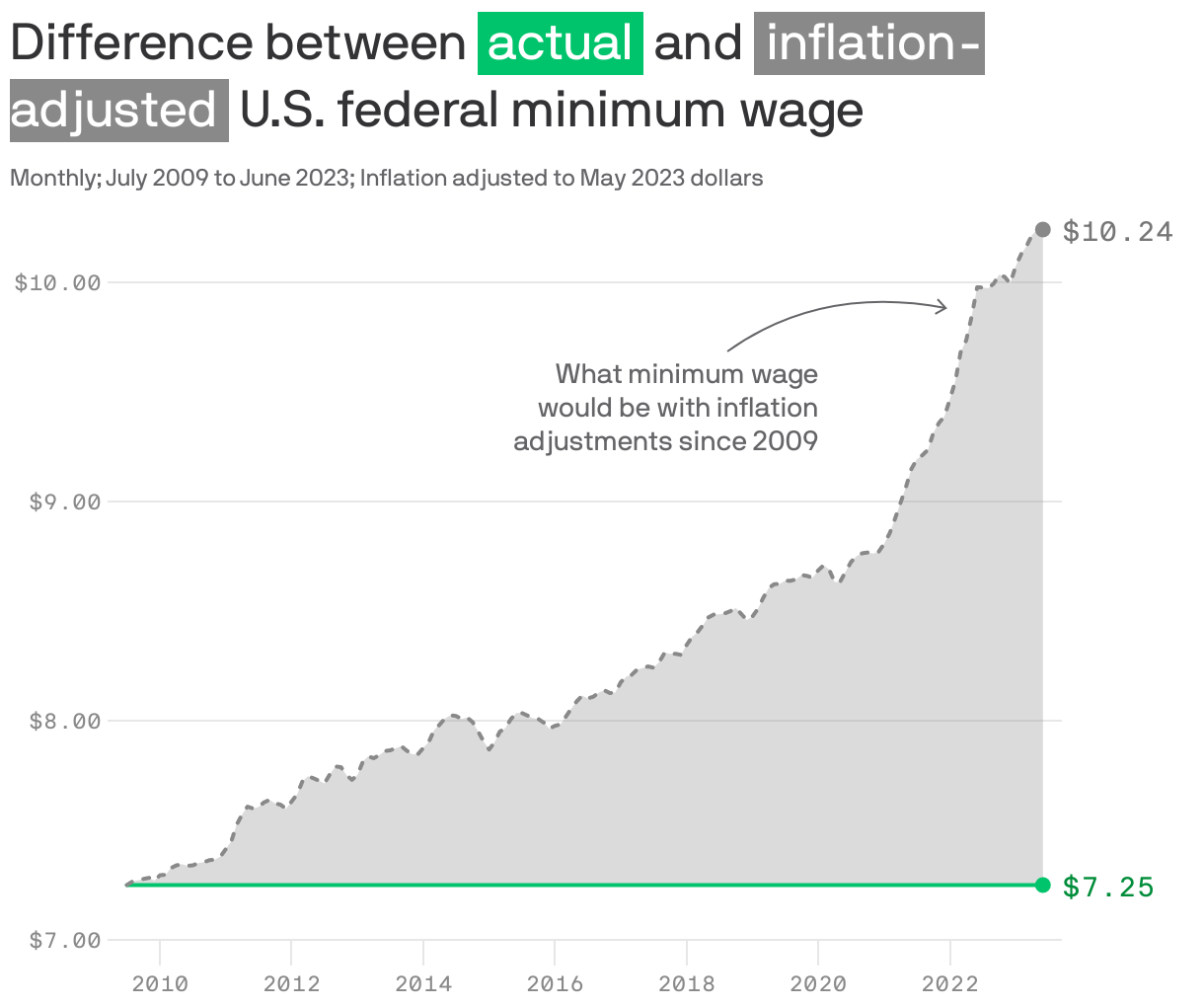
Meanwhile, the federal minimum wage of $7.25 an hour hasn't changed since 2009; if it had been adjusted for inflation since then, it would be up to $10.24 (see the chart above).
- 20 states use the federal minimum, per a count from the Labor Department, including Alabama, Georgia, Louisiana, Mississippi, South Carolina, Tennessee and Wyoming.
Editor's note: The top story has been corrected to state that the Texas grid was producing a record 31 gigawatts of renewable power on Wednesday June 28, rather than megawatts.
Was this email forwarded to you? Subscribe here.
Today's Axios Markets was edited by Kate Marino and copy edited by Mickey Meece.
Sign up for Axios Markets

Stay on top of the latest market trends and economic insights