
Axios Markets

November 17, 2023
🥳 Friday! We did it. Next week: Thanksgiving. It's all happening people. Let's do this. Today's newsletter is 1,161 words, 4.5 minutes.
1 big thing: AI labor battles to come

Illustration: Shoshana Gordon/Axios
The groundbreaking AI provisions in the Hollywood actors' union contract are a sign of the big changes coming across all kinds of jobs, thanks to the fast rise of AI technologies, Emily writes.
Why it matters: The AI issue is urgent in the entertainment industry, which has created digital replicas of actors. But with the tech moving so fast, all of us will likely face disruptions soon enough, economists said at a Brookings panel this week.
- That could mean AI is on the agenda in more union contract negotiations — or unions use the threat it poses to organize new workforces.
- For nonunionized workers, big changes are coming, too — particularly among white-collar folks — and experts urged policymakers and employers to pay attention.
- "We need to be prepared for a range of scenarios for how AI will continue to affect labor in the coming years and decades," says Anton Korinek, an economist at the University of Virginia and nonresident fellow at Brookings.
Zoom in: The 118-day Hollywood actors' strike took longer to resolve than the writers' strike — not because of a fight over pay or even streaming — but because of the union's demands around AI.
- "[O]ur members are some of the first people to really deeply feel the effects of generative AI," says Duncan Crabtree-Ireland, national executive director and chief negotiator of SAG-AFTRA, which represents actors.
- Some have had their images manipulated in deepfake pornography, he says.
AI wasn't something they could punt to a contract a few years down the line, since Hollywood's eager to use digital replicas, he says.
- Crabtree points to Carrie Fisher’s posthumous return in "Star Wars: The Rise of Skywalker," and Paul Walker's, in "Furious 7."
- The new contract contains specific provisions around consent and compensation for digital "replicas" used in films and TV shows.
The big picture: If you'd asked any economist three years ago what jobs are most exposed to automation, they would have said blue-collar work, says Korinek.
- But the fast adoption of generative AI has meant the most disruption in the white-collar space.
For example: "There are jobs that are already almost fully replaced, like translators. Copy editors are getting there," he says. Software engineering is changing fast.
- "Even economists like myself see that a growing number of the things we do in our daily work are suddenly being automated," Korinek adds.
- Jobs that require writing are also threatened (author's note: erm, gulp). A paper released last month found a 14% decrease in the number of listings for freelance jobs associated with writing — including electronic engineers, accounting research and web development — after the introduction of ChatGPT.
The intrigue: It's hard to predict if AI will replace these jobs or just augment them, changing the way people work.
The bottom line: Hollywood actors — they're just like us — only they got here first.
3. Oil hits 4-month low


U.S. oil prices dropped nearly 5% yesterday, hitting four-month lows, Matt writes.
Why it matters: The slide in crude oil is yet another indication that the balance of power has swung toward sharply slowing inflation in the U.S. economy.
- That could be good news for drivers, suggesting that gasoline prices — already down about 11% to $3.34 a gallon from a year ago — could fall a bit more ahead of Turkey Day-related trekking.
State of play: The slide started earlier this week after fresh data showed a much higher-than-expected rise in stockpiles of crude oil in the U.S., along with growing stateside production.
- A slowdown in demand from China, seen in slower gasoline refinery output numbers published Wednesday, added to the drop, as did reports on Thursday that Saudi exports had risen in September, the latest month for which data was available.
4. Red cup rebellion
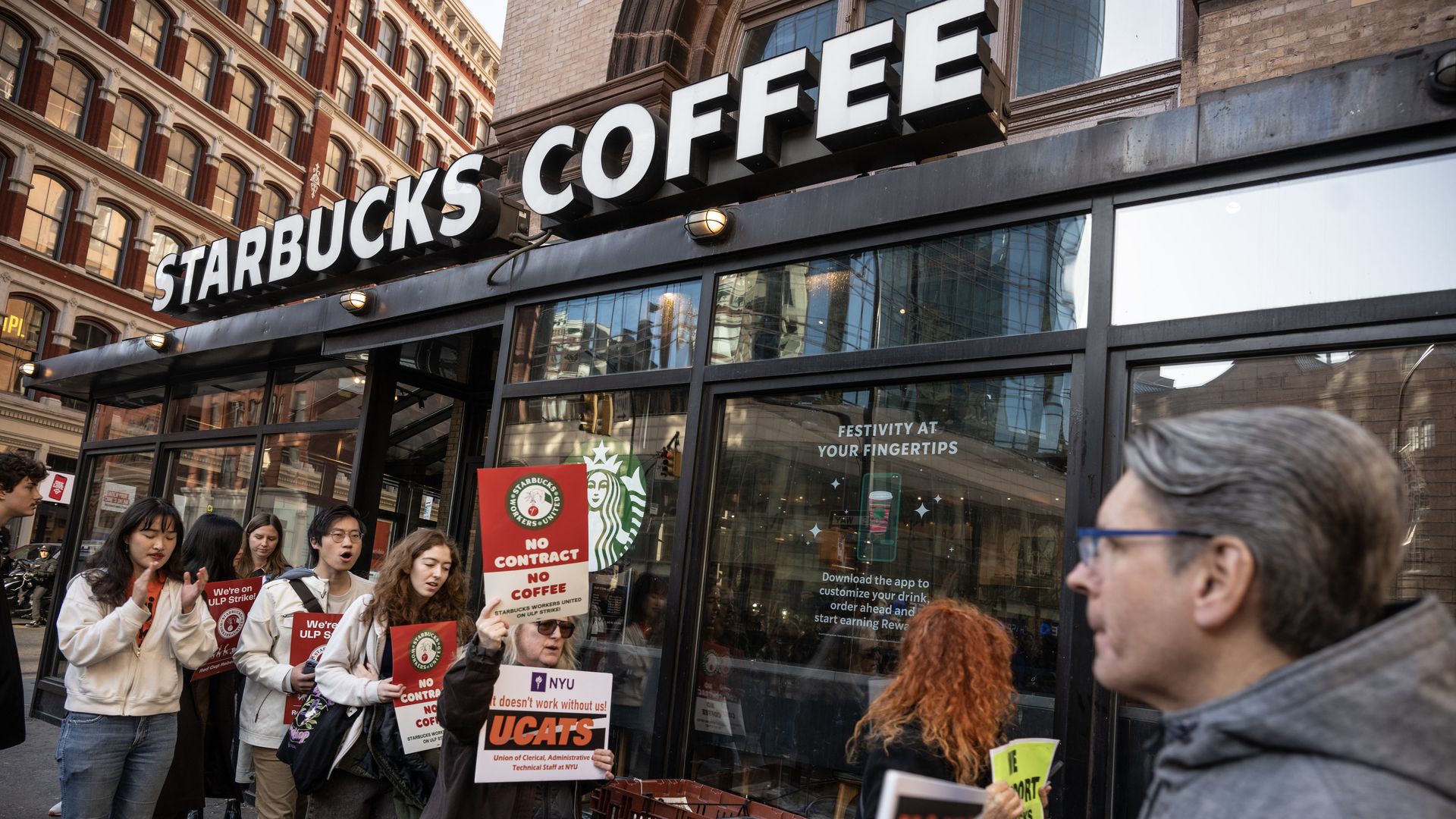
Starbucks Workers United union members and supporters on a picket line in New York yesterday. Photo: Victor J. Blue/Bloomberg via Getty Images
The Red Cup Day strike at Starbucks by thousands of Workers United members was the largest in the union's history, organizers say, Emily writes.
State of play: Over the past two years, more than 360 of 9,600 corporate-run Starbucks stores in the U.S. in more than 40 states have voted in favor of unionizing, per Workers United, an affiliate of the Service Employees International Union.
Reality check: That is less than 4% of U.S. locations. If every single unionized store closed for a strike, customers could probably get a latte at another Starbucks.
- That means employees don't have the kind of leverage that, say, unionized autoworkers can muster.
Meanwhile: None of the unionized stores have come close to getting a contract — they each have to bargain for one individually (another massive hurdle).
- They're going up against a corporate giant that's aggressively fended off unionizing efforts.
- The union filed hundreds of labor charges against the coffee chain at the National Labor Relations Board. The NLRB sends out a regular email update on all the Starbucks charges to reporters — "I know these emails are getting pretty long," the board's press secretary wrote in this week's missive.
- NLRB regional offices have issued more than 100 complaints against Starbucks, alleging that it engaged in, essentially, illegal union busting —threatening employees with loss of benefits or taking them away, illegally firing workers, and refusing to negotiate in good faith. (Those complaints then get adjudicated by an administrative judge, and can be appealed.)
The other side: Starbucks has denied wrongdoing.
- A Starbucks spokesman tells Axios that fewer than 100 stores had workers who protested yesterday — the union says it was 200 stores.
- Starbucks said it's the union that's delaying the bargaining process. "Despite escalating rhetoric and recurring rallies demanding a contract, Workers United hasn't agreed to meet to progress contract bargaining in five months."
5. A rare feel-good Twitter, er X, story
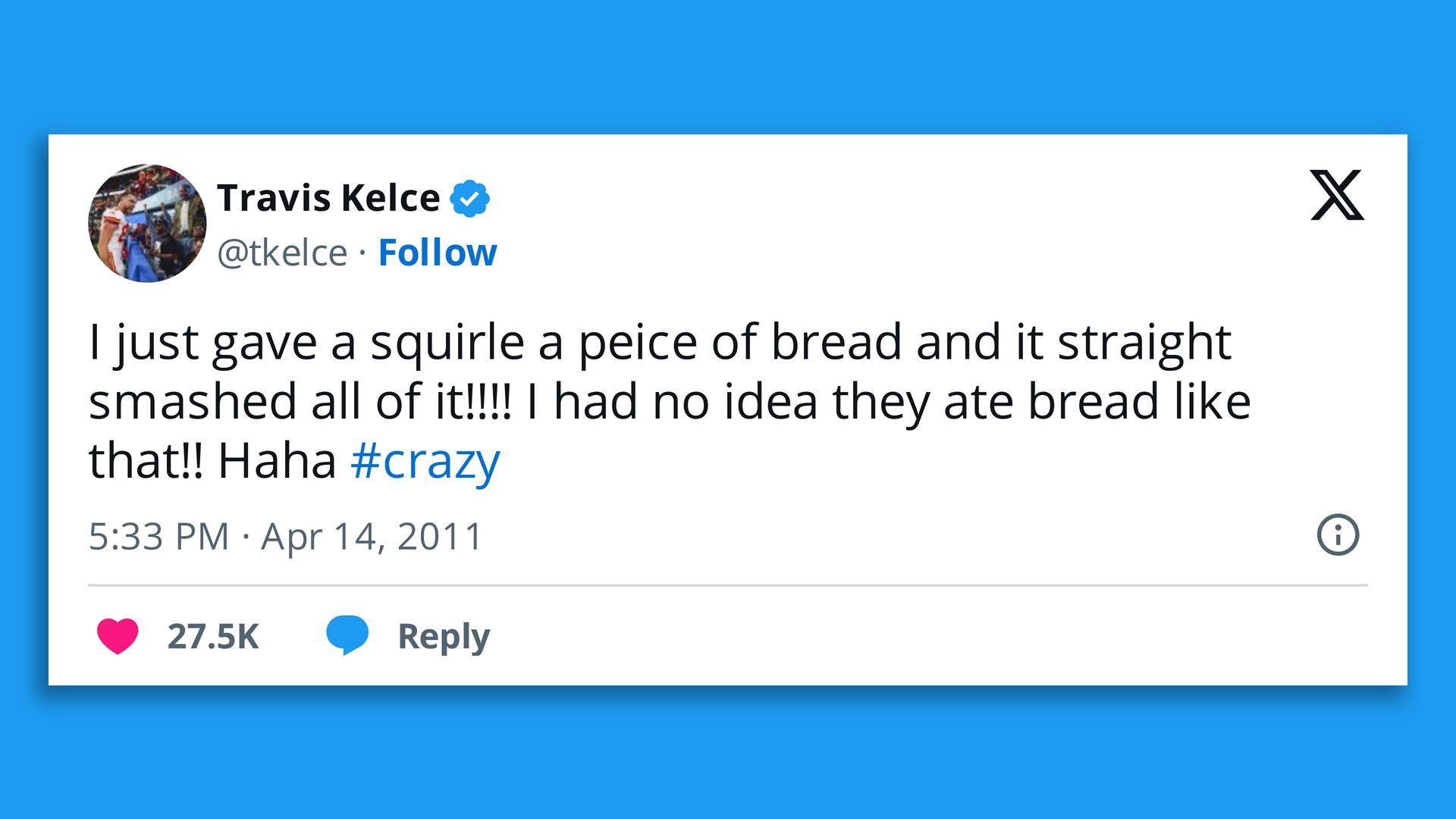
Swift's fans mostly overlooked the spelling issues.
Taylor Swift's fans dug through her new boyfriend's old tweets, now called "posts" on the renamed X platform, and they're ... totally fine! Wholesome even, Emily writes.
Why it matters: It doesn't, but it's the rare story of a celebrity's old tweets resurfacing and being basically benign.
Zoom in: Here are some of Kansas City Chiefs tight end Travis Kelce's old tweets. They're pretty relatable and contain nothing hateful — unless you count his dislike of long lines.
- April 14, 2011: "I just gave a squirle a peice of bread and it straight smashed all of it!!!! I had no idea they ate bread like that!! Haha #crazy."
- May 19, 2011: "I hate it when the #Chipotle line is damn near to the door.... Smh," he posted.
- June 27, 2011: "Up at Olive Garden with papa!! Had to grab the Fettucini with the Chicken Alfredo!! #shmackin"
The bottom line: Swift's fans can be intense, but they seem to like this guy.
- "This man is undergoing the most exhaustive background check ever created and passing with flying colors," ESPN's Mina Kimes posted yesterday.
Go deeper with former Axios reporter Herb Scribner — who did find at least one exception that didn't seem to bother fans very much.
🌏 1 last thing: Axios is heading to Dubai for COP28 where we'll host a full line-up of events — we'll have interviews with NASA administrator Bill Nelson, former U.S. vice president Al Gore, and more.
- Check out our agenda and register for Axios House events.
đź“§ Was this email forwarded to you? Subscribe here ... Axios Markets is edited by Kate Marino and copy edited by Mickey Meece.
Sign up for Axios Markets

Stay on top of the latest market trends and economic insights