Axios Markets

May 18, 2023
Welcome back to Markets! Today, we're going all in on pandemic-era inflation — and big changes in the conventional wisdom about what's driving it.
Today's newsletter is 1,042 words, a 4-minute read.
1 big thing: "Greedflation" goes mainstream
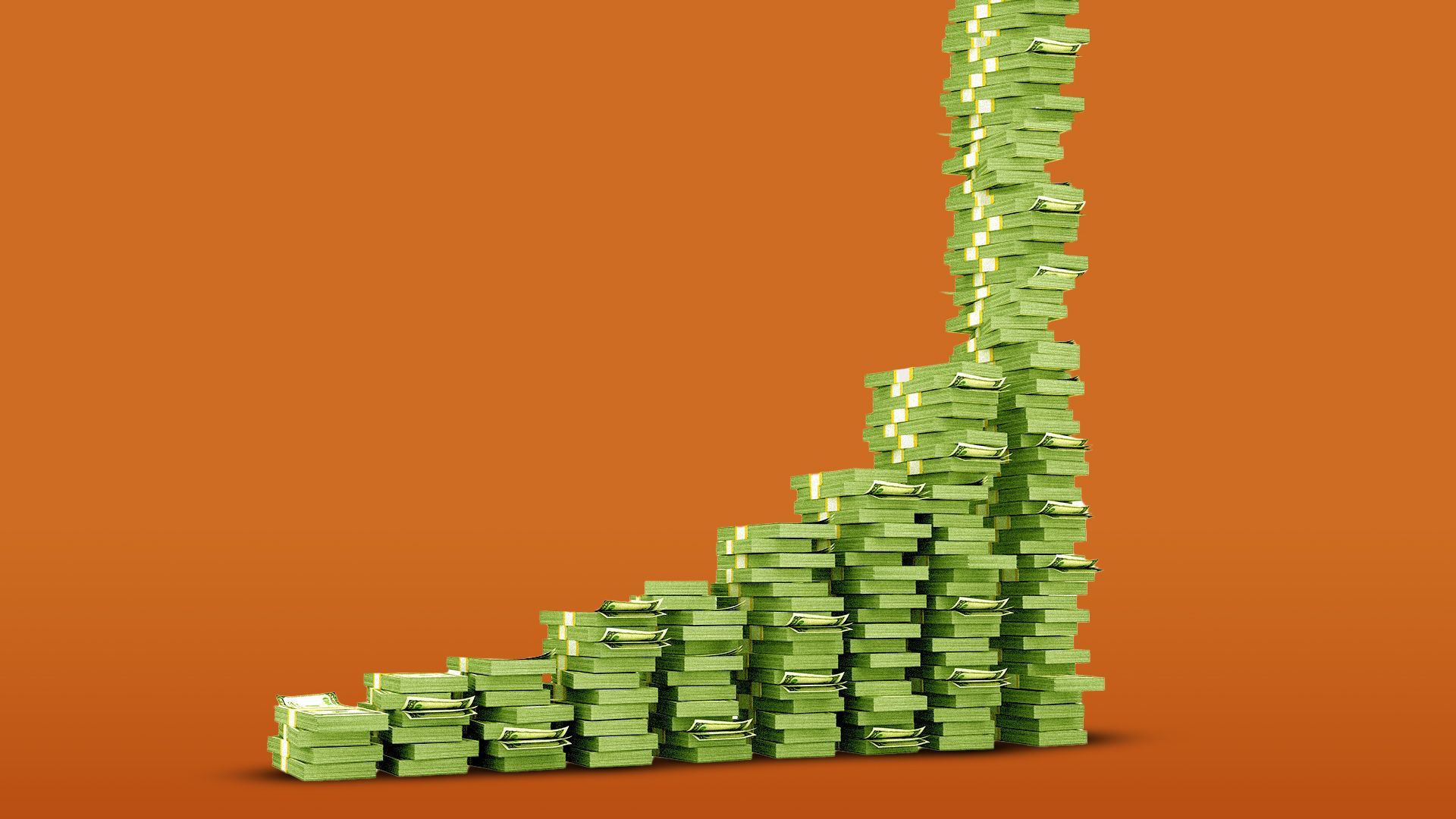
Illustration: Aïda Amer/Axios
Once dismissed as a fringe theory, the idea that corporate thirst for profits drives up inflation, aka "greedflation," is now being taken more seriously by economists, policymakers and the business press, Emily writes.
Why it matters: Though inflation is starting to come down, it still remains well above the Fed's target level of 2%, and understanding what's causing inflation is key to combatting it — now and the next time.
The idea that profits drove our current bout of inflation surfaced in the last few years among progressive economists and lawmakers but was waved away by more mainstream types as a "conspiracy theory." That changed earlier this year.
- In a speech in January, then-Fed vice chair Lael Brainard said wages weren't the main driver of inflation and pointed to a "price-price spiral," where companies mark up prices far higher than the increases in their input costs.
- In March, the chief economist at UBS Global Wealth Management, Paul Donovan, published a note on "profit margin-led inflation," describing how in late 2022 and into this year, companies — particularly retailers and consumer goods makers — convinced consumers that they needed to raise prices. (They didn't really.)
- Most of the time, these companies have "weak pricing power," meaning they depend on repeat customers and can't just wildly increase prices because consumers will abandon them, he says.
But businesses both large and small had a convincing story to tell: They really didn’t want to raise prices, but there was "this terrible war or the pandemic or labor shortages or whatever," Donovan tells Axios. "That's what's basically been going on."
- With so much in flux, people were more accepting of higher costs for everything, and more convinced companies HAD to raise prices.
- In earnings conference calls last year especially, executives spoke in corporate lingo about consumers accepting such price increases.
A few weeks after Donovan's paper came out, European Central Bank executive board member Fabio Panetta expressed worries that inflation growth was "due to increasing profits."
- The following month, a column in Bloomberg Opinion drew attention to increasing profit margins and urged consumers to push back. "The idea that corporate profit expansion has been a big driver of inflation was once mostly confined to trade unions and left-wing academics, but it’s now taken seriously by central bankers," the authors wrote.
- By May, the Wall Street Journal published a story on how corporate profits were keeping inflation high, citing the work of Isabella Weber, an economist at the University of Massachusetts, Amherst, who was derided for her work on the topic back in late 2021.
- In a stunning comeback this month, The Times of London profiled Weber's rise from a lone voice to a star economist who's drawn attention to the notion that companies and certain sectors can drive inflation.
What she's saying: "Suddenly everybody wants to know how to think about inflation differently," Weber tells Axios. She's been inundated with calls recently, she says, from central bankers, Parliamentarians, think tanks and academics — and reporters, of course.
2. Margin call


When inflation kicked up in 2021, economists were watching for the kind of wage-price spiral the U.S. saw back in the 1970s, Emily writes.
- That is, as prices for goods increased, workers would demand and receive higher pay, which would in turn drive prices even higher.
- But the spiral never quite materialized, leading many to search for other answers. Data and research from Weber, of UMass, and other places helped bolster the case for inflation's connection to corporate profits.
The chart above shows how record profit margins helped turn the tide toward a different explanation for inflation, Weber tells Axios.
- She included the chart in a working paper she co-authored this year looking at "sellers' inflation" — drawing on specific examples from corporate earnings calls, among other data, to illustrate the phenomenon.
- By the time it crossed people's screens, economists and policymakers were hungry for a new explanation for inflation and why it hadn't gone away despite supply chains heading back to normal (see below) and energy prices falling, she says.
Key point: Most folks aren't sticking with the "greedflation" label — that got a lot of blowback from those who argued that companies have long been "greedy."
- That's not what's at play — Donovan's and Weber's work describes companies taking advantage of a window of opportunity to raise prices more than normal. Like kids in a candy shop.
Worth noting: Even Fed chair Jerome Powell said earlier this month that wages are not the principal driver of inflation — an apparent pivot from his views in late 2021.
- Yes, but: When asked if he thought corporate profits were a cause, Powell said no. Plenty of other economists are still on that side of the fence, too.
The bottom line: Though there's nothing like consensus on the topic, "the discussion has widened," Claudia Sahm, a former Fed economist, tells Axios.
4. Unchained


One reason no one was taking greedflation all that seriously in 2021 was that profits were less of a factor in the early stages of inflation — back then, snarled supply chains combined with surging demand for goods were the primary drivers of the price gains.
- The index charted above, which tracks conditions in the global supply chain, shows stress peaked in November 2021.
- Fast forward to now: Supply chain pressure is lower than the historical average.
5. 🥛Bonus chart: Milking profits


Behold: One of the most striking examples of how profits drive inflation, the United Kingdom milk market.
- For nearly two decades, UBS' Paul Donovan notes, the retail markup on wholesale or "farm gate" milk prices was around 25 pence — but in recent months it shot up to around 44 pence.
- Now, retail milk prices in the U.K. are up about 75% from last year.
State of play: Donovan says retailers have been able to increase the price faster than costs have risen by using a compelling argument about inflation.
- "Companies have a story that they can tell, and consumers have this naive idea that the milk that they buy basically comes direct from the farm. Well, of course, it doesn't."
Thanks for reading! Was this forwarded to you? Subscribe here.
Axios Markets was edited by Kate Marino and copy edited by Mickey Meece.
Sign up for Axios Markets

Stay on top of the latest market trends and economic insights