Axios Markets

October 01, 2026


1 big thing: The AI wealth generator


Most of the benefits of the AI boom, for humans at least, have filtered into the stock market — but that leaves a lot of folks out.
Why it matters: Record wealth from stock market gains is helping drive strong consumer spending and economic growth overall, but it's a fragile situation: What goes up can come down, after all.
- Plus, there are plenty of Americans who have little or no exposure to the market — especially lower-income households — and they're currently struggling to deal with falling real wages, rising gas prices and stubbornly high inflation.
By the numbers: Americans' wealth jumped by $12.8 trillion in the second quarter, per Fed data, led by a nearly $11 trillion gain in stock holdings and other financial assets (see chart). That's the biggest single quarterly increase, in dollar terms, on record.
- Household equity holdings climbed to $74 trillion in Q2, a record high, up from $63 trillion in Q1.
Zoom out: "The AI boom, and the expectations of all the future earnings that will come from it, have delivered extraordinary increases in the value of the stock market," says Krishna Guha, head of economics at Evercore ISI, who wrote about the wealth effects of this surge this week.
- And that increase is fueling spending in the U.S. economy: Half of all the growth in consumption is now being driven by those wealth effects, he says.
- For lower earners with less wealth, tax refunds and the use of savings are also keeping American spending chugging along.
It's not a K-shaped economy, he says, but a "gator economy" — as in an alligator's mouth, where the bottom stays flat and the top is pointing to the sky poised to chomp.
Zoom in: The share of people making net withdrawals from investment accounts has doubled since 2019, according to anonymized data from more than 20 million JPMorgan Chase bank accounts.
- Higher-income people age 65 and older are leading that rise, but the bank says withdrawals have increased across all age and income groups.
Between the lines: The stock market today is becoming more important to the economy — because of the market's astronomical growth.
- Folks in the market both spend more of their investment gains — and also spend more because they psychologically feel wealthier.
What to watch: In the event of a stock market downturn, the economy would be more vulnerable than normal, Guha says.
Reality check: While an increasing number of Americans do have some money in stocks — it's primarily the richest who are seeing these gains.
- The top 1% by wealth held 51% of stocks and mutual fund shares in the second quarter, per Fed data. The bottom 50% held less than 1%.
- Because so much of the stock market gains go to wealthier Americans, that spending effect is muted. Each dollar of wealth gained in the market equals about a penny of spending, according to research from the Federal Reserve last year.
The bottom line: We often say the stock market is not the economy, but these days it increasingly looks as if it is.
Bonus chart: Stocks > Houses


Stocks, not houses, have been the largest single asset on household balance sheets for a while — and the gap is widening.
2. Oil and interest rates dominated the third quarter
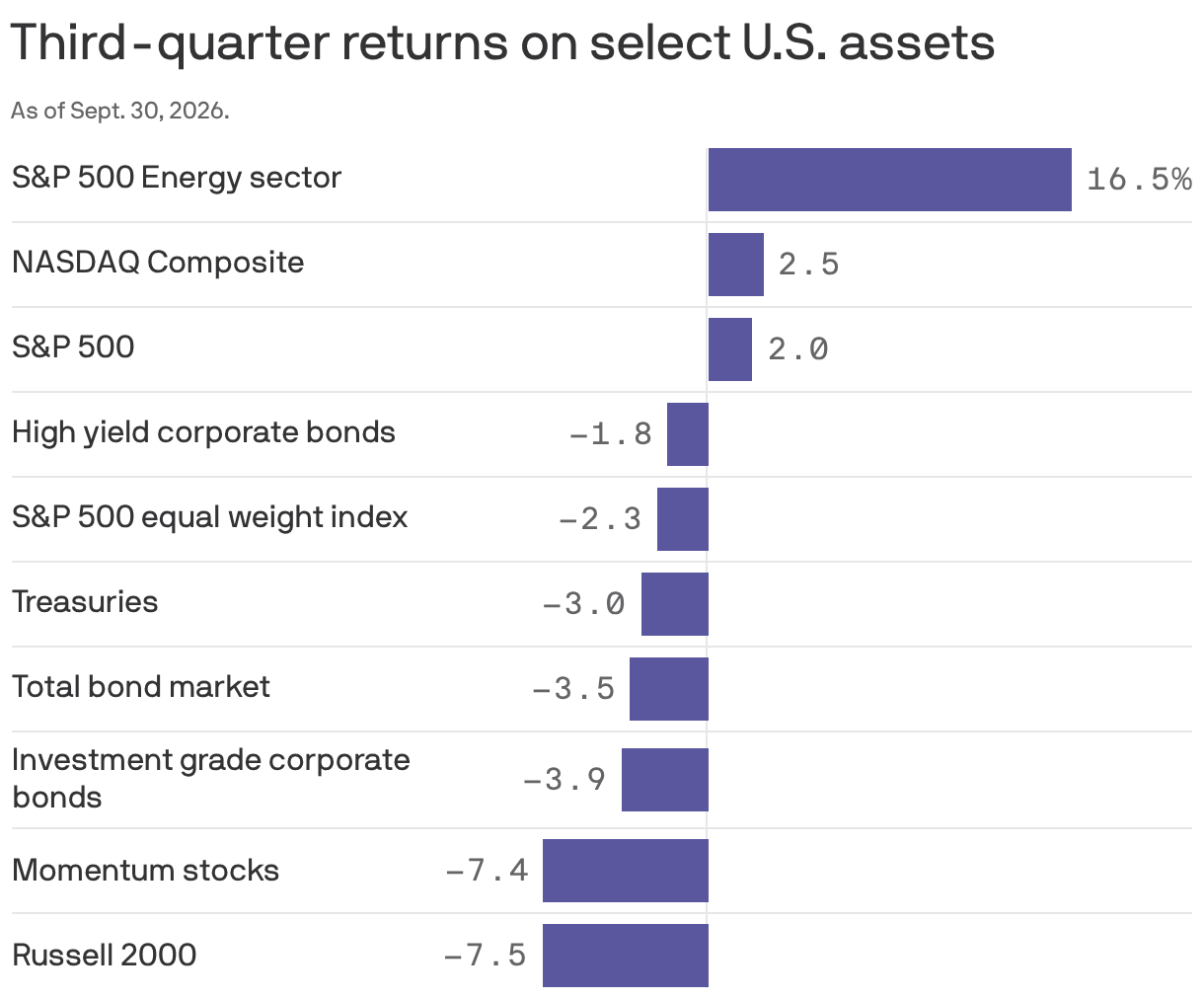
Energy stocks were some of the best-performing U.S. assets to own in the just-ended third quarter, as inflationary pressures related to the Iran war and irrepressible U.S. growth established themselves as key price-drivers.
Why it matters: The performance of oil-and-gas drillers, refiners and retailers was crucial to keeping broader indexes such as the S&P 500 in the black (+2%) during the three months that ended yesterday.
- For the year so far, the S&P is up 11.8%.
Zoom out: Renewed pressure from oil prices — or more specifically diesel-fuel prices — related to the Iran war were a dominant theme during the quarter.
- That nudged the market and the Fed toward higher interest rates.
- But those higher rates slammed rate-sensitive parts of the market like small caps (that's the Russell 2000 index) — which tend to have less financial flexibility, and more floating-rate debt.
- So-called momentum stocks — investor favorites for their propensity to go up, rather than fundamentals like revenue and profit — also got hit, as they have significant overlap with high growth shares that tend to suffer from higher rates.
- Of course, rising interest rates also hammered bond markets. The broad U.S. bond market endured its worst quarter since back in 2022, when the Fed was hustling to lift rates to quell surging inflation.
The bottom line: Oil and rates giveth, and taketh away.
Axios Markets