Bond sell-off continues as 10-year yield hits 5.19%

Add Axios as your preferred source to
see more of our stories on Google.
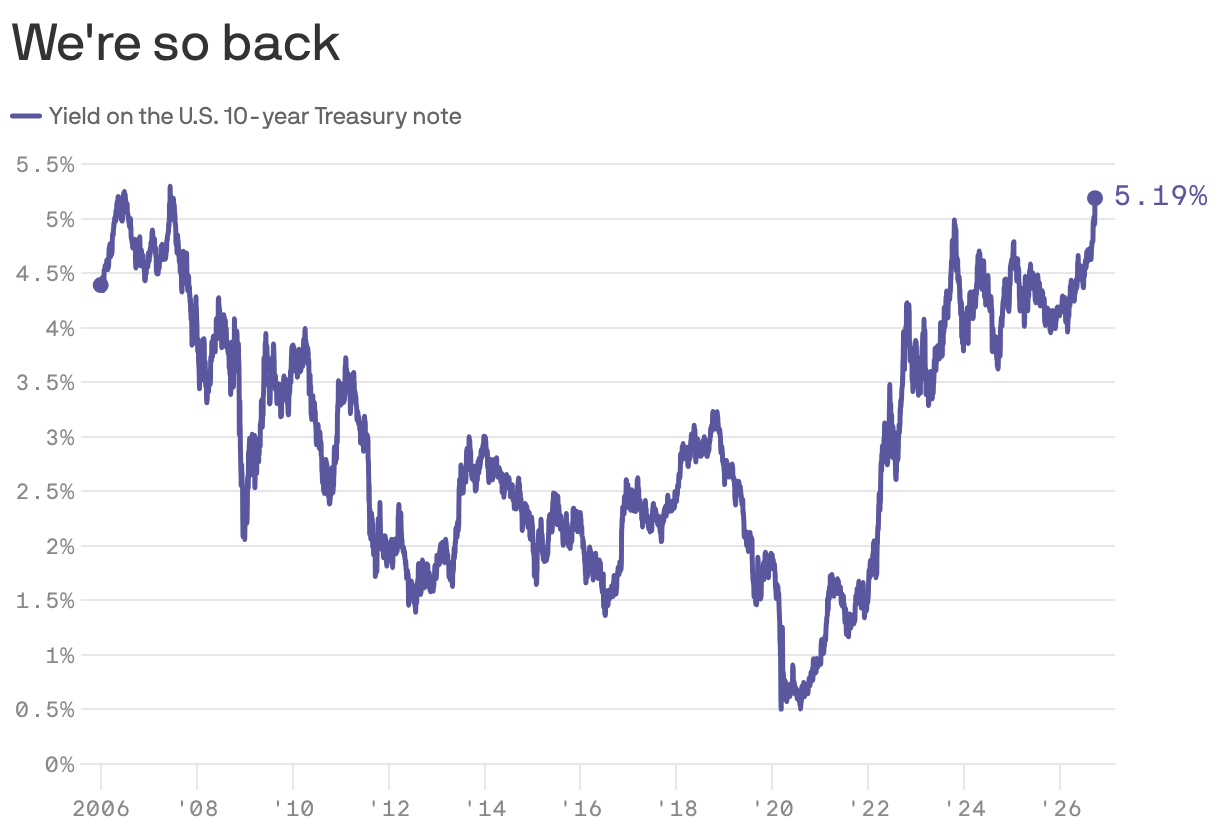
Another day, another tough session in the bond market, with yields on U.S. government debt continuing to push toward levels seldom seen in decades.
The latest: The yield on the 10-year note rose to roughly 5.19% in late afternoon trading in New York, the highest closing level since July 2007.
Driving the news: It's the same old story.
- The Iran war and associated energy shocks — diesel at about $6.50 a gallon and regular gasoline at $4.50 a gallon, according to AAA — are feeding what seem like serious inflationary pressures.
- As a result, traders are growing more confident that the Federal Reserve will raise interest rates at its next two meetings.
- Elsewhere, the deteriorating profile of the U.S. government's finances and competition for bond investor dollars from AI are adding to pressure.
What we're watching: If and when the stock market will start getting indigestion as rates keep climbing. On Thursday, the S&P 500 was basically flat.
What they're saying: JPMorgan market analysts recently looked at the relationship between key interest rates — like the yield on the 10-year — and the valuation of the S&P 500.
- "Based on ~80 years of historical analysis, there is an inverted 'U' relationship between the 10-year bond yield and S&P 500 multiples," they wrote.
- "During periods of above-trend EPS growth (~15% y/y), 10-year yields can continue to rise to ~5% before the equity multiple starts to de-rate."
The bottom line: Even with the ruckus in the bond market, ongoing wars and growing consumer pain from higher rates and energy costs, we're only about 1% below the all-time high for blue-chip stocks, which seems kind of remarkable.
- But that's likely because expectations for profits are still sky-high, with Wall Street analysts predicting that S&P 500 earnings per share in the third quarter this year will be up about 29% compared with the same quarter last year.
