Axios Markets

February 07, 2023

👋 Hi folks! We're doing something a little different today.
- We here at Axios are all busy at our annual company retreat, so we bring you a story from our colleague Kate Marino, who tackles a topic that piqued her interest while traveling in Colombia last month.
Read on. It's 1,083 words, 4.5 minutes.
1 big thing: The power of public transportation
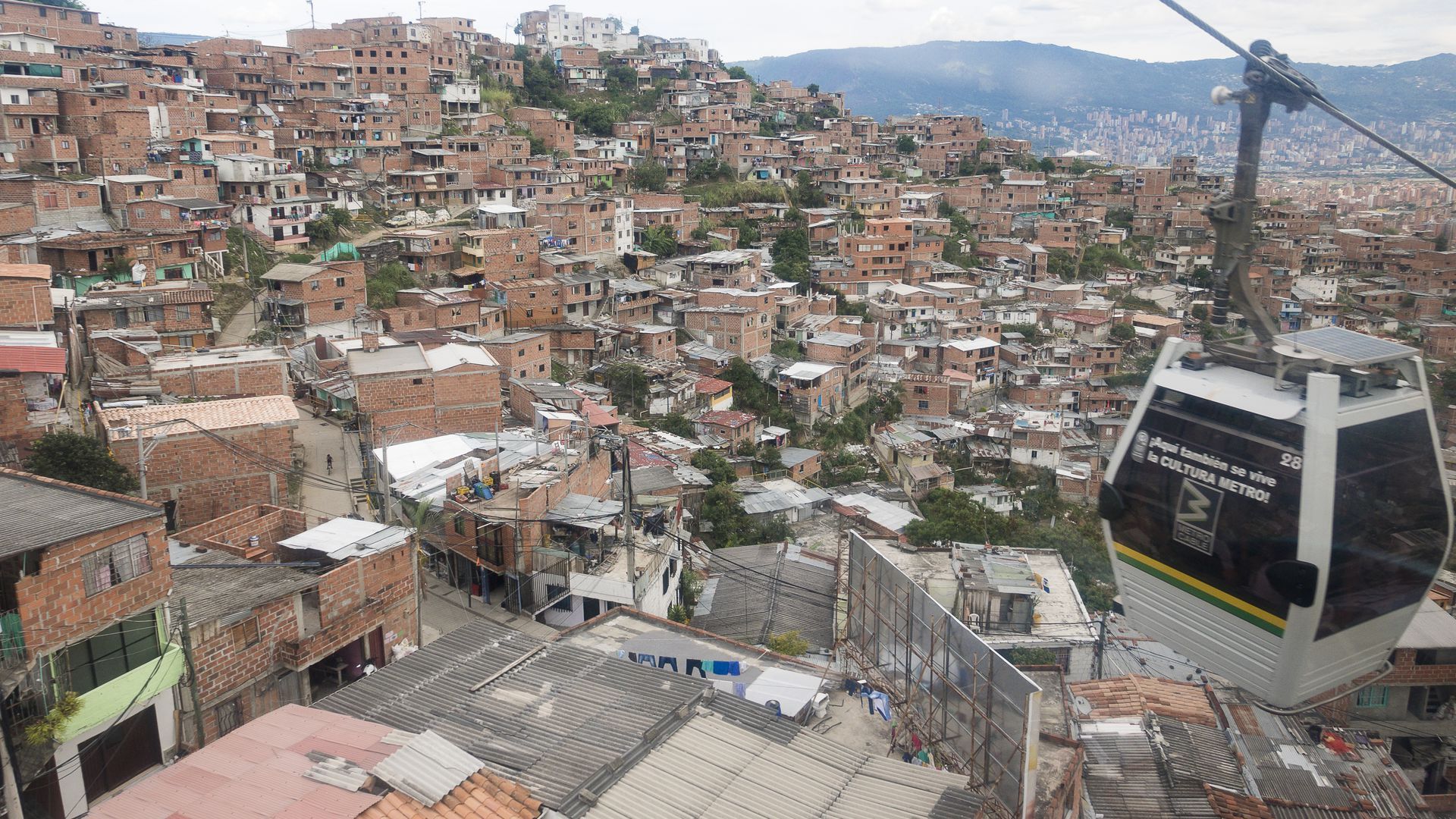
MetroCable of Medellín. Photo: Thierry Tronnel/Getty Images
They look like the fancy aerial cable cars that shuttle tourists to Instagram-worthy mountaintops in the Alps, Axios' Kate Marino writes.
- They’re actually part of Medellín, Colombia’s mass transit system, moving tens of thousands of people a day to and from some of the poorest neighborhoods of the city.
Why it matters: Mobility is the engine that powered Medellín’s economic and social transformation from the most dangerous city on the globe in the 1990s, to the world's “most innovative city” in 2013. That's according to Jorge Pérez-Jaramillo, urbanist, author, and a lead planner for Medellín from 2012 to 2015.
It seems so logical now: Buses or trains aren’t well suited for steep, mountainous terrain in a region as densely populated as Medellín. Un-intrusive aerial cable cars fit right in and are a low-emissions solution to boot.
- Yet, Medellín was the first city to build cable cars to serve its poorest communities, rather than the wealthy or tourists. Now, others are emulating it.
- Medellín's cable cars connect to the city's network of trains (the metro opened in 1995), trams, buses and free public bikes.
The backstory: The city's mobility plan was designed in part to help break down barriers between extraordinarily segregated rich and poor neighborhoods, Carlos Moreno, professor at Panthéon-Sorbonne University in Paris, tells Axios.
- By the '90s, makeshift, informal housing steadily expanded up the steep hillsides, amid one of the world’s largest movements of internally displaced people — a result of the upheaval of the violent Pablo Escobar era.
The MetroCable system opened in 2004 and slashed a two-hour, often physically grueling trip between the mountain barrios and downtown Medellín to just 30 minutes. The economic benefits of this are clear:
- Pérez-Jaramillo says a young man told him recently that he wouldn't be able to attend university without the cable cars; an empanada vendor said she can now transport triple the product to her stand. These are typical stories.
The impact: Medellín made for a natural experiment that academics, urbanists and economists rushed to study. Research showed that homicide rates and perceived violence declined for the entire city — but they fell significantly more in the neighborhoods with MetroCables.
- Overall, life expectancy, education levels and food access significantly improved, particularly for the poorest communities.
- Poverty rates dropped from 37% of the city’s population in 2002, to 14% in 2018, other researchers noted.
💭 Kate's thought bubble: Seeing the pride and respect that Paisas (residents of Medellín) have for their sparkling clean metro system is a reminder of how much we take for granted the subway in NYC, where I live. It’s the one thing we New Yorkers can all unite around — our complaints about the subway’s age, reliability, and filth.
- But many Paisas remember a time when there was no metro — or when simply gathering in public felt too dangerous. It’s why the transportation system has become a symbol of Medellín's transformation.
2. It didn't happen in a vacuum

Illustration: Allie Carl/Axios
In Medellín, the metro system's direct impact on accessibility and commute times is only part of the story; it’s all about social inclusion, the feeling you’re part of the city. That you have options outside of the gangs and crime that offered the most visible opportunities in a once-isolated community, Kate writes.
- To that end, the transit lines were accompanied by new education facilities and expansive public cultural spaces like library parks nearby.
The big picture: It was a conscious choice to invest in social inclusion strategies, rather than putting those funds toward building housing or heavy policing, says Soledad Garcia-Ferrari, an urban studies professor at the University of Edinburgh who has researched the city of Medellín.
Go deeper: In fact, experts have attributed Medellín’s progress, in part, to early moves by city leaders to bring people impacted by the decisions into the planning process.
- One example: A community project in which the residents simply demanded a new walking and biking path. The new path, co-designed by residents and city planners, now connects formerly disconnected neighborhoods along the mountainside, write the report's authors.
- Overall, “the participatory planning tools were as important as the actual infrastructure tools that were used,” Garcia-Ferrari says.
That’s the biggest lesson for other cities that want to duplicate Medellín’s transit success, including La Paz, Bolivia, and Caracas, Venezuela.
- On the flip side: Rio de Janeiro, Brazil, opened cable cars to some of its distant favelas in 2011, ahead of hosting the 2014 FIFA World Cup and 2015 Olympics — but without buy-in from residents. The system closed in 2016.
What’s next: “It’s important to reflect on successes — but also on the challenges that remain,” Garcia-Ferrari says. “Medellín still shows a high level of inequality.”
4. Bed Bath & Beyond's last chance
Illustration: Aïda Amer/Axios
Bed Bath & Beyond looks like it's toast — but on Monday, if you squinted, it almost seemed as though the meme-stock traders might be handing it a lifeline, writes Axios' Felix Salmon.
Why it matters: In an echo of the meme-stock frenzy of two years ago, Bed Bath & Beyond shares soared on Monday to an intraday high of more than $7 per share.
- The company responded with a press release saying that it wants to raise over $1 billion by selling various equity-linked securities.
The big picture: The idea is to offer hedge funds a way to make money from the retail traders bidding up the stock.
Between the lines: The securities the troubled retailer wants to sell — convertible preferred stock and warrants to purchase convertible preferred stock in the future — are not the kind of things the Reddit crowd generally likes to own.
- But if a hedge fund buys the new securities while also shorting the stock, it can protect itself from any potential meme-stock short squeeze and lock in profits even if — as is almost certain — the shares ultimately end up going to zero.
💭 Felix's thought bubble: Given the price action in Bed Bath & Beyond shares yesterday, it would almost be irresponsible for the company not to attempt this kind of Hail Mary. But the chances of it succeeding remain minuscule.
What they're saying: The move is the "last roll of the dice from a company that is desperate to raise cash," GlobalData managing director Neil Saunders wrote in a research note on Monday.
Was this email forwarded to you? Sign up here to get Axios Markets in your inbox.
Today's newsletter was copy edited by Mickey Meece.
Sign up for Axios Markets

Stay on top of the latest market trends and economic insights