Axios Markets

January 04, 2024
Good morning, folks. Today's newsletter is 1,108 words, a 4.5-minute read.
1 big thing: Companies are backing away from "DEI"
Illustration: Annelise Capossela/Axios
Laudable goals like achieving "equity" and "diversity" and making people feel "included" have become weaponized terms and now corporate America is navigating the minefield, Emily writes.
Why it matters: The year ahead will be pivotal for corporate diversity efforts, as attacks against DEI — diversity, equity and inclusion — will likely intensify.
- But for many employers, maintaining a diverse workforce where employees feel included is a key part of attracting and retaining workers (particularly in a tight labor market).
Catch up fast: It's been a long strange trip for diversity efforts — which can range from employee resource groups to anti-bias training to hiring programs.
- For years, DEI was criticized for being ineffective corporate window dressing, or for being counterproductive — but more recently, conservative politicians and pundits have made DEI a target, with new laws limiting its practice cropping up in Florida and Texas.
- Ousted Harvard president Claudine Gay's commitment to DEI was part of the reason she faced such strong criticism from the right.
- DEI funding and staffing flailed last year, after a two-year boom in the wake of the protests that followed the murder of George Floyd in 2020.
Meanwhile: The Supreme Court's decision last year overturning the use of affirmative action in universities has drawn attention to corporate diversity efforts.
- Businesses are trying to avoid any programs that could draw legal scrutiny — any kind of goals around hiring particular demographic groups are increasingly frowned upon.
- "Anything that smacks of a quota" is out, says Diana Scott, leader of the Human Capital Center at the Conference Board.
The intrigue: At the same time, many business leaders say they're still committed to diversity. In a survey of chief human resource officers recently conducted by the Conference Board, zero respondents said they were planning to scale back DEI in 2024.
State of play: This all means that the way DEI happens inside companies is changing.
- Some firms, like Blackstone, are focusing on hiring for socioeconomic diversity, and on changing job requirements to find more diverse talent without targeting a specific race or ethnicity, Fortune recently reported.
- And businesses are pulling back from the DEI term. The focus is moving away from "those three words" toward efforts around "well-being and inclusion," Scott says.
- "Companies are really starting to look at other ways to do the work without saying that they're doing the work," says Cinnamon Clark, co-founder of Goodwork Sustainability, a DEI consulting firm.
- Businesses will likely be talking more about "employee experience" or "wellness," which falls under the inclusion bucket, says Clark.
What to watch: Cutbacks in DEI could lead to a decline in diversity in organizations. One recent study found that companies with DEI teams make more diverse hires and have higher levels of employee morale.
3. Happy two-year anniversary

It's been two years since the stock market last touched a record high, Matt writes.
Why it matters: The stock market is within spitting distance of hitting a new record, but investors haven't yet given it the shove it needs.
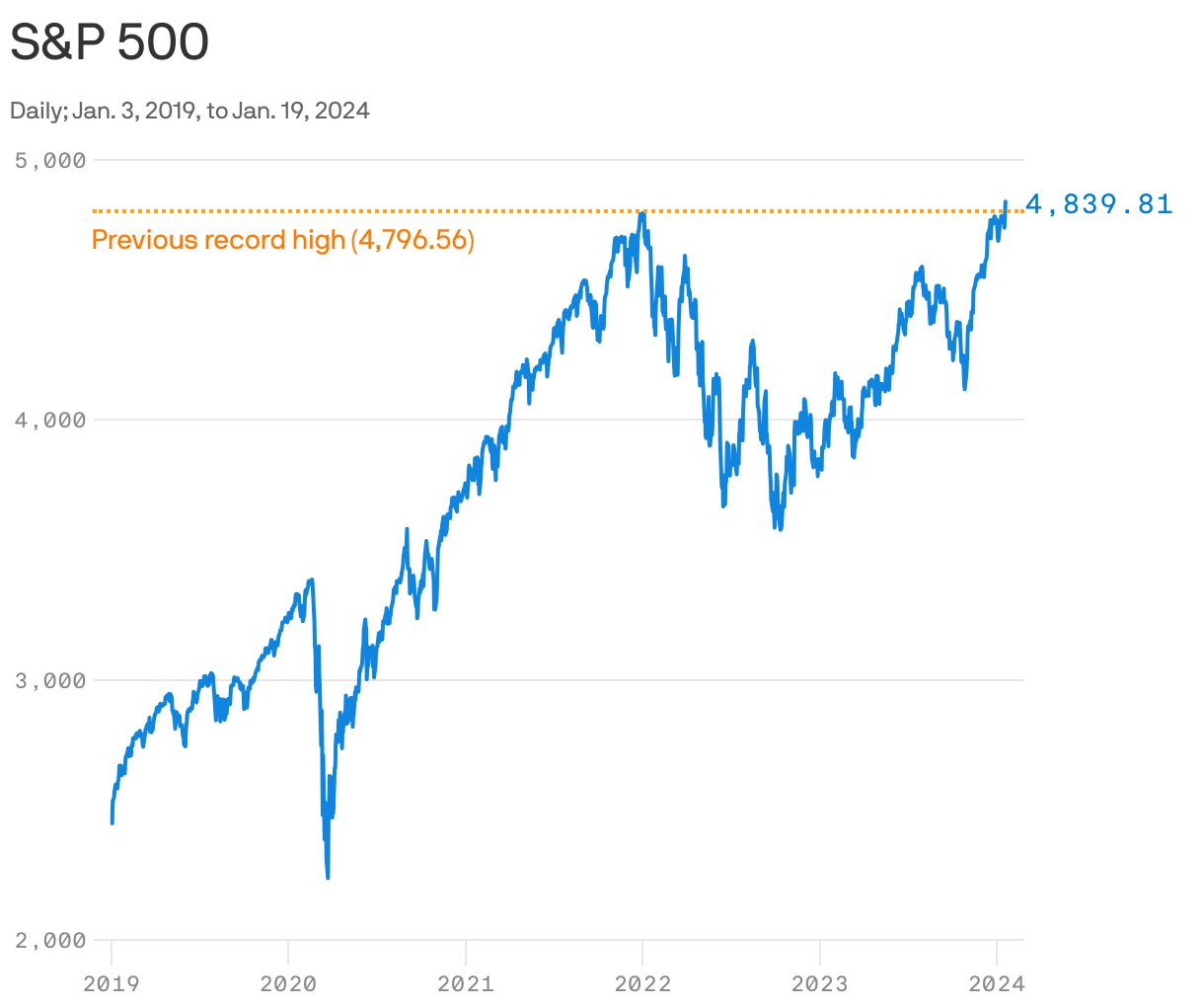
- The S&P 500 crested at 4,796.56 on Jan. 3, 2022, the end of a remarkable rally of more than 110% from the COVID-era low of March 2020.
The intrigue: Diehard Axios Markets readers might be interested to know that the market high of Jan. 3, 2022, was also the day that Emily Peck and yours truly took over as your trusty markets correspondents.
- You've been underwater ever since!
State of play: At the end of last month, the S&P seemed almost certain to eclipse that record, closing within 1% of it in the five final sessions of the year.
- But stocks slipped in the first few trading sessions of 2024, putting the record a bit further away.
The bottom line: Equity investors shouldn't despair. The index is less than 2% — or one good trading day — from a new closing high water mark.
4. Charted: Biden's factory boom


America's spending on the construction of new factories is surging, Emily writes.
Why it matters: The Biden administration's signature legislation — particularly the CHIPs Act and Bipartisan Infrastructure Law has spurred a surge in construction spending that's buoyed the economy, as Axios' Neil Irwin reported.
By the numbers: Manufacturing-related construction hit a $210 billion annual rate in November, more than triple the average rate in the 2010s, according to census data out this week.
- All that spending is driving a boom in construction hiring. Job openings in construction increased by 43,000 last month, according to data from the BLS out yesterday — and are up by 111,000 from last year.
- Contractors are even facing labor shortages in areas with industrial mega projects, Anirban Basu, the chief economist of the Associated Builders and Contractors said in a release yesterday.
The intrigue: The boom has done little for President Biden politically — as most voters likely don't think about the building of new factories when they assess the condition of the economy.
- Plus: Republican politicians have claimed credit for a lot of the construction that's happening thanks to those new laws.
What to watch: The surge in construction will eventually translate into a surge in hiring for manufacturing jobs, says Aaron Sojourner, a senior researcher at the W.E. Upjohn Institute for Employment Research.
5. Breakout year for delivery drones

Illustration: Natalie Peeples/Axios
After more than a decade of development, delivery drones are finally going mainstream this year, Axios' Joann Muller reports.
Why it matters: More electric drones in the sky means fewer noisy trucks on the road and less tailpipe emissions.
What's happening: With some (but not all) regulatory hurdles cleared, retailers, medical centers and logistics platforms will soon start offering drone delivery in many more suburban neighborhoods.
- That means receiving meals, prescriptions and household items at your doorstep in less than 30 minutes.
Catch up fast: Until recently, commercial drone operators weren't permitted to fly their aircraft long distances without visual spotters.
- Having observers staged every mile or so along a drone's route is impractical and costly, which is why companies couldn't afford to scale up drone deliveries.
- Instead, they were limited to trips within a mile or so of retail partners like Walmart and Walgreens.
That changed last fall when the Federal Aviation Administration began authorizing some drone operators to fly their aircraft "beyond the visual line of sight."
- That key breakthrough has opened the door for companies like Zipline, Wing and Amazon to begin more widespread drone deliveries this year.
The bottom line: 2024 is the year that drone delivery becomes a reality.
Was this email forwarded to you? Subscribe here.
Axios Markets is edited by Kate Marino and copy edited by Mickey Meece.
Sign up for Axios Markets

Stay on top of the latest market trends and economic insights