Axios Markets

August 24, 2026


1 big thing: ⚡️ We finally found that energy shock


A long-predicted energy shock is finally showing up in sky-high prices for diesel fuel.
Why it matters: Diesel fuel is a key input for virtually anything grown or transported throughout the U.S., making it a potentially inflationary force.
Between the lines: It means the market's relief over crude oil's relatively muted reaction to the Iran war could be misplaced.
- "The market is out to lunch, looking at crude oil prices," Jeff Currie, a former commodities analyst with Goldman Sachs and Carlyle, tells Axios. "Look at diesel prices."
The latest: Futures prices for diesel have soared to roughly $100 above those of crude oil, the divergence between prices for the two products reflecting a dearth of diesel refinery capacity worldwide.
- This refinery shortage has been a growing issue since Ukraine launched a highly effective drone campaign targeting Russian refineries, resulting in a collapse of Russian production of refined product, shortages and a government ban on exports.
- That's a big deal because Russia is one of the world's largest exporters of diesel.
- The closure of the Strait of Hormuz has also curtailed global supplies of refined products previously exported by Gulf states.
Zoom in: This isn't just a story of abstract geopolitical choke points. The cost of diesel will likely filter down to everyday life.
- The cost of diesel accounts for between 3% to 5% of production costs for major U.S. crops like wheat, soybeans and corn, Axios' Ben Geman recently wrote, putting upward pressure on prices for those items as well as other agricultural products that use them as feedstock.
- Diesel is the key fuel for trucking, and its surge has already raised the costs of truck transportation for goods throughout the economy, which is gradually getting passed down the food chain.
Case in point: Performance Food Group, a distributor of food products to restaurants and convenience stores, said on a recent earnings call that it faced some $16 million in additional costs related to diesel prices during its recently completed quarter, telling analysts its "team worked to manage the increase in diesel prices through our surcharge program."
- TL;DR: In other words, price increases.
The bottom line: "Diesel is the cost base of everything. Every container, every tractor, every locomotive, every mine truck - you get the idea," Currie wrote on X last week, adding: "That pass-through will reach into trucking, food and producer prices, and it is barely getting started."
2. 🛢️ Oil markets are tuning out Trump's "truths"


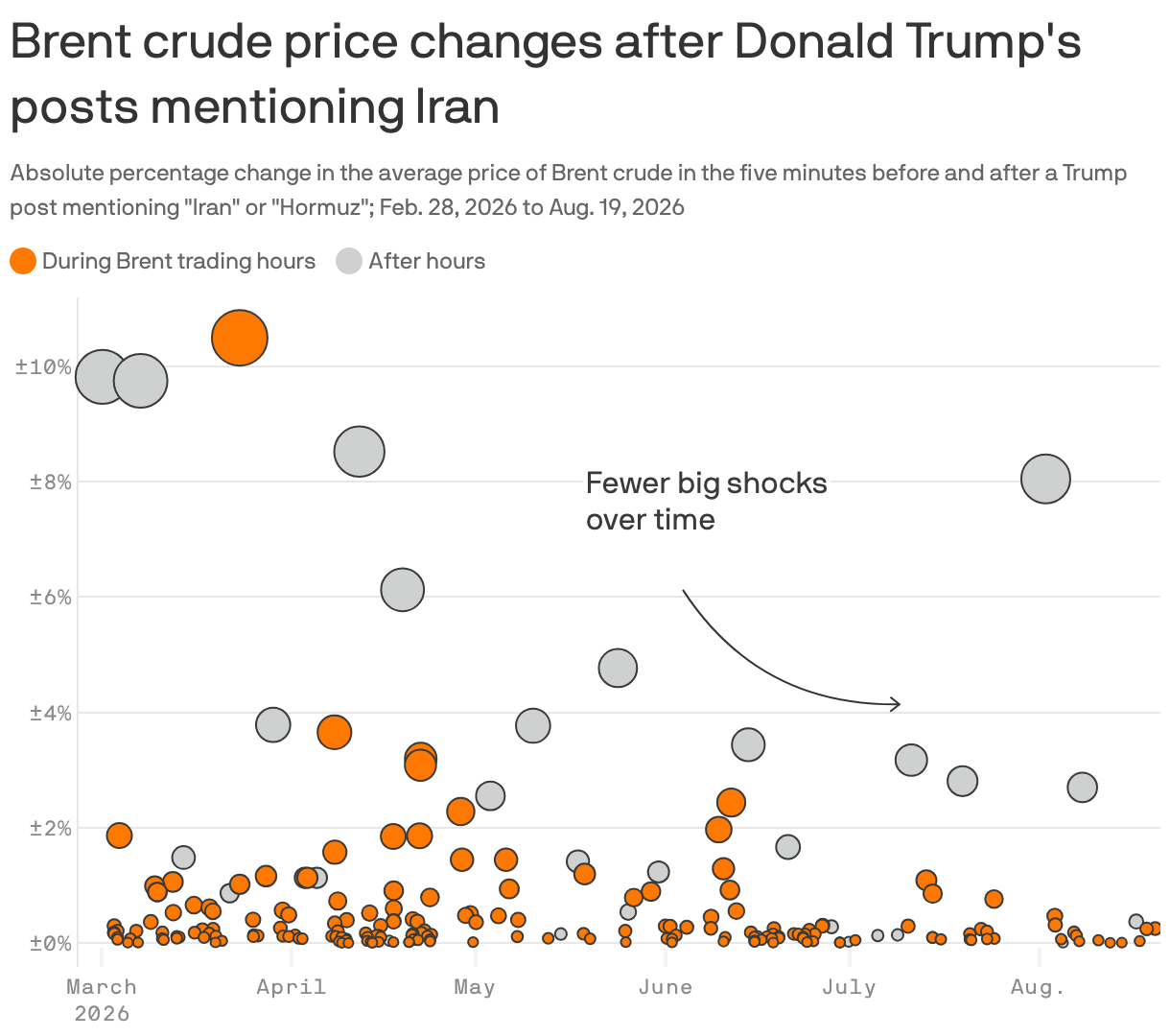
Oil price changes in response to the president's social media posts about the Iran war have been shrinking over time, an Axios analysis shows.
Why it matters: Oil price changes ripple throughout the U.S. and global economies, and the conflict has brought unprecedented supply disruption.
- Traders weigh whether Trump's comments suggest U.S. moves that would help or hinder oil transit, as well as the potential for attacks on energy sites.
The big picture: In the early weeks, there was an "information vacuum" and high uncertainty about U.S. policy and objectives, said oil analyst Ben Cahill.
- Markets "overreacted" to a lot of posts in response.
"For months now, the market has been tuning out social media posts because they just don't reflect the reality on the ground," said Cahill, a senior fellow with the Atlantic Council.
- Many of Trump's proclamations about the status of the Strait of Hormuz, his policies, and the war's aims have had "zero correlation" to how many barrels are leaving the waterway, he said.
How it works: Axios tracked 269 posts on Truth Social between Feb. 28 and Aug. 19 that mentioned Iran or the Strait of Hormuz.
- During that period, the average five-minute change in the futures price — that is, comparing adjacent, nonoverlapping five-minute blocks — was 0.2%.
- But in the five minutes after these Truth Social posts appeared, or in the five minutes after the next market open, the average change was almost four times higher, averaging 0.73%.
Yes, but: The effect is diminishing, as you can see above.
Catch up quick: The Iran war shows how Trump's posts have the power to quickly move markets.
- Truth Social has begun charging Wall Street up to $1.2 million a year for a split-second edge on posts, but the offering is facing litigation.
What we're watching: Trump's waning power to "jawbone" oil markets has political consequences, as Democrats use energy prices as a cudgel against Republicans in the midterm elections.
Axios Markets