Axios Markets

December 05, 2024

🌆 Thursday. We're back with more tales of big companies getting bigger thanks to their Trump ties.
- Plus, CEOs reassess their security and tariff chatter is up (guess why).
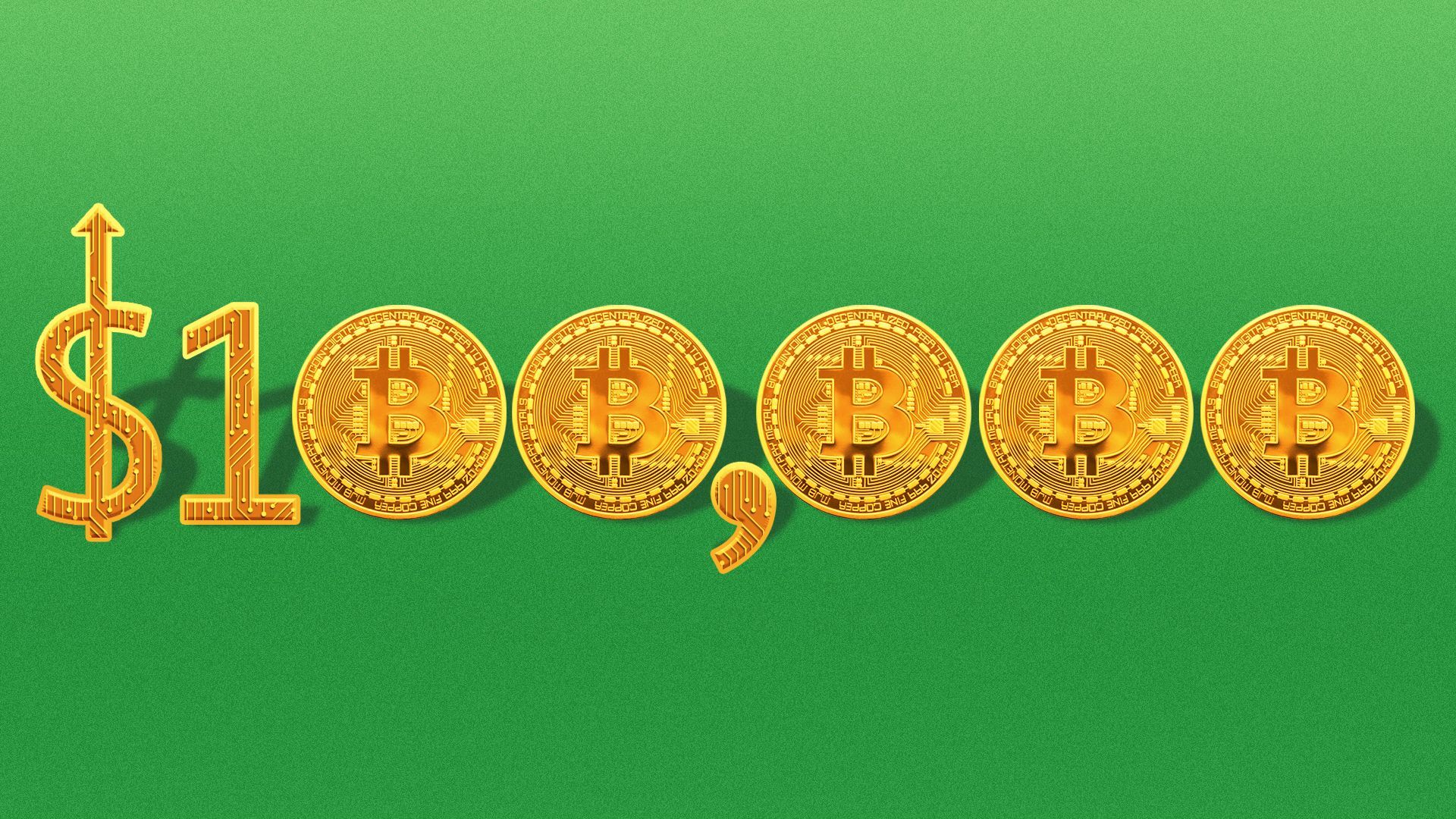
đź’¸ Situational awareness: Bitcoin broke through $100,000 for the first time overnight, a key psychological level the crypto community has awaited for years. More below from our colleague Brady Dale.
All in 936 words, a 3.5-minute read.
1 big thing: The AI darling that's 21 years old


Palantir, a 21-year-old technology company that's been public for four years, is suddenly being valued as though it's a fast-growing startup.
Why it matters: Palantir's most recent earnings report came out the day before Donald Trump won the presidency. The two events have helped to propel the stock to record highs.
Where it stands: Palantir's current valuation stands at about $160 billion — with Peter Thiel's stake now worth $7 billion.
- The Palantir chairman has been described as a "kingmaker" in Trumpland after Trump picked Thiel protégé JD Vance as his running mate.
- In its most recent quarter, 44% of Palantir's $726 million in revenue came from the U.S. government.
The big picture: Palantir has impressive earnings growth for a pretty mature company — net income doubled year-on-year — but even so it trades at eye-watering multiples.
- Palantir's market cap is 60 times its revenue over the last year and 350 times its earnings.
- CEO Alex Karp is undaunted, claiming that "a juggernaut is emerging" and that Palantir intends "to take the entire market."
- Wedbush analyst Dan Ives agrees with him, telling Axios that "Palantir is leading the AI Revolution on the software front" and that the company "could be the Oracle and Microsoft of the next decade."
The bottom line: A fast-rising share price can act as a FOMO engine, especially when AI can justify almost any valuation.
- Add in a connection to the White House, and the company starts approaching meme stock status.
2. C-Suite security scare

Firms that provide security to executives are bracing for an influx of calls after the head of UnitedHealthcare, Brian Thompson, was shot and killed yesterday in what appeared to be a targeted attack in midtown Manhattan.
Why it matters: It's not uncommon for high-profile executives to hire security guards. Thompson, however, was a relative unknown and had no protection.
- "I'm just shocked the guy didn't have a protective detail," says Michael Julian, chief executive of MPS Security & Protection.
- The murder also unleashed social media outrage — not in sympathy, but in vitriol against Thompson and other insurance executives.
By the numbers: Nearly 28% of S&P 500 firms disclosed spending on security for at least one top executive from 2021 to 2023, per Equilar data cited by Bloomberg.
Zoom in: Other experts said it wasn't that surprising Thompson was unguarded. Not all companies want to pay for protection, particularly if the executive isn't a widely recognized person.
- Famous billionaire CEO types, like Mark Zuckerberg and Elon Musk, pay millions for security coverage — or, rather, their companies do.
- Top execs are walking around Manhattan all day long unprotected, Glen Kucera, president of Enhanced Protection Services at Allied Universal, tells Axios.
- After an incident like this, he typically gets flooded with requests (and says the calls had already started coming in).
How it works: Security can mean 24/7 protection from an armed detail that extends to family members, or a more targeted approach where an executive is accompanied on travel to more dangerous locations or high-profile events.
- About 95% of what these firms do is provide "visual deterrence," Kucera says. Just the sight of armed bodyguards near an executive is (usually) enough to scare away potential attackers.
Threat level: Threats against corporate executives are especially common with consumer-facing companies in areas like travel, transportation and retail, Chris Pierson, CEO of security firm BlackCloak, tells Axios.
- These are areas where people have deep personal connections and grievances. Certainly, health care is in that club. The sector has grown increasingly troubled by violent incidents in recent years — though these episodes typically occur at hospitals or other medical settings.
Adding to the challenge of protecting corporate executives is that publicly traded companies are required to disclose certain details about their public events, Pierson says.
The bottom line: Even the best security isn't foolproof. If someone is intent on causing harm, it's not always possible to stop them.
3. Charted: Tariff talk takes off


The chatter around tariffs looks to be headed back to where it was during Trump's first term.
- Executives at public companies that deal with imports are buzzing about how the incoming administration could disrupt trade policy and what to do about it.

4. Bitcoin hits $100,000
Bitcoin's price broke $100,000 on Wednesday night, capping a bull run that has seen the original cryptocurrency rise more than 30% since Election Day.
Why it matters: It's a big round number, and also a symbolic one — marking what could be the industry's next stage of long-term growth.
The big picture: Excitement around what Trump will do for crypto has poured gasoline on the fire of a bitcoin bull run that was already in motion. But bitcoin hitting $100,000 is not just an effect of Trump.
- It's a milestone hit during the fourth of bitcoin's remarkably predictable "cycles."
- And if six-figure bitcoin in 2024 wasn't itself predictable, it's certainly a number traders had their sights on long before Trump declared his love of crypto back in May.
Reality check: Risks abound for new investors. To name a few:
- If the next Congress can't get its act together on blockchain legislation.
- If the Securities and Exchange Commission doesn't soften its stance on cryptocurrency in the new administration (though that looks like less of a risk following Paul Atkins' nomination to lead the agency)
- Or if the president-elect changes his mind and starts selling the nation's bitcoin holdings.
Any of those situations would likely slow, or even halt, bitcoin's positive price momentum.
Yes, but: If bitcoin's next bear market ends without it losing 80% to 90% of its value from the peak — say more like 50% — we'll know something has changed, perhaps for good.
Thanks to Ben Berkowitz for editing and Anjelica Tan for copy editing. It's almost the weekend, folks, hang in there!
Sign up for Axios Markets