Crypto's roaring comeback

Add Axios as your preferred source to
see more of our stories on Google.

Illustration: Sarah Grillo/Axios
This Saturday marks two years since CoinDesk published an article that led to the collapse of crypto exchange FTX, the imprisonment of its founder — and declarations that the digital currency dream was dead.
Why it matters: Not only is crypto still alive — it's thriving.
- The price of bitcoin hit $72,700 Tuesday afternoon, closing in on March's all-time high — partly on the belief that crypto booster Donald Trump is poised to win the presidential election.
The big picture: Digital assets are now a crucial issue in the battle for power in D.C., which could lead to legislation that legitimizes the industry.
Three big developments explain what happened:
The launch of bitcoin ETFs: After a court ruling in January forced the SEC's hand, institutional investors entered the market.
- So far, $68.6 billion has flowed into these new instruments.
A gigantic election war chest: This year the industry collectively devoted $169 million in contributions to candidates in both parties.
- Fairshake, a network of three PACs backed by some of the biggest crypto companies, has been aggressively placing TV ads to boost name recognition for politicians from both parties who it hopes to win over as permanent allies.
Donald Trump's conversion: It's been a frequent talking point for the presidential candidate.
- It seems like once he made some money and learned about how much others were making, Trump saw an opportunity to win over a wealthy new fanbase.
Friction point: The comeback comes as no surprise to long-time investors in crypto assets.
- For many it was good riddance when so many crypto companies failed in 2022, such as booster-y hedge fund Three Arrows Capital, all the over-extended lenders (in particular the notorious Celsius), and, of course, Sam Bankman-Fried's untrustworthy exchange, FTX.
By the numbers: In September, 220 million addresses (wallets that contain digital currency) interacted with a blockchain (networks where crypto moves) at least one time — a record high, per a report from a16z.
- That's many millions of people — though it's hard to pinpoint exactly how many.
- Stablecoins, or tokens that stand in for dollars, have become the killer app. Tether (USDT), always the top stablecoin, has gone from $5 billion in daily trading volume in 2019 to over $80 billion today.
- On any given day, Bitcoin has between 500,000 and 700,000 active addresses, and more than a million addresses hold at least one bitcoin.
What we're watching: A Trump win next week could send the price up further on hopes he'd be more favorable to the industry.
💭 My thought bubble: In 2022, I wrote that crypto would come roaring back after FTX, but this has been surprisingly quick.
Rise and fall and rise, etc.
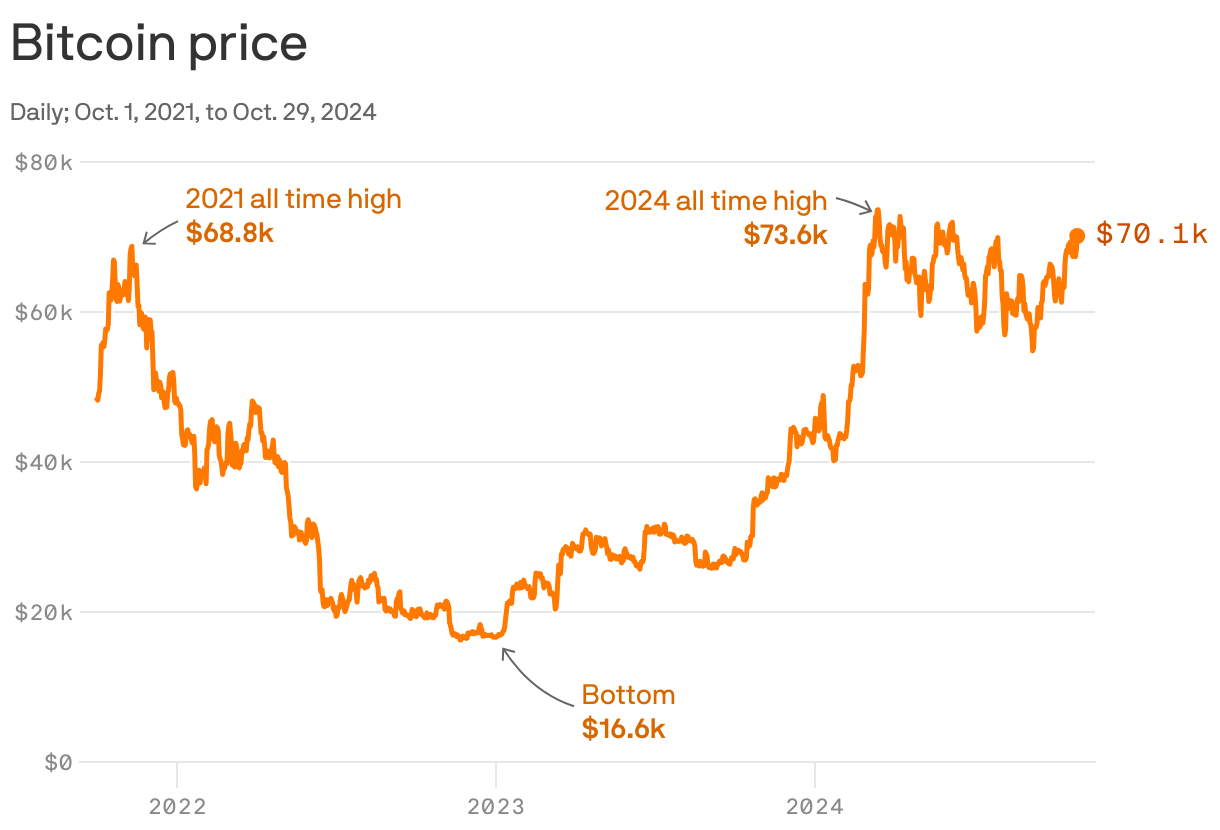
The boom and bust cycle has been a feature of crypto investing going back a decade.
- Bitcoin always leads the run-up, and, in previous busts, has crashed about 80% when the FOMO turns to "Oh. No."
- Each time, bitcoin's fall has rebounded to somewhere around the prior all-time high, suggesting that, as irrationally exuberant as any given bull run might have been, it always comes out with some permanent converts.
