Crypto is dominating corporate election spending

Add Axios as your preferred source to
see more of our stories on Google.
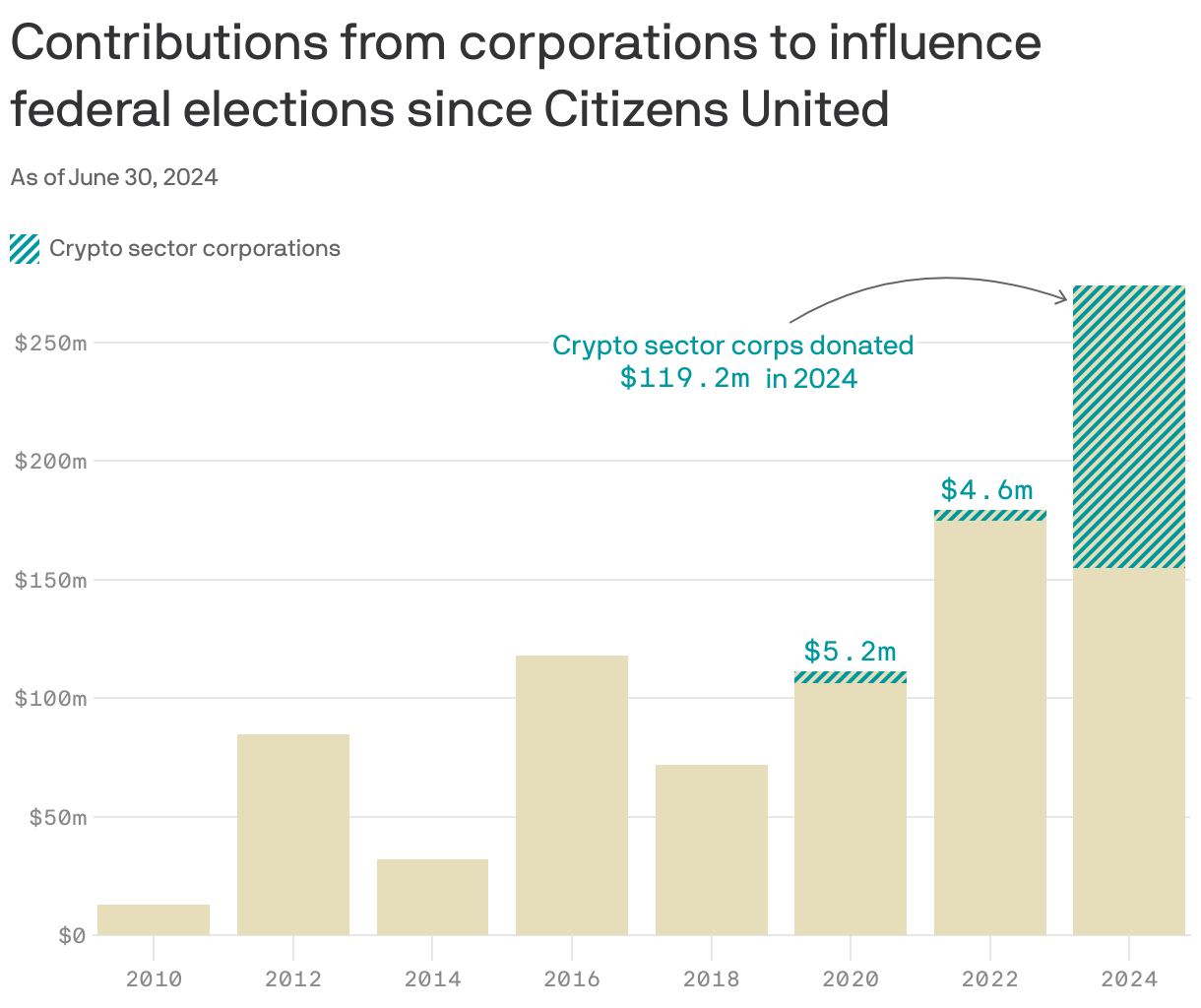
The crypto industry accounts for almost half the money contributed by corporations to political action committees so far in 2024, according to a new report from Public Citizen, a consumer advocacy group.
Why it matters: Crypto is pioneering a strategy for direct corporate election spending that could usher in a new era of spending by big companies to get the outcomes they want in elections, the organization argues.
By the numbers: Blockchain companies have supplied 48% of the $248 million of corporate money donated to influence federal elections this cycle, according to the research.
- Fairshake, the crypto industry's dominant political action committee, says it has raised $169 million. Public Citizen goes with a larger figure ($202 million) based on Federal Election Commission data, but that includes a double-counting of cryptocurrency-based contributions from individual donors, according to the OpenSecrets research group.
- And though some of that money comes from wealthy individuals, Fairshake's been a magnet for business dollars, with nearly $114 million coming from corporate backers.
- Contributions have come primarily from Coinbase, the largest U.S. crypto exchange, and Ripple, the company behind a stablecoin called XRP. Both companies have been at the forefront of crypto's battle with regulators for legitimacy.
Zoom out: The crypto sector is breaking with the tradition of industries primarily siding with one party or another.
- Fairshake has been backing or opposing candidates on both sides of the aisle, based on whether or not a candidate is viewed as helpful or harmful to cryto.
- It endorsed equal numbers of Democrats and Republicans in House races this year (for a total of 18).
- And its decision to back two Democrats and one Republican in the Senate races (so far) has drawn ire from partisans on both sides.
How it works: When it has engaged in paid media, Fairshake has not spent its money to make cryptocurrency itself an issue in elections.
- It ran ads against Rep. Katie Porter in California's Democratic Senate primary, and incumbent Rep. Jamaal Bowman in the Democratic primary for New York's 16th Congressional District.
- The ads were designed to smear the targets' reputations, without mentioning digital assets. (Both Porter and Bowman lost their primaries.)
- In the general election, Fairshake's most high-profile pick is endorsing Republican Bernie Moreno in the Ohio Senate race — a move likely designed to defeat Sen. Sherrod Brown, the Banking Committee chair and a crypto critic.
What they're saying: "No industry has ever before so wholeheartedly embraced raising as much directly from corporations and openly using that political war chest...to discipline lawmakers toward adopting an industry's preferred policies," the report's author, Rick Claypool, writes.
- "The crypto sector strategy seems to be: give crypto corporations what they want, or your political career gets it."
💭 Our thought bubble: The industry's politics look to be in the same spirit as former British Prime Minister Henry John Temple (better known as Lord Palmerston), who said in 1848:
- "We have no eternal allies, and we have no perpetual enemies. Our interests are eternal and perpetual."
Editor's note: This story has been corrected to reflect that Fairshake has raised $169 million and to explain the larger figure ($202 million) that Public Citizen derived from the Federal Election Commission via OpenSecrets.
