
Axios Markets

January 08, 2024
👋 Welcome to Monday. Congrats to all the Golden Globe winners! To avoid icy stares, we will refrain from making jokes about Taylor Swift. Today's newsletter is 1,013 words, 4 minutes.
1 big thing: Peaking beneath the surface

Illustration: Annelise Capossela/Axios
If you're looking exclusively at public companies to assess the health of U.S. businesses, you're missing a big piece of the puzzle, Axios' Kate Marino writes.
Why it matters: By many measures, public companies came out of the pandemic financially stronger than they were going into it; that paints a rosy picture of what's happening in the economy.
- But a big chunk of U.S. economic activity is generated by smaller, private companies that don't divulge their earnings to the public — and what's happening there is very different.
Call it the "riptide" economy. Everything looks great on the surface, but underneath, unseen risks are building.
- That's according to a new provocative paper out this morning from Marblegate Asset Management, which focuses on distressed investing and private credit.
How it works: Marblegate looked at anonymized financial stats for about 1,200 private companies with revenue between $100 million and $750 million — the cohort known as the middle market, which employs about 50 million Americans and accounts for about a third of private sector GDP.
- Marblegate obtained the data from RapidRatings, a supply chain risk analytics firm that gets hired by corporate giants like Unilever and Under Armour to assess the financial health of all the companies in their supply chains.
- The firm compared the private company stats to averages in the Russell 3000, one of the broadest measures of U.S. public companies.
The findings: Between 2019 and the end of 2022 (the most recent full-year data), EBITDA — a key measure of earnings — declined 24% for midmarket companies. For public companies, it soared 18%.
- EBITDA margins collapsed by 25% in the midmarket; the Russell 3000's margins only softened by 2%.
- Financial leverage, or the ratio of debt to EBITDA, rose 62% in the midmarket; in stark contrast, it declined 14% among public companies.
The big picture: "Beneath the surface of the ticker-tape economy made up of large public companies is the real economy — the middle market — with more limited access to capital," writes Marblegate in the paper.
- And larger companies have the scale that helps them better absorb financial shocks and pass on problems — like threats to their margins — to others, like their vendors, which are often midmarket companies.
- "The economic stress that has threatened the margins at large companies appears to have largely been passed on to the suppliers and vendors of the middle market," the paper says.
Where it stands: The data only goes through 2022. In 2023, rising interest costs were a major source of stress for companies across the midmarket, which mostly borrow from regional banks and private credit funds using floating-rate debt.
The impact: Bankruptcies among midmarket companies soared in 2023 — you may not have noticed because these aren't the household names that make for sexy headlines and get all the press (e.g. WeWork, Bed Bath & Beyond).
The big question: How will this stress ripple into the broader economy — particularly, the labor market? After all, the strength of the labor market has driven the consumer spending growth that's been keeping the economy strong so far.
3. Market's streak of weekly gains ends at nine
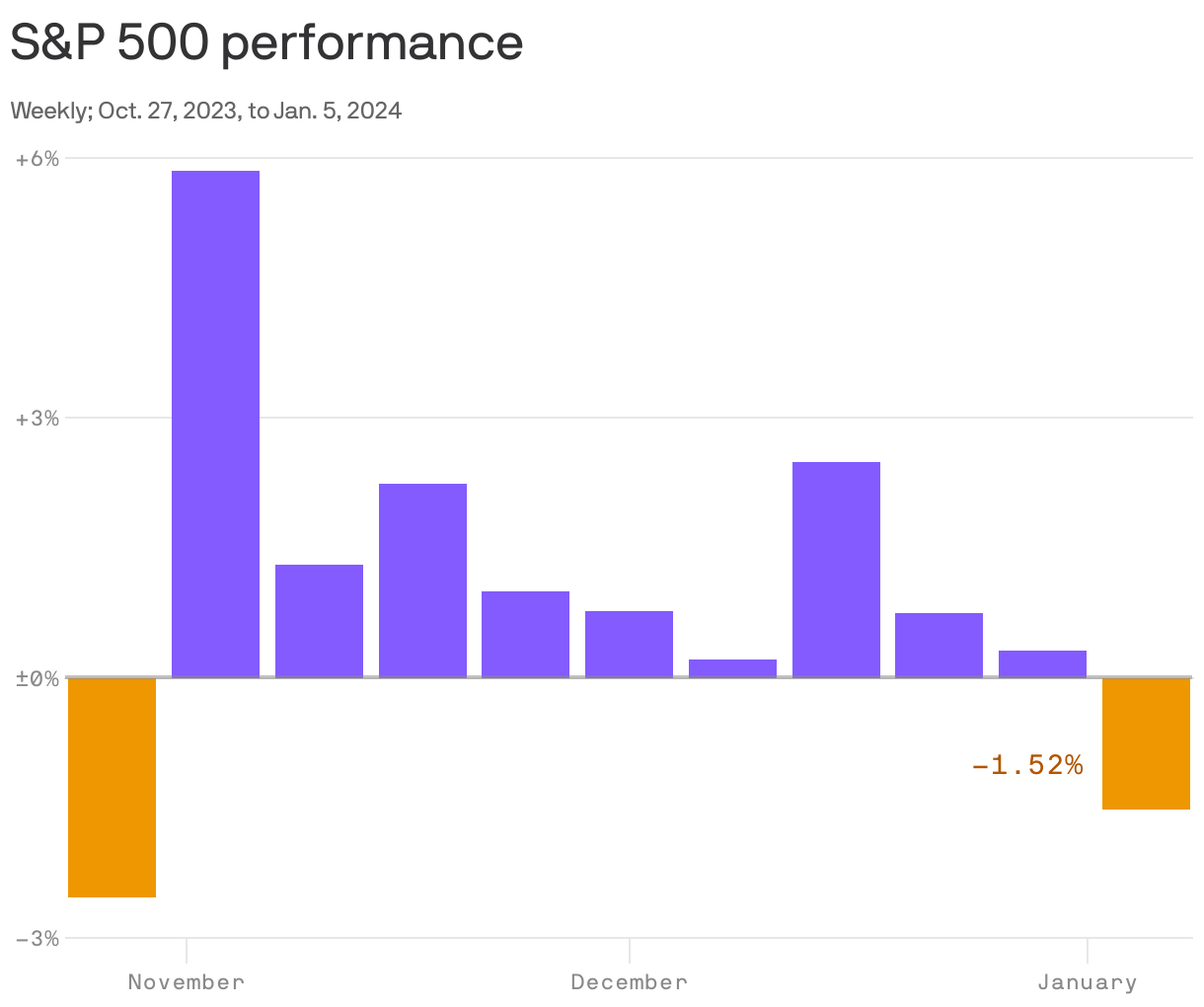
The S&P 500 snapped its string of consecutive weekly gains last week, Matt writes.
Why it matters: The streak of nine straight weekly gains lifted the stock market index as much as 16% at points.
- It was the longest weekly winning streak since January 2004.
State of play: A bit of a retreat from the sharp rally at the end of last year, as well as concern about higher oil prices and potential trade disruptions related to violence in the Middle East all helped take the spring out of investors' step in the first week of 2024.
What to watch: Coming up this week, the latest report on U.S. consumer price inflation, due Thursday, will likely be the market's main event.
4. Pay is beating inflation again


Americans are now getting an actual pay raise, even after accounting for inflation, Matt writes.
Why it matters: Rising real — that is, inflation-adjusted — earnings are a basic indication of improving standards of living.
Driving the news: Average hourly earnings of private sector employees rose at an annual rate of 4.1% in December, according to Friday's job report, a smidge higher than the 4% gain in November, and roughly 1 percentage point above the 3.1% annual rise inflation that month.
- December CPI data is due Thursday morning.
Yes, but: Don't expect spontaneous parades. From April 2021 to June 2023 — more than two years — inflation was significantly higher than earnings, meaning that workers' standards of living fell sharply.
The bottom line: It'll likely take a long stretch of real wage gains before Americans feel better after that inflationary pinch.
Read more: The majority of workers are making more money now than they were a year ago
5. Child care jobs recovery still lags


The number of employees in child care services crept up by a few thousand to 1.023 million in December — but employment in the sector still isn't back to where it was in February 2020, according to data out Friday, Emily writes.
Why it matters: It's somewhat surprising because there is a record share of parents — mothers, more specifically — in the job market. And their kids need child care.
- In a typical market, an increase in demand from more parents needing care would lead to an increase in supply.
- But child care isn't a typical industry — operators run on razor-thin margins and they're fairly constrained in what they can charge working parents.
Zoom out: Hiring's been slow, partly because this is a low-pay industry and there are better, higher-paying jobs out there.
- Plus, pandemic-era child care funding has run out, leaving many centers scrambling.
The intrigue: Remote work may have been the saving grace here; enabling some parents to manage child care in a more ad hoc way.
Was this email forwarded to you? Subscribe here.
Axios Markets is edited by Kate Marino and copy edited by Mickey Meece.
Sign up for Axios Markets

Stay on top of the latest market trends and economic insights