Axios Login

May 18, 2023

Hey there, it's Ryan.
I'm Chicago-bound, to hear Fortune 500 execs discuss how AI and geopolitics are reshaping their supply chains. If you're at the Supply Chain USA conference, hit me up: [email protected].
Today's Login is 1,221 words, a 5-minute read.
1 big thing: Where AI evolves from here
Illustration: Aïda Amer/Axios
Microsoft researchers say the latest model of OpenAI's GPT "is a significant step towards AGI" — artificial general intelligence, the longtime grail for AI developers, Axios' Scott Rosenberg reports.
The big picture: If you think of AI as a technology ascending (or being pushed up) a ladder, Microsoft's paper claims that GPT-4 has climbed several rungs higher than anyone thought.
Driving the news: Microsoft released the "Sparks of Artificial General Intelligence" study in March, and it resurfaced in a provocative New York Times story Tuesday.
- The researchers found that "GPT-4 can solve novel and difficult tasks that span mathematics, coding, vision, medicine, law, psychology and more, without needing any special prompting."
- Among other remarkable responses, they asked GPT-4 how to stack "a book, 9 eggs, a laptop, a bottle and a nail," and it provided a plausible plan.
Catch up quick: Three key terms to understand in this realm are generative AI, artificial general intelligence (AGI), and sentient AI.
- Generative AI sounds like a person.
- AGI reasons like a person.
- Sentient AI thinks it's a person.
GPT-4, ChatGPT, Dall-E and the other AI programs that have led the current industry wave are all forms of generative AI.
- These are big software programs — mostly, "large language models" or LLMs — that are trained on troves of text, images or other data to perform one trick over and over: filling in the next word or pixel in a pattern that the user has requested. Developers then fine-tune these models for more specific applications.
- Generative AI does amazing things today, but experts are divided over whether it is on course to evolve toward the loftier status of AGI.
AGI has a variety of definitions, all centering on the notion of human-level intelligence that can evaluate complex situations, apply common sense, and learn and adapt.
- The "Sparks" paper authors define AGI as "systems that demonstrate broad capabilities of intelligence, including reasoning, planning, and the ability to learn from experience, and with these capabilities at or above human-level."
- OpenAI's mission statement is to build AGI and ensure that it "benefits all of humanity."
Some experts, like Microsoft's authors, see a clear path from the context-awareness of today's generative AI to building a full AGI.
- Another expert contingent believes that generative AI is likely to plateau at some point, and the quest for AGI will need to explore different avenues to advance.
Beyond the goal of AGI lies the more speculative notion of "sentient AI," the idea that these programs might cross some boundary to become aware of their own existence and even develop their own wishes and feelings.
- Last year, a Google engineer went public with a claim that the firm's LaMDA language model had become sentient enough that it should be granted the AI equivalent of human rights. Google later fired him.
Virtually no one else is arguing that ChatGPT or any other AI today has come anywhere near sentience. But plenty of experts and tech leaders think that might happen someday, and that there's a slim chance such a sentient AI could go off the rails and wreck the planet or destroy the human species.
- These are the concerns that drove many industry insiders to sign an open letter in March calling for a six-month pause in the development of the next generation of AI.
- Other experts discount that worry as a distant and unlikely scenario — and believe that it distracts from closer-to-reality harms stemming from actual AI systems in use today that make biased decisions, disrupt employment and confuse fiction with fact.
The bottom line: For help navigating this landscape, you're likely to find as much value in the science fiction novels of Philip K. Dick as in the day's news.
2. Laptop trades screen for 100-inch AR display
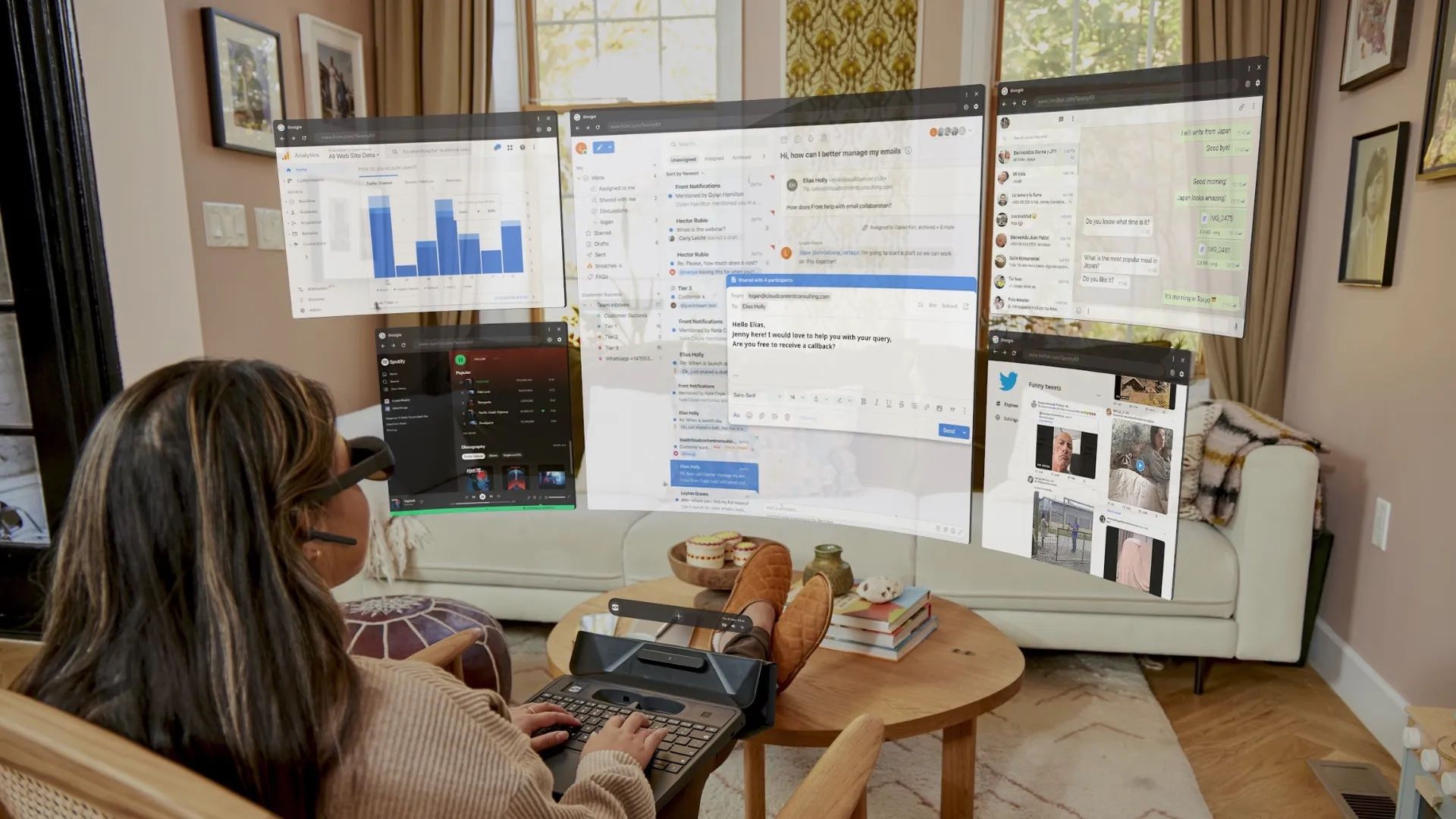
Image: Sightful
Two former Magic Leap employees have teamed up to create Spacetop, a $2,000 laptop that ditches the traditional screen and instead uses its own augmented reality glasses to create a 100-inch virtual display, Axios' Ina Fried reports.
Why it matters: Laptops have always been defined around the space constraints of the screen, with display size determining just how big the device needed to be.
How it works: The company is selling 1,000 of the devices as part of an early access program, with hopes of using the feedback to inform a broader launch.
- The Spacetop runs a custom operating system, with its backers touting the ability to run web-based applications such as Zoom, Google Workspace and Figma.
- The Tel Aviv-based company behind the startup Sightful is led by CEO Tamir Berliner and COO Tomer Kahan, both formerly of AR headset maker Magic Leap. They have raised $61 million in venture funding.
- Sightful says the glasses offer 1080p resolution per eye, which they promise is enough to offer sub-pixel viewing resolution. In a pinch, the Spacetop can also connect to a traditional monitor for some features, with more available later via software updates.
The big picture: The idea of using virtual space to display traditional computer windows has been tried in a variety of ways, but has yet to move beyond niche status.
3. Montana becomes first state to ban TikTok

Illustration: Natalie Peeples/Axios
Montana Gov. Greg Gianforte (R) signed into law Wednesday a bill banning TikTok statewide, effective Jan. 1, 2024, Axios' Rebecca Falconer reports.
Why it matters: This move dramatically escalates a trend that's seen a growing number of Republican-led states issue TikTok bans on government-issued devices after the FBI warned of possible threats to national security posed by the Chinese-owned social media platform.
- A TikTok spokesperson said in an emailed statement Wednesday evening that the ban is an infringement of First Amendment rights.
Zoom out: TikTok CEO Shou Zi Chew testified before Congress in March that the app's parent company ByteDance is not an agent of China's ruling Communist Party.
- But the U.S., the EU, Canada, and several other nations have in recent months moved to impose bans and other restrictions on the app in relation to official government devices.
What we're watching: The Montana Department of Justice will be responsible for investigating any potential violations of the ban, according to the bill.
- "Internet service providers and companies that violate the ban would face a $10,000 fine per day for each violation," while residents would not be fined, per a statement from the state attorney general's office.
What they're saying: Jameel Jaffer, executive director at Columbia University's Knight First Amendment Institute said in a statement that "because Montana can't establish that the ban is necessary or tailored to any legitimate interest, the law is almost certain to be struck down as unconstitutional."
Flashback: The political realities that make a national TikTok ban tricky.
4. Take note
On Tap
- Bitcoin 2023 kicks off in Miami Beach, Florida, where the confab faces tough times in the crypto universe.
ICYMI
- A new accessibility feature for Apple devices will capture the sound of a user's voice and "speak" for those who are nonspeaking or at risk of losing that ability. (Axios)
- MIT economist David Autor discusses real world impacts of implementing generative AI at work, suggesting it could be a boon for the middle class. (NPR)
5. After you Login

Immersive Light And Sound Show 'Wintjiri Wiru' tells Indigenous stories of Uluru, central Australia. Photo: David Gray/Getty Images for Voyages Indigenous Tourism Australia
Drones in the desert: There's a new world's largest permanent drone show — in the unlikely setting of the Australian outback — telling a sacred story of the local Anangu people. Each night 1,100 drones dominate the Uluru rock formation, which itself tops out 1,142 feet above the surrounding plain.
Thanks to Scott Rosenberg and Peter Allen Clark for editing and Bryan McBournie for copy editing this newsletter.