Axios Login

March 24, 2023

Hello from Washington, D.C. I'm going to be mostly off the next few days, but I will be at What's Next Summit next week interviewing Box CEO Aaron Levie and White House Office of Science and Technology Policy director Arati Prabhakar. Watch live here.
Today's Login is 1,216 words, a 5-minute read.
1 big thing: TikTok CEO hearing fallout
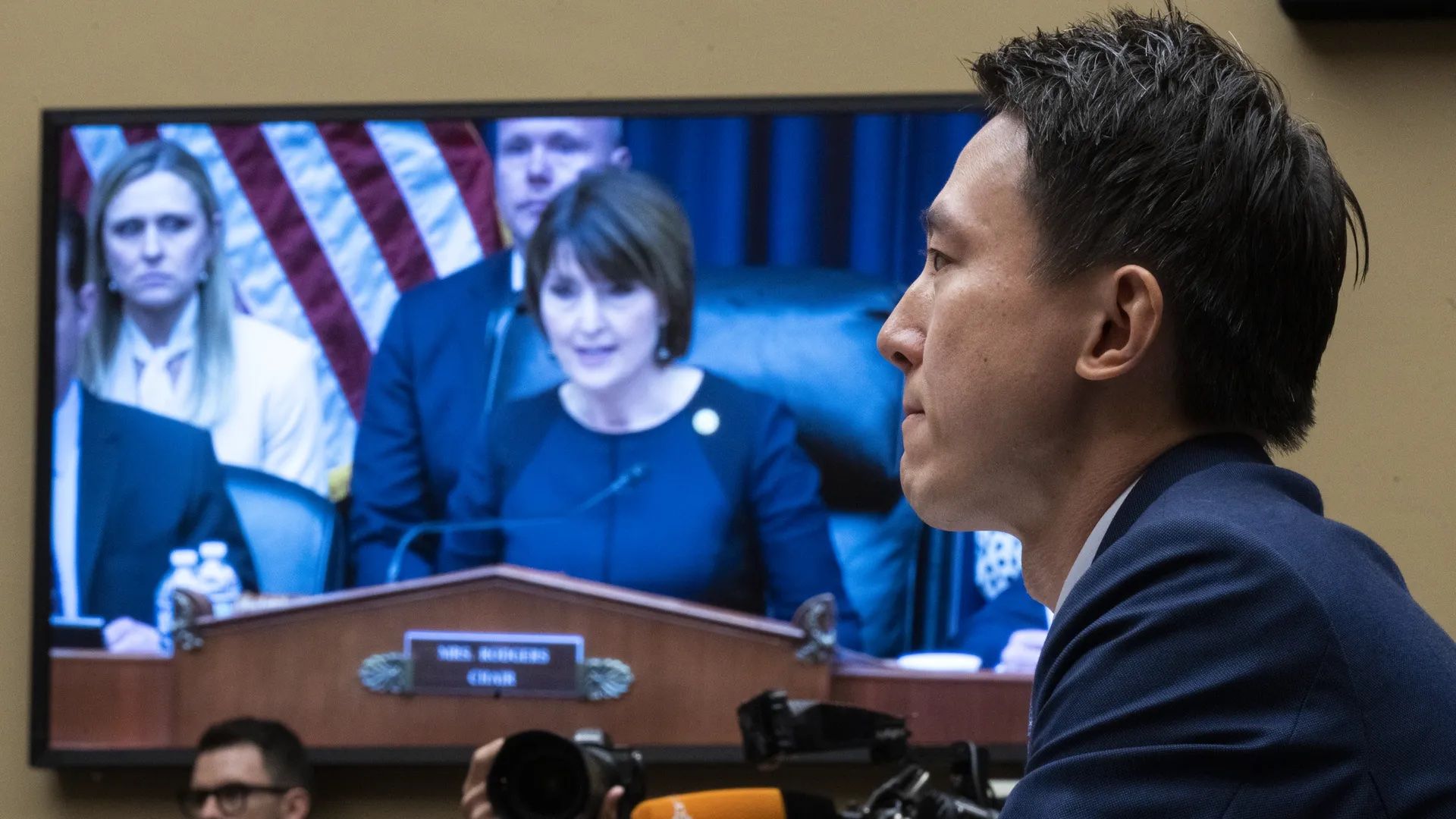
Rep. Cathy McMorris Rodgers makes an opening statement before TikTok CEO Shou Zi Chew testified Thursday. Photo: Tom Williams/CQ-Roll Call Inc. via Getty Images
There was pretty much nothing TikTok CEO Shou Zi Chew could have said at his Thursday Capitol Hill testimony to convince lawmakers that TikTok is safe.
Yes, but: The hearing could have an unexpected consequence — reviving bipartisan legislative efforts to pass a national privacy law, Axios Tech Policy Pro's Ashley Gold and Maria Curi report.
Why it matters: Companies and consumers alike have been begging for national privacy standards since long before the TikTok controversy.
- An outright ban on the app — or a forced sale to separate it from Bytedance, the Chinese firm that owns it — is seen as a targeted approach to an immediate national security threat. But lawmakers recognize that a long-term solution to the risks all apps raise would be more meaningful.
- A reintroduced American Data Privacy and Protection Act (ADPPA) will be the starting point for new bipartisan privacy negotiations, which achieved promising momentum in the last Congress.
- Bill proponents say language on data transfers, algorithmic transparency and kids' protections would address issues related not only to TikTok but also to other U.S. apps that are vulnerable to foreign adversaries.
The big picture: There are many other proposals in play.
- Chew told lawmakers he supports updating the Children's Online Privacy Protection Act, an idea being pursued by Sen. Ed Markey (D-Mass.) in his COPPA 2.0.
- Rep. Yvette Clarke (D-N.Y.) told Axios she would reintroduce her Algorithmic Accountability Act in June. The bill, which she touted during the hearing, would address content moderation concerns, including programming bias that perpetuates race-based discrimination.
- Sen. Mark Warner's bipartisan RESTRICT Act would empower the Commerce Department to deal with tech products that foreign adversaries have an interest in.
- Rep. Bob Latta and others brought up Section 230's liability protection for platforms like TikTok, suggesting it should be amended to remove protections for algorithmic suggestion of content.
Between the lines: The ADPPA still faces an uphill battle.
- The same sticking points from last year remain, namely California lawmakers. Rep. Anna Eshoo told Axios she still has issues with the bill, as California fears a federal law will weaken the state's own privacy law.
Meanwhile, Chew's four-hour grilling seemed to leave TikTok in further peril of U.S. government action, Axios' Zachary Basu and Stef W. Kight report.
- The Singapore-born, Harvard-educated Chew faced a near-impossible task as the House Energy and Commerce Committee questioned him on TikTok's ties to the Chinese government, data practices and harmful effects on children.
- Some of Chew's answers seemed likely to accelerate a U.S. ban of the immensely popular app, even as the Biden administration prefers to force a sale by TikTok parent ByteDance.
- "If this committee gets its way, TikTok's time is up," Rep. Randy Weber (R-Texas) told Chew, a comment that reflected the absence of friendly faces — Democratic or Republican — throughout the hearing.
For more content like this, subscribe to the Axios Pro Tech Policy newsletter launching March 27.
2. TikTokers rally to app's defense
Illustration: Aïda Amer/Axios
It was a near-perfect split screen: As lawmakers ripped TikTok and its CEO, the app's users took to the platform to defend it, Axios' Erin Doherty reports.
Driving the news: A hashtag — #tiktokhearing — garnered 2.8 million views as of 3:30pm Thursday.
- Users posted videos to the hashtag that mocked the hearing and they slammed the prospect of a potential ban.
- "What is currently going down in Congress is straight up fear-mongering," @tegareacts, who has 3.9 million followers, said in a video posted Thursday.
- "If you genuinely cared about children and the welfare of Americans, you'd do a lot of things, like health care, funding for teachers, gun control," she added.
- "I'm not saying TikTok is perfect by any means ... but this should lead to legislation that affects all consumer apps, not just one specific one," user @frankniu said in a video posted Thursday.
The big picture: House members were relentlessly hostile to the app.
- Rep. Tony Cárdenas (D-Calif.) at one point said TikTok's issues were a matter of "life and death."
But in the lead-up to Chew's testimony, users defended TikTok as a powerful tool to bring people together.
- "On TikTok, you will find your community and you will find it quickly!" said one user, @engineer2educator, who is a math teacher. He has 252.8K followers.
- Another user, with the username @drue..b, who has 1.2 million followers, said in a video posted this week: "I have made so many friendships, I have met so many new people [through the app]."
3. New York Times touts continued Wordle success
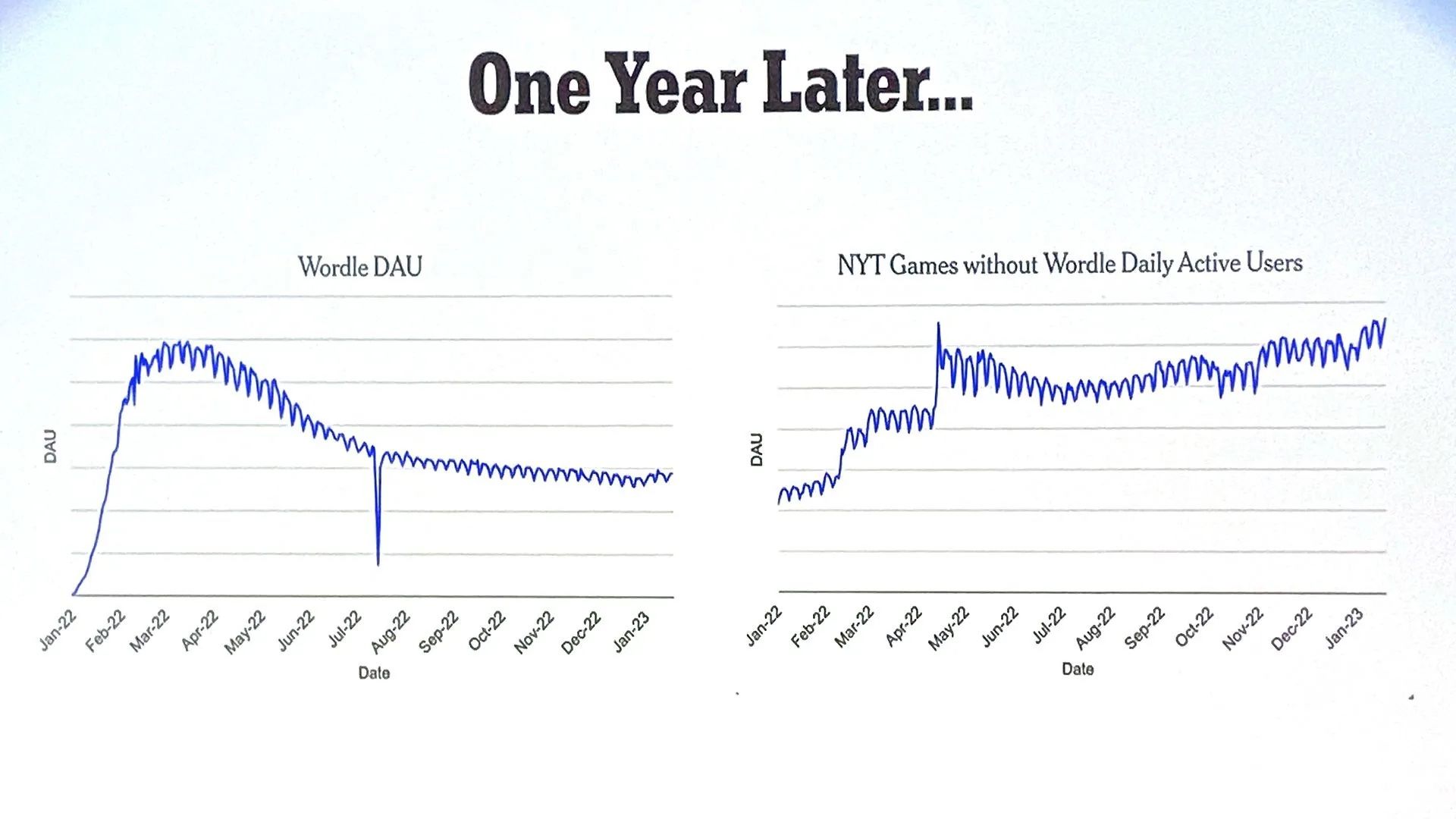
The New York Times' data on Wordle usage (including a brief July outage). Photo: Axios
Wordle usage peaked in March of last year, but has remained strong since the game’s purchase by the New York Times last January, Axios Gaming's Stephen Totilo reports.
Why it matters: Despite some players' fears, the NYT hasn’t ruined Wordle, according to player stats. Far from it.
- Making that case today at the Game Developers Conference in San Francisco was Zoe Bell, a 14-year industry veteran and executive producer at NY Times Games.
- The paper's strategy, she said, was to "preserve Wordle as an internet treasure" and follow a simple ethos of "do no harm," with admittedly mixed results.
Details: Bell described the Times' management of Wordle throughout 2022 as a careful process focused on keeping changes to the game minimal, rolling them out slowly and being transparent with players.
- The company didn't rush to monetize Wordle, spent months preparing to change its codebase for better stat-tracking and more months to bring it into the Times' mobile app, all while keeping the user experience as similar to its indie incarnation as possible, Bell said.
- The game's post-acquisition growth was actually a surprise, she said: "We thought people would think that Wordle had peaked and how long can exponential growth go on?"
One positive not usually cited by big game publishers: The addition of an editor to Wordle in late 2022 put a human face to the game.
- Having that human element is "so important for our brand and the delight of our players," she said, joking that now frustrated Wordle players had someone to blame when they struggled.
Yes, but: There was occasional friction with Wordle's users.
- Some players were upset when the paper removed words from the word list because they were deemed too obscure (agora, fibre) or in violation of the Times' sensitivity guidelines (slave, wench, lynch).
- The Times' Wordle team also faced complaints mid-year that the game's difficulty had been increased, which Bell denies was the case (that said, a September puzzle solution PARER was the year's top snapper of players' streaks, quadrupling the average daily number of broken streaks).
Between the lines: Some 35% of the users who subscribe to the Times' gaming subscription service now cite Wordle as the reason they subscribed, Bell says.
- That's despite it being a free game.
4. Take note
Trading Places
- Travel optimization startup FLYR Labs named former CloudBees and Hitachi executive John Tzioufas as chief revenue officer.
ICYMI
- Utah became the first state to sign a law limiting kids' social media use. (Axios)
- Twitter says it will start removing its old-school blue "verified" checkmarks April 1 — henceforth, a checkmark will indicate you're a paying subscriber. But also: note the date. (The Verge)
- The U.K.'s Competition and Markets Authority has reached a "provisional conclusion" that Microsoft buying Activision Blizzard would not reduce console gaming competition in the U.K. (CMA)
5. After you Login
Some good info here here from the National Park Service.
Thanks to Scott Rosenberg and Peter Allen Clark for editing and Bryan McBournie for copy editing this newsletter.