Axios Login

May 15, 2023

Hi from Washington, D.C. Still feeling the joy from this weekend's GLAAD Media Awards in New York, which honored the #letters4transkids project that I started last year. Today's Login is 1,255 words, a 5-minute read.
1 big thing: AI's loneliness crisis

Illustration: Aïda Amer/Axios
Loneliness in the U.S., which spiked during the isolation of COVID, remains a public health "crisis" — and now the advent of ubiquitous AI-driven chatbots could make actual human contact even scarcer, Axios' Ryan Heath reports.
Why it matters: In the long haul, experts worry that AI might further cocoon people from the relationships and conversations they need. But in the short term, AI-powered companions, pets and mental health support services are already being drafted to fight the loneliness epidemic.
The big picture: There aren’t enough therapists, counselors and care providers in the U.S. to support every lonely person, while AI-based services can be scaled to poorly served regions and offered 24/7.
- 3 in 4 Americans say they experience loneliness, and Gallup estimates 44 million are experiencing "significant loneliness."
- U.S. Surgeon General Vivek Murthy says the effects can be equivalent to smoking up to 15 cigarettes a day.
Yes, but: Some mental health experts worry risks from AI tools offering health services without regulatory approval outweigh potential benefits.
On the positive side, advocates point to a list of applications where AI can provide some loneliness relief.
- Virtual therapists can benefit veterans reluctant to open up to a person and people struggling to access in-person therapy in their native language
- AI conversations might be a boon for the 77% of Americans who say they want to age in their own homes. Beyond small talk, AI companions can help with fall detection.
- 24/7 support from AI can provide out-of-hours back-up for those already receiving clinical help, such as chat based on existing individual patient notes.
- Rural areas — where 3 in 4 counties lack the cash to expand access to behavioral health services — could also benefit.
AI pets are already a growth industry.
- They've improved since the 1990s Tamagotchi fad and can include realistic programmed personalities and physical features like fur and tails that wag.
- Living pets bring well-established benefits, including reduced loneliness and anxiety for owners, and promoters of AI pets say they offer similar benefits for those who can't take on the the responsibilities and costs of keeping a pet alive.
China has blazed the trail for deploying AI against loneliness.
- Since 2019, Xiaoice — Microsoft's China-focused chatbot — has developed an audience of 660 million users.
- Xiaoice was trained to learn EQ skills before IQ skills, so that users see "her" as a friend. Microsoft admits, "Sometimes the line between fact and fantasy blurs. She gets love letters and gifts."
Reality check: Mental health care presents life-and-death challenges.
- The American Psychiatric Association estimates more than 10,000 apps claim to provide mental health services, but few are certified by professional bodies or governments.
- AI tools trained on the open internet or released without guardrails have allegedly played a role in at least one suicide.
Generational differences and racial disparities add complexity, with younger people more likely to want to talk through mental health challenges, and older generations more likely to medicate. White communities access mental health services at higher rates.
- Amid declining face-to-face socializing, minors may treat AI as a replacement for developing social skills.
- When Snapchat slotted My AI, a ChatGPT-powered tool, into users' friends list earlier this year, some underage users asked the bot to act as their virtual boyfriend or girlfriend.
What’s next: Look for startups to combine machine learning and behavioral psychology to data-mine our emotions.
- Nirit Pisano, chief psychology officer at Cognovi Labs, told Axios that helping AI better read how we're inclined to think and act in certain emotional states opens the door to 24/7 support, greater self-understanding and systems that can nudge us towards useful behaviors or emergency services.
- But a public already wary of ad-driven digital surveillance and biased AI algorithms might think twice before sharing state-of-mind data with profit-driven chatbots.
The bottom line: The faster AI gets deployed as a mental-health stopgap, the sooner we'll discover whether it's boon or bane.
2. Google: AI should not be considered an inventor
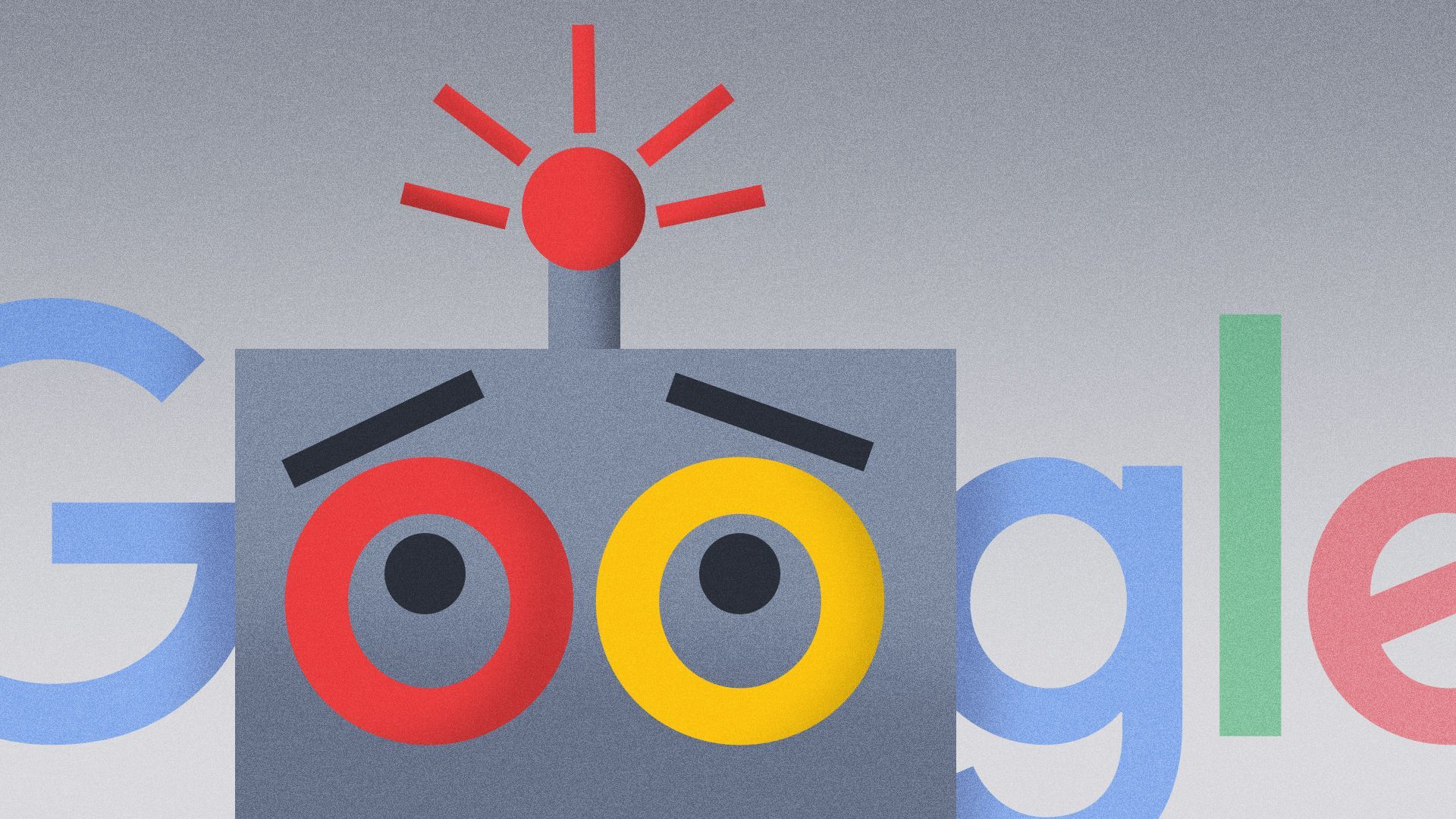
Illustration: Shoshana Gordon/Axios
AI technology should not be considered an "inventor" by U.S. patent law, Google argues in a new filing with the U.S. Patent and Trademark Office first shared with Axios' Ashley Gold.
Driving the news: USPTO is currently soliciting comments on AI technologies and inventorship — asking people, among other things, how AI is being used in creating inventions and whether its contributions would qualify it for treatment as a joint inventor.
- Questions posed by USPTO include: "If an AI system contributes to an invention at the same level as a human who would be considered a joint inventor, is the invention patentable under current patent laws?"
- "Are there situations in which AI-generated contributions are not owned by any entity and therefore part of the public domain?"
Why it matters: The rapid rise of generative AI technologies has posed endless legal questions about ownership, authorship, copyright and other matters.
What they're saying: "As our comments say, we believe A.I. should not be labeled as an inventor under the U.S. Patent Law, and believe people should hold patents on innovations brought about with the help of AI," Google senior patent counsel Laura Sheridan said in a statement to Axios.
- Per Google's comments: "In our view, current industry uses of AI are well within the zone where humans are properly named as the inventors and AI is leveraged as a tool in the invention process. We expect to remain in this zone for some time."
3. New Twitter CEO Yaccarino risks the glass cliff

Illustration: Natalie Peeples/Axios
Elon Musk vaulted Linda Yaccarino into one of the most visible leadership positions in the world Friday when he named her Twitter's new CEO.
Why it matters: While the appointment of the former NBCUniversal ad chief reflects continued progress in gender representation at the corporate top, experts also see the move as thrusting another woman onto a "glass cliff," Axios Closer's Hope King reports.
Context: Similar to the "glass ceiling," a metaphor for the invisible social barrier that limits women's upward mobility, the glass cliff is a metaphor: it represents the dilemma facing women or members of other underrepresented groups when they are asked to transform a faltering firm — in situations where anyone would face a high likelihood of failure.
- An oft-cited study in the Harvard Business Review reveals that women are preferred to take over when a male-led company is in crisis.
State of play: Yaccarino is inheriting a company that's shed roughly 80% of its workers since Musk took over last October.
- Outages, user discontent and advertiser skepticism have plagued the platform since.
What to watch: How dominant Musk will remain, while he works on product design and new technology. Yaccarino will be responsible for business operations primarily.
- "She should get out quick" if Musk remains dominant, says Jennifer Chatman, professor of management at the Haas School of Business.
Meanwhile, Twitter said Friday it was blocking certain content in Turkey at the government's behest, a day before a national election there.
4. Take note
On Tap
- Out In Tech DC and Axios HQ are hosting a panel on AI ethics that I will moderate at Axios' Arlington, Virginia, office on Tuesday. Come join us! Register here.
ICYMI
- The Chinese Communist Party "maintained supreme access" to data belonging to TikTok parent company ByteDance, including data stored in the U.S., a former top executive claimed in a lawsuit Friday. (Axios)
- Malicious hackers are embedding malware into illegal downloads of the "The Super Mario Bros. Movie," researchers at ReasonLabs told Axios.
5. After you Login

Photo: Ina Fried/Axios
I had a little time in New York on Sunday and got to check out the Nintendo store. But, as the sign says, just make sure you don't touch, climb or sit on Bowser.
Thanks to Scott Rosenberg and Peter Allen Clark for editing and Bryan McBournie for copy editing this newsletter.
Sign up for Axios Login

Taking you inside the AI revolution, and delivering scoops and insights on the technologies reshaping our lives.