Axios Login

May 16, 2022
Join me and Axios' Niala Boodhoo tomorrow at 12:30pm ET for a virtual event examining the cyberthreat landscape in 2022. Guests include Rep. John M. Katko (R-N.Y.) and Harvard Belfer Center's Cyber Project executive director Lauren Zabierek.
- Register here.
Today's newsletter is 1,192 words, a 4-minute read.
1 big thing: Floodgates opening for Texas "censorship" lawsuits
Illustration: Brendan Lynch/Axios
Tech platforms are facing a new reality: Unless the U.S. Supreme Court intervenes, Texans could immediately start suing giants like Meta and YouTube over content moderation decisions they don't agree with, Axios' Ashley Gold reports.
Driving the news: The U.S. Court of Appeals for the 5th Circuit reversed an earlier ruling that had stopped Texas from enforcing its social media law, H.B. 20, last week. Industry groups asked the Supreme Court Friday for an emergency stay.
The law's supporters see it as a way to get Facebook, YouTube, Twitter and other social media companies to stop what many on the right have long viewed as "censorship" of conservative viewpoints.
Opponents point out that the law is likely to let virtually anyone challenge any content-related decision by the platforms, even though most content moderation involves blocking spam and porn and barring harassment and bullying.
Details: H.B. 20, which applies to platforms with 50 million or more U.S. monthly users, bars "censorship" based on "viewpoint."
- It defines "censorship" as acts that "block, ban, remove, deplatform, demonetize, de-boost, restrict, deny equal access or visibility to, or otherwise discriminate against expression."
- It empowers individuals to bring legal action against companies that violate the law.
How we got here: Texas passed H.B. 20 last September, but a federal district court judge blocked it from going into effect in December.
- Last week's appeals court ruling reversed the lower court and will allow the law to take effect unless the Supreme Court steps in.
What they're saying: "H.B. 20 strips private online businesses of their speech rights, forbids them from making constitutionally protected editorial decisions, and forces them to publish and promote objectionable content," Chris Marchese, counsel for NetChoice, one of the groups appealing the ruling, said in a statement.
- "The First Amendment prohibits Texas from forcing online platforms to host and promote foreign propaganda, pornography, pro-Nazi speech, and spam."
The big picture: A number of state legislatures have attempted to pass laws that prevent social media platforms from taking down posts they find objectionable, in an attempt to fight alleged bias against conservatives.
- Members of Congress have introduced similar bills.
- In Florida, a similar law passed last May was almost immediately put on hold by a federal judge. The state's appeal of that decision is awaiting a ruling from the 11th Circuit.
The bottom line: The 5th Circuit decision shows that these "anti-censorship" laws can find at least some judges who won't reject them out of hand.
- Content moderation experts tell Axios this will give other states an incentive to see if they can find other sympathetic judges.
2. Live streaming motivated the Buffalo shooter
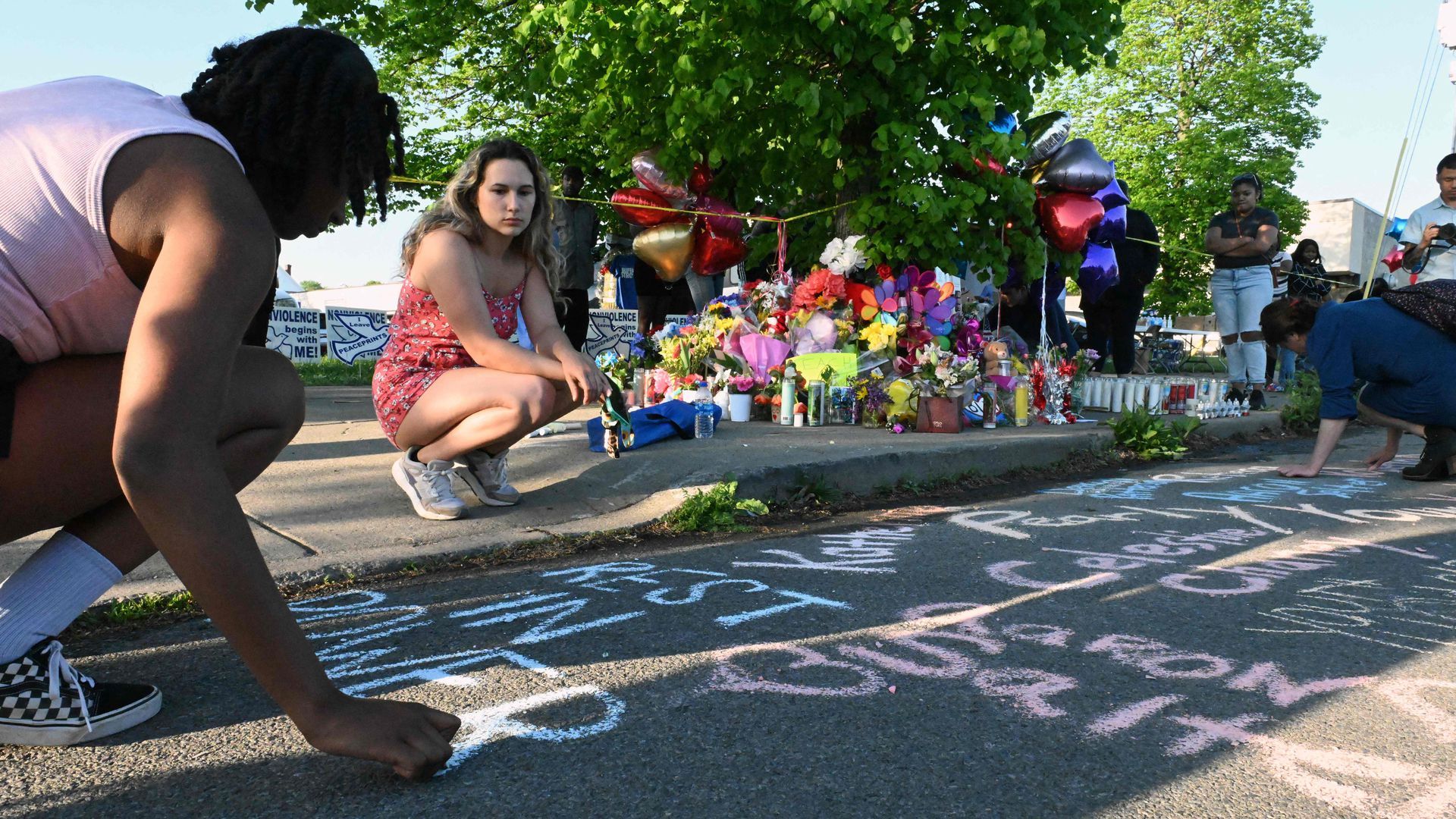
People leave messages at a makeshift memorial near a Tops Grocery store in Buffalo, N.Y., on May 15. Photo: Usman Khan/AFP via Getty Images
Twitch says it managed to take down the live stream of the weekend mass shooting in Buffalo within two minutes after it started. However, videos of the shooting have been viewed millions of times, in part because it remains easy to re-upload copies of videos to multiple platforms, Axios' Sara Fischer and I report.
Why it matters: Live-streaming mass shooting events can give assailants assurance that their crimes will live online for many years.
- Indeed, the man arrested in conjunction with the shooting said knowing he could broadcast his attack was part of his impetus.
- "Live streaming this attack gives me some motivation in the way that I know that some people will be cheering for me," the shooter said during his racist video rant during the attack, per the Washington Post and NY Times.
Catch up quick: Authorities are investigating the mass shooting by an 18-year-old white man as a hate crime and a case of "racially motivated violent extremism."
- The attack at a Buffalo, New York, supermarket on Saturday evening killed 10 and wounded 3. Eleven of the 13 people were Black, per police.
Details: The shooter wore a camera during the attack and posted the footage in real time to Twitch, the live-streaming platform owned by Amazon that often features live videos of video gaming.
- The only video uploaded to Twitch by the shooter, the company believes, was the live footage of the attack. Twitch confirmed to Axios that it removed the stream less than two minutes after the violence started.
The big picture: Tech platforms said they were quick to identify the video as a violation of their policies and removed it shortly thereafter, but copies of the video still circulated online for hours after the live stream ended.
- For example, Axios watched part of the video that was posted to Facebook on Sunday at 11:30am ET before it was taken down a few hours later.
What they're saying: Twitch said in a statement that the user who streamed the shooting has been indefinitely suspended.
Be smart: The Department of Homeland Security has cited a pattern amongst some mass shooters of watching and studying videos online of other mass shooting events, like the 2012 Sandy Hook Elementary School shooting.
Between the lines: Tech firms have long struggled to identify and block videos of mass shootings and other gruesome events that are live streamed or uploaded to their platforms as the violence is taking place.
- Violent content uploaded to platforms for on-demand replay after the fact is easier for companies to weed out using artificial intelligence, either at the point of upload or before it's widely noticed — the automated systems can match the videos to databases of previously flagged content.
3. One Musk tweet drives stock tickers into frenzy
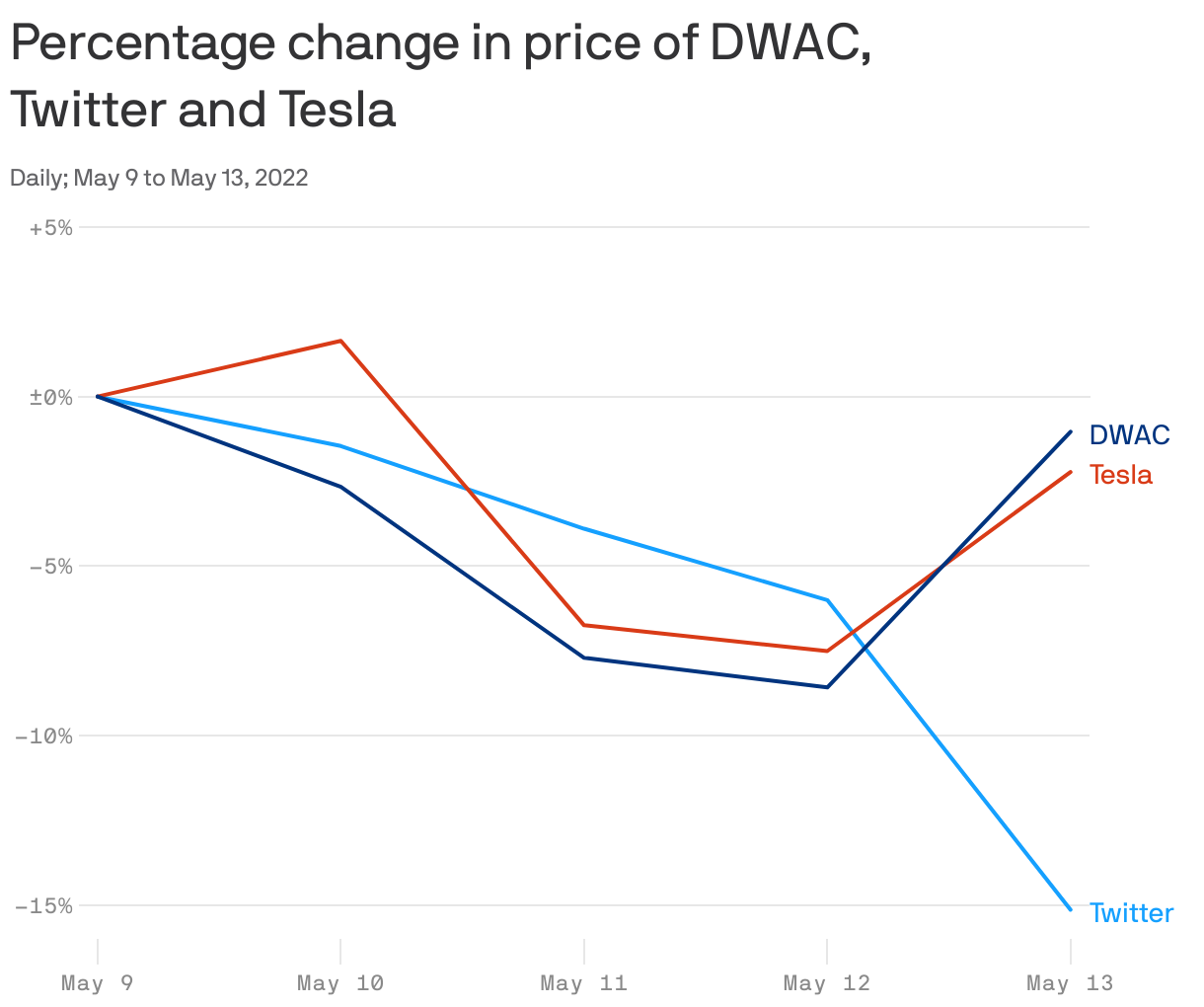
There's no better sign of Twitter's impact on public conversation and markets than the record of how one Elon Musk tweet on Friday changed the valuation of three separate companies by billions of dollars in a matter of minutes, Sara reports.
Driving the news: Musk's tweet that his pending Twitter takeover deal was "temporarily on hold" sent Wall Street on a wild ride Friday.
- Investors were already beginning to grow skeptical of Musk's bid, but the possibility that he could walk sent Twitter's shares tumbling more than 20% before the market opened.
- Musk's tweeted clarification two hours later that he was still "committed" to the acquisition gave the stock a pop, but shares still closed down nearly 10% at market close.
Be smart: Musk's tweet set off a ripple effect across a slew of companies, including Tesla, which saw shares jump nearly 6% on the possibility that Musk might abandon his Twitter deal.
- Shares in DWAC, the blank check company that plans to take former President Trump's social media company Truth Social public, also gained on the possibility that Musk might bail on Twitter.
4. Take note
On Tap
- Gamemaker Take Two Interactive Software, which is in the process of acquiring Zynga, reports earnings after the markets close today.
Trading Places
- Dawn Woodard, previously a senior director at Uber, has joined LinkedIn as a distinguished engineer/scientist, reporting to Ya Xu, the company's head of data.
ICYMI
- Several women who attended the Bitcoin 2022 conference in Miami say they were harassed at the event. (Wired)
- Former President Trump has committed not to post on social networks competing with his own Truth Social, new documents show — but he's also left himself big loopholes to return to Twitter if he wants (and is ever allowed again). (Axios)
5. After you Login
The difference between design and user experience, as illustrated by kids on a playground.


