Axios Login

May 13, 2020

Today's Login tackles a single topic — virtual reality, and why it's not helping us through the coronavirus crisis the way many thought it might.
It's also 1,944 words, a 7-minute read.
1 big thing: VR misses its pandemic moment

Illustration: Eniola Odetunde/Axios
Virtual reality can bring faraway people together and take us places we can't physically go. That should make it the perfect breakout technology for both personal and professional life in the stay-at-home era — yet it remains a niche product.
The big picture: Virtual reality remains in its infancy, despite decades of on-and-off development, billions of dollars in investment and a ton of anticipation. Sales of VR headsets have repeatedly failed to live up to expectations. IDC reported 1.4 million units sold globally in Q4, down 23% from the prior year.
The fizzle is due to a number of reasons, the same issues that explain why VR isn't having a boom right now:
- There was too much hype before the tech was ready. That meant many users experienced VR before the technology was particularly comfortable or compelling — leaving the industry in the stage of the hype cycle known as "the trough of disappointment."
- It's supposed to be the next best thing to being somewhere, but often it isn't. VR is more immersive than the competition — but computers and gaming consoles offer more precise controls, TVs offer higher resolution, and both allow you to multitask.
- It's still an uncomfortable experience for long periods of time. Even at its best, today's VR isn't to the point where it is comfortable to spend hours on end in a headset. And even if it was, the devices' battery life won't support that, anyway.
- The interfaces aren't good enough to create viable workspaces. Seeing Microsoft Office and the web as just windows within a nearly limitless virtual space feels novel, until you find yourself trying to, say, use a keyboard that you can't see to take notes. "We are Frankensteining two different areas of computing together," says Gartner analyst Tuong Huy Nguyen. "Even if you're passionate and you want to do it, it is really awkward."
- Many software makers and content providers that dabbled in VR have shifted their attention elsewhere. There are a decent number of games and documentaries available on VR platforms, but many developers have found other markets to be more lucrative and moved on.
- A lot of VR companies have already pivoted to the enterprise market in a desperate move to stay alive. In most cases, that has meant trying to offer technical training for shop-floor workers, rather than the kind of general-purpose office computing or communications that might be more in demand right now.
The bottom line: All this meant that when so many Americans started sheltering in place and sought ways to connect with friends and co-workers, they turned to Zoom, Slack and social networks rather than VR headsets.
- Excited as people were to experience computing in three dimensions — something that they'd been promised for decades — the experience was still far short of the sci-fi promise.
- "It wasn't going to take us to 'The Matrix,'" Nguyen said. "That's where the mismatched expectations were."
2. Where VR stands right now
Illustration: Aïda Amer/Axios
One simple reason VR isn't more popular today: You need special hardware to experience it, yet most people haven't been persuaded to buy a headset — and many of those who did so own a less capable model that's gathering dust.
Why it matters: VR lost its place in today's shelter-in-place survival kit because the industry failed to bring the right mix of products to market.
For many people, their first VR headset was something like Samsung's Gear VR or Google's Daydream or Cardboard — basically a pair of lenses that attached to a smartphone, drawing on its display, battery and processing power.
- Many of those devices have doubtless been relegated to a drawer or given away.
- Those who want to dust off their unit may find it doesn't work with their current smartphone.
Even among the minority of people who do own a more capable device, the industry is quite fragmented.
- There are fully powered models that are tethered to a PC, like Oculus Rift, HTC Vive and Windows Mixed Reality devices.
- Sony's PlayStation VR is one of the most popular options, tied to Sony's PlayStation 4, though sales have begun to wane amid anticipation for the PlayStation 5, due out this holiday season.
- There are standalone mobile VR headsets, such as Oculus Go, that use technology similar to a smartphone with everything one needs built in – offering the all-in-one advantages of phone-based VR, but with better ergonomics and battery life.
- The Goldilocks of devices right now is probably the Oculus Quest, which is portable and standalone, but has built-in cameras and other technologies that give it more of the powerful capabilities of the PC-based systems. Sales of the Quest have been relatively strong, with Facebook's Oculus unit struggling to manufacture enough of the $399 headsets to meet demand.
What's next: Headsets are getting better and lighter, addressing two key limitations, with more models on the way. Market researcher IDC predicted that global AR and VR headset would dip 10% in the first quarter of 2020, and drop 24% in the second quarter due to the pandemic.
- However, assuming production returns to normal, the market researcher believes increased demand could drive sales up more than 23% for the year, to more than 7 million.
Go deeper:
- The complicated future of augmented and virtual reality (Axios)
- The VR Winter (Benedict Evans)
- This should be VR's moment. Why is it so niche? (New York Times)
3. The next pandemic could be VR’s moment

Illustration: Eniola Odetunde/Axios
Many have pointed out that, as hard as the pandemic is, it would have been much harder 10 or 15 years ago, without today's high-speed internet connections, multiple streaming services, and apps like Zoom, Slack and Google Classroom.
Yes, but: Another way to look at this is that in just a few years, the experience of sheltering in place might be way better, once augmented and virtual reality become mainstream.
Here's how a more mature VR environment could make our time apart more meaningful:
The virtual office could look a lot more like a traditional office, with face-to-face interactions using realistic avatars and facial expressions, as well as better group interactions.
Education is struggling mightily to meet the challenge of the moment. For many, especially younger students, a series of back-to-back Zoom meetings is not a reasonable replacement for the classroom.
- A headset wouldn't solve everything, but it might be more compelling to learn about dinosaurs with a 3D roaring animation than a PowerPoint presentation. While VR has a lot of potential in this space, today's headsets aren't recommended for pre-teens and younger children. And like any technology, it will only work for school if all kids have access.
- Presumably these hurdles could be overcome as the technology matures.
A sense of physical proximity to each other could be better replicated by more sophisticated VR than what’s currently on the market. One of the hardest parts of the pandemic is being physically distant from people we care about.
- A clunky avatar, though, probably isn't much more compelling than a stable video chat.
- Both the technology and the interfaces will have to make a lot of progress to make a meaningful difference.
Be smart: While the technology isn't ready to be a savior during this pandemic, its obvious future utility may help the industry figure out where to put its energies.
Between the lines: Many big players have long seen the promise of this space, but have also been measured in their investment, recognizing the technology wasn't yet ready for mass adoption.
- That's why Microsoft's HoloLens remains largely in the hands of developers, for example, and probably why Apple has yet to introduce any of its long-rumored products.
4. Experiencing VR firsthand
Sports Scramble lets you bowl using everything from a basketball to a pineapple. Screenshot: YouTube
For this project, I spent a few hours over the last week with an Oculus Quest headset, trying out a number of different options for play, work, education and relaxation.
Why it matters: To really appreciate the current state of VR requires spending some time in a headset.
Gaming: I started with Beat Saber, one of VR's most popular titles, which offers a cross between Candy Crush and Guitar Hero, as you slash blocks to the beat using a virtual light saber.
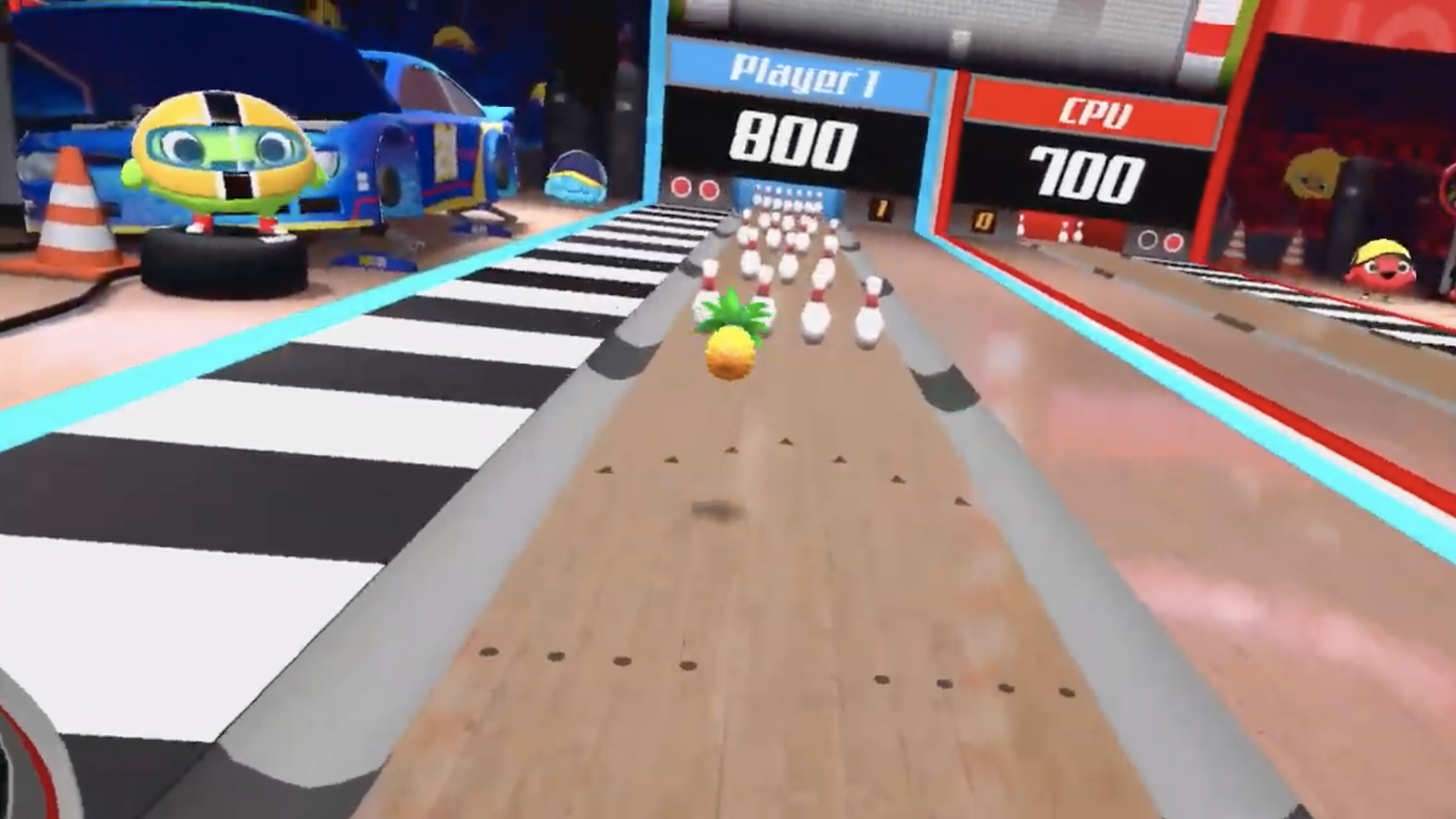
- Being a big sports fan, I also tried out Sports Scramble, which allows you to bowl using a basketball, pineapple and curling rock, among other objects, down lanes of varying textures. There are also mash-up versions of baseball and tennis within the game.
Entertainment: A number of standard streaming services are available in VR, along with more immersive options, such as YouTube VR and content custom designed for the headset. I watched a little Netflix. I also revisited an immersive music video from Beatie Wolfe, a friend and musician who specializes in bringing together music and technology.
Education: I decided I needed a little bit of culture, so I took a virtual tour of the Anne Frank House, along with watching part of the VR documentary Traveling While Black.
Travel: As someone who was a frequent flier before the pandemic, I do miss getting to see new parts of the world. I took the opportunity to use VR to travel to Costa Rica, a place that I haven't been (and still hope to one day).
Exercise: As in real life, this seems to come last on my list. I didn't get a chance to check out Supernatural, a new VR title that mixes some of the feel of Beat Saber with more of a workout.
5. Having meetings in VR
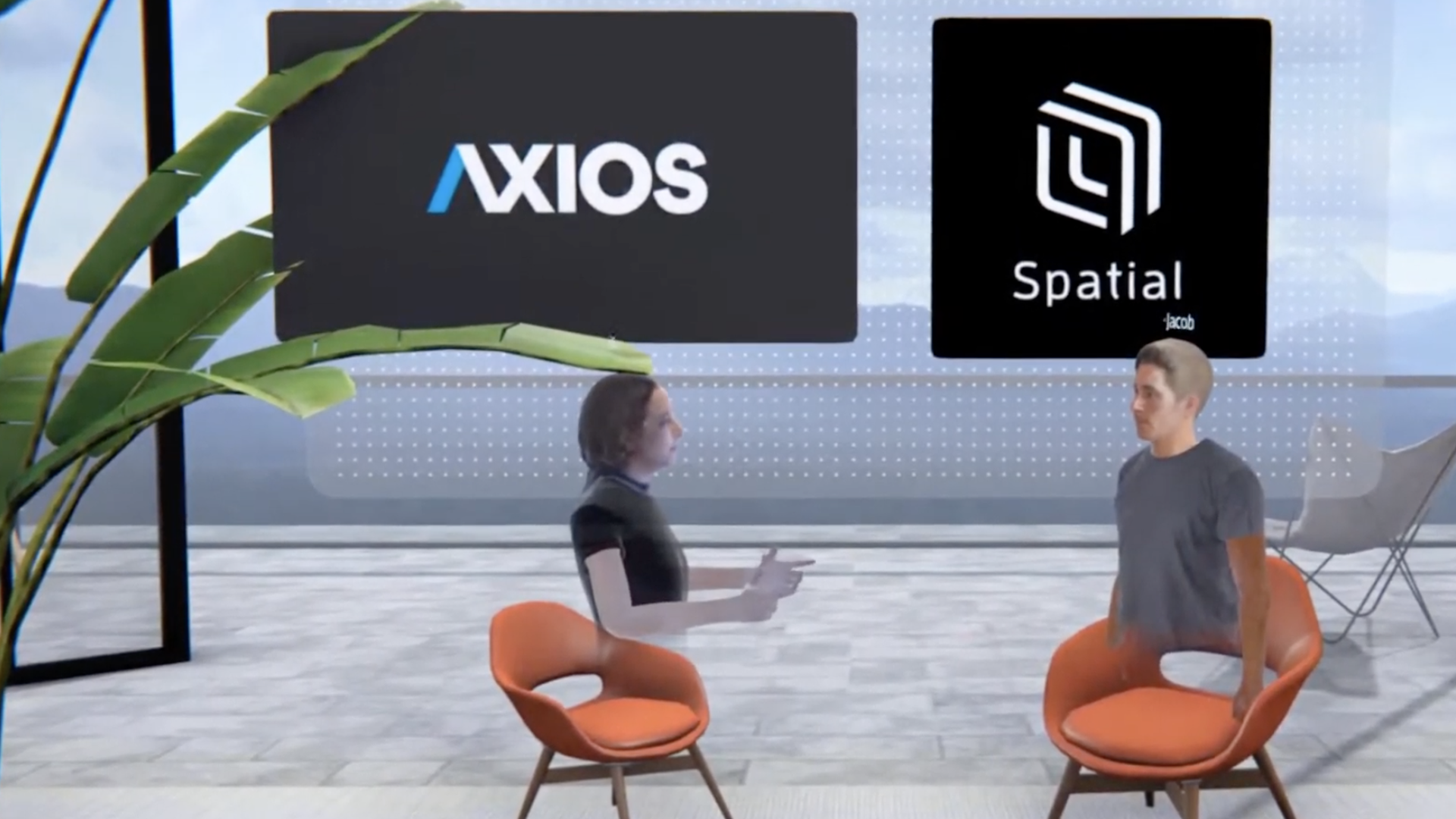
Spatial's Jacob Loewenstein speaks with Axios' Ina Fried, within Spatial's VR app. Screenshot: Axios
While two-dimensional video chat has become the standard for remote office meetings, a number of startups are working to bring that experience to VR.
Why it matters: VR has some advantages, including its immersiveness and the feeling of connection. However, as with other uses of VR, there are drawbacks, including challenges related to multitasking, or even taking notes.
Driving the news:
- Spaces VR, which builds destination VR attractions at theme parks, has pivoted and these days is focused on letting people join Zoom meetings from their VR headsets.
- Spatial, meanwhile, has its own VR environment that people can join from several types of VR and AR headsets. Today, Spatial is announcing the environment can also be reached from a standard PC or phone browser, albeit with a more limited set of controls. Spatial is also making its premium features, which it sells to businesses, free for the next several months so people can use it to ride out the pandemic.
My thought bubble: I recently tested out Spatial, and being able to meet via avatar was a nice change of pace from the usual square grid of a Zoom call. But other aspects of work remain tricky in VR, especially for a journalist trying to take notes during a meeting.
- Spatial has a cool voice dictation feature, but unfortunately everyone could hear me dictating, so it really wouldn't work for journalism, or even a worker wanting to take good meeting notes.
Yes, but: VR-based collaboration could yet have its moment in the next couple of years. Prior to the pandemic, there wasn't a compelling enough case, since people that needed to work closely together had better options.
- "COVID has thrown all this on its head," Spatial business chief Jacob Loewenstein said in an interview (conducted in VR). "No more travel. No more working in the same office."
Go deeper: You can watch a video of my full interview with Loewenstein, and see some additional highlights from my time in Spatial. Both are on YouTube — no headset required.
6. Take Note
On Tap
- Cisco is slated to report earnings after the markets close.
ICYMI
- Grammarly is taking an undisclosed stake in Docugami, the document automation startup by XML format pioneer Jean Paoli. (Grammarly)
- Apple, known for its in-the-office culture, is expected to return workers to campus sooner than many other Silicon Valley companies. (Bloomberg)
- At the other end of the spectrum, Twitter said Tuesday that most employees can work from home permanently, if they choose. (Axios)
- Facebook will pay $52 million to content moderators to help compensate for mental health issues created by their work. (Axios)
- Telegram is giving up on a blockchain project after the SEC challenged the legality of the company's initial coin offering. (The Verge)
- Chinese and Iranian hackers are aggressively targeting U.S. coronavirus vaccine researchers, possibly hampering their efforts. (Wall Street Journal)
- Uber has reportedly approached Grubhub with a takeover offer. (Axios)
- Amazon announced a set of upgrades to its Fire HD 8 tablet. (The Verge)
7. After you Login
There was a brief Slack outage on Tuesday evening, an event that got added attention since the app has become so central to this work-from-home era. Reactions varied, as some bemoaned the outage, some lampooned it and still others celebrated the chance to get a break from colleagues.