Axios Login

February 13, 2023

Congrats to Rihanna for winning the Super Bowl and the Kansas City Chiefs for defeating the Philadelphia Eagles in a highly entertaining pre- and post-concert football game.
💥1 big thing: Axios is hosting our second annual What's Next Summit on March 29 in Washington, D.C., spotlighting the innovations, trends and people that are breaking boundaries and shaping our world. Check out our speaker lineup and register to livestream the event here.
Today's Login is 1,209 words, a 5-minute read.
1 big thing: ChatGPT's edge is that we want to believe

Illustration: Natalie Peeples/Axios
ChatGPT rocketed into our world because of exponentially compounding advances in artificial intelligence programming — but also because of the primordial wiring of our brains, Axios' Scott Rosenberg writes.
How it works: Human perceptual systems are finely tuned to recognize another person, researchers have established, and we do this so well that we project humanity even when it's not there. Two dots and a circle become a face; the moon gets a man in it.
- We humanize elements of nature and abstract shapes — and conversations with computers, too.
We may understand that ChatGPT is code that doesn't know what words mean, yet can put one word after another in sequences that resemble human speech. But when we engage with it we inevitably slip into the comfortable feeling that we're communing with a fellow being.
Why it matters: Tech giants and startup companies want to deploy AI programs like ChatGPT into all facets of our work and lives, and they have a powerful ally in the evolution-forged pathways of human perception.
Flashback: It doesn't take a modern supercomputer to trigger this anthropomorphic response.
- In 1966 users who traded lines of text with Eliza, a pioneering chatbot created by MIT's Joseph Weizenbaum, readily imagined they were conversing with a human partner.
- Eliza gave users open-ended questions modeled on a therapist's prompts, and they began avidly sharing their feelings.
- Weizenbaum, whose family had fled Hitler's Germany, spent the rest of his career sounding alarms over the dangers of AI in the hands of powerful companies and governments.
The big picture: The so-called Eliza effect is part of what's propelling the hype wave for generative AI. It plugs into potent myths and images that we've built around AI itself, from its name to its representations in culture to the grand promises businesses are making for it.
- "Artificial intelligence" sounds so much grander than "large language model" or "machine-learning-trained algorithm." The label deliberately emphasizes open-ended possibilities and downplays limits.
A Google engineer named Blake Lemoine made headlines last year by declaring that he believed Google's ChatGPT-like LaMDA program had achieved "sentience."
- Skeptical experts, along with Lemoine's Google colleagues, argued this was just another instance of the Eliza effect.
- But the incident is likely to replay itself as millions of people start regularly interacting with programs like ChatGPT.
What's next: As ChatGPT-style computing spreads, we'll face more and more uncertainty online and in daily life over the nature of the entities sending words our way.
- Already, when we engage with a corporate help desk or customer service center via text or instant message, it's getting difficult to tell whether the typing at the other end is coming from a person or a bot.
2. Exclusive: Supply-chain info startup staffs up
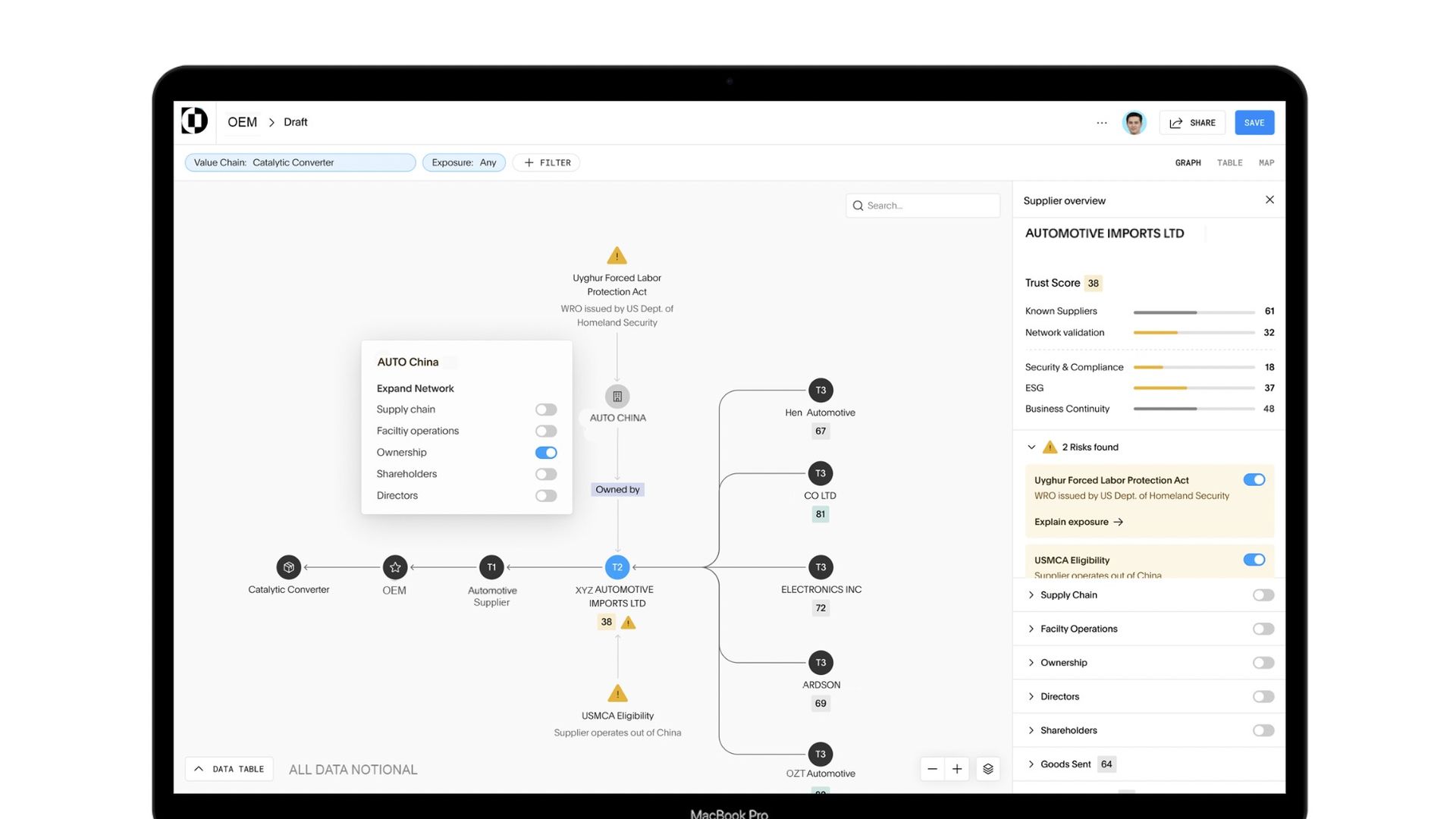
Image: Altana
After raising more than $115 million, New York startup Altana has made several key executive hires designed to advance its mission: mapping the world's supply chains.
Why it matters: Companies are paying a lot more attention to supply chains in a world disrupted by global pandemics, wars and climate change. Even so, many have little idea what is taking place beyond the first layer or two of their suppliers.
Details: The company's most recent hire is Jonathan Prince, who left Slack last week to become Altana's marketing chief.
Also joining in recent weeks are:
- Former Komodo Health executive Kathleen Ragelis as vice president of people;
- Coursera and LinkedIn veteran Shwetabh Mittal as vice president of product;
- and Aashish Patel as vice president of information security.
How it works: Altana provides a dynamic graph of the global supply chain fed by a mix of publicly available data and non-public supply chain data, in some cases providing visibility all the way from raw materials into finished products.
- Altana uses a federated learning approach, connecting to — and learning from — siloed, non-public customer data. Sensitive data remains on customers' computer systems, while the derived insights are shared across Altana's customer base.
- "We work with sophisticated organizations with very sensitive data, and all of our customers agree to this intellectual property framework," CEO Evan Smith told Axios. Publicly identified customers of Altana include shipping giant Maersk, UPS, Boston Scientific, Merck and the U.S. Customs and Border Protection Agency.
- Altana has 120 employees, three times its size a year ago, and more than 20 customers, Smith said.
The big picture: A better understanding of supply chains can help companies in a variety of ways, from preventing disruptions to adding redundancy to calculating environmental impact.
Between the lines: Altana uses a variety of incentives to convince companies to share their data. With its customs and border patrol partnership, for example, companies who share their supply chain data can help speed their shipments through inspections designed to bar the import of goods made using forced labor.
- In the future, sharing such information could give customers access to financial services, such as insurance against supply chain disruptions.
3. Layoffs take toll on tech's edgiest projects

Illustration: Sarah Grillo/Axios
The recent wave of tech layoffs has hit some of the industry's most innovative departments and projects particularly hard, Axios' Alex Fitzpatrick writes.
Why it matters: As tech companies tighten their belts, some of those working on their riskiest — yet most intriguing and futuristic — bets are first on the chopping block.
What's happening: Microsoft last week cut 10,000 jobs, including some from its HoloLens mixed reality team, Bloomberg reports.
- Those layoffs "throw into question whether the company will produce a third iteration" of the HoloLens headset, Bloomberg added. ("There are no changes to HoloLens 2 and our commitment to mixed reality," a Microsoft spokesperson told Axios.)
- Amazon's recent layoffs struck its robotics and drone delivery wings, CNBC reports, among other departments. ("Innovation is core to everything we do, and we remain excited about the progress we've made in robotics, drone delivery, and newer initiatives like Prime Video, Alexa, Grocery, Kuiper, Zoox, and Healthcare," Amazon spokesperson Brad Glasser told Axios.)
- Several of Alphabet's "Other Bets" have also undergone layoffs this year, per the Wall Street Journal, including Verily Life Sciences (a health care research organization) and Intrinsic (an AI and robotics software firm).
- Even Facebook parent Meta — which remains committed to bringing about its vision of a metaverse — is trimming headcount at the department responsible for that effort, Reality Labs.
Driving the news: Rising interest rates and other macroeconomic factors are forcing the world's biggest tech companies to rethink their approach of continually funding "moonshot" projects with uncertain returns.
- Instead, they're doubling down on proven projects, or those they view as surer short-term bets.
- And they're trimming jobs in part to please investors.
Yes, but: Layoffs don't necessarily mean the end of all these teams or projects.
Reality check: There's no guarantee any of the moonshot projects suffering cuts would have ever borne fruit, even with all the staffing in the world.
4. Take note
On Tap
- Palantir reports earnings after the markets close.
Trading Places
- The National Telecommunications and Information Administration has tapped Russ Hanser to lead its domestic internet policy, cybersecurity, and emerging tech portfolios and Amanda Toman to lead a new Public Wireless Supply Chain Innovation Fund.
ICYMI
- Some Google employees are criticizing the company for its rushed launch of Bard, its ChatGPT rival. (CNBC)
5. After you Login
Apparently I wasn't the only one who saw that Tubi ad in the Super Bowl and thought maybe dad sat on the remote.
Thanks to Scott Rosenberg and Peter Allen Clark for editing and Bryan McBournie for copy editing this newsletter.