Axios Login

October 26, 2022
Good morning and welcome to another busy day in tech.
Today's Login is 1,260-words, a 5-minute read.
1 big thing: Groups demand crackdown on midterm misinformation

Illustration: Sarah Grillo/Axios
There's a growing fear that political misinformation is spiraling out of control on social media two weeks before the U.S. midterm elections, Axios' Ashley Gold reports.
Driving the news: Activist groups are sounding the alarm on election-related dis- and misinformation, putting pressure on tech platforms to be more vigilant, per a letter to the CEOs of Meta, TikTok, Twitter and YouTube signed by more than 60 groups and shared exclusively with Axios.
- "[I]t remains painfully clear that social media companies are still failing to protect candidates, voters, and elected officials from disinformation, misogyny, racism, transphobia, and violence," the letter reads.
- It was signed by organizations focused on abortion rights, women's rights, LGBTQ rights, voting rights and tech accountability, including the National Organization of Women, GLAAD and the Global Justice Center.
- Concurrently, watchdog group Accountable Tech placed a $250,000 national television and digital ad buy starting this week, criticizing Meta for what the group describes as rolling back election integrity safeguards.
- And cybersecurity firm Recorded Future warned this month that both Russian and Chinese state-sponsored actors are likely to conduct "malign influence operations" targeting U.S. audiences to sway perceptions of the elections.
The big picture: Misinformation and inaccurate narratives perpetuated on both social and traditional media have plagued the past few elections.
- "There is so much pressure on the social media companies and yet they seem only responsive to a fraction of it," Jiore Craig, head of elections and digital integrity at the Institute for Strategic Dialogue (IDS), told Axios. "It is worthwhile to all of these groups to apply this pressure, as long as companies remain the only entities who can immediately impact this at scale, at any moment."
The intrigue: Platforms have largely gotten a handle on the type of foreign meddling seen in 2016. The misinformation landscape is now mostly driven by domestic forces.
- Heated rhetoric toward election workers and public officials has worsened, spurred by continued claims of Trump wrongfully losing the 2020 election, ISD researchers said in an October note.
- That includes calls for "vigilante" actions at places like ballot drop-boxes and polling locations, ISD researchers noted. Two people were seen last week lingering in tactical gear near a drop-box in Mesa, Arizona.
What's happening: The groups' letter demands platforms remove false information, hate speech, threats against candidates and election workers.
- Accountable Tech's ad buy accuses Meta of disbanding Facebook's Civic Integrity Team, cutting its election-focused staff and not seeing the safeguarding of elections as a priority.
- Meta has pushed back against claims that its elections-focused Civic Integrity team was disbanded. Guy Rosen, the company’s chief information security, said in a tweet that the Civic Integrity team was integrated into a more central team to do work across the company.
What they're saying: "We know what's possible when platforms don't act," Bridget Todd, communications director at Ultraviolet, the letter's organizer, told Axios.
- "The problem with platforms is that too often they are reactionary, when election dis- and misinformation can lead to real world violence and threats to democracy."
The other side: Many platforms have publicized their 2022 midterms strategy.
- TikTok launched an elections center in August, offering election and voting information. TikTok does not allow paid political advertising and has a policy against election misinformation.
- YouTube is prominently recommending authoritative news outlets when users search of midterms content, the company's vice president of government affairs Leslie Miller wrote in a September blog post. Miller said YouTube removes content that violates its policies against inciting violence, spreading misinformation or interfering with voting.
- Meta says it will provide links to official information about voting and the midterms and has a "dedicated team in place to combat election and voter interference," per an August blog post from president of global affairs Nick Clegg.
- Twitter activated its Civic Integrity Policy banning misleading information about elections, which includes placing labels on tweets with disputed information, for the 2022 midterms in August, the company said in a blog post.
2. Android users alerted before Calif. earthquake
Screenshot: MyShake
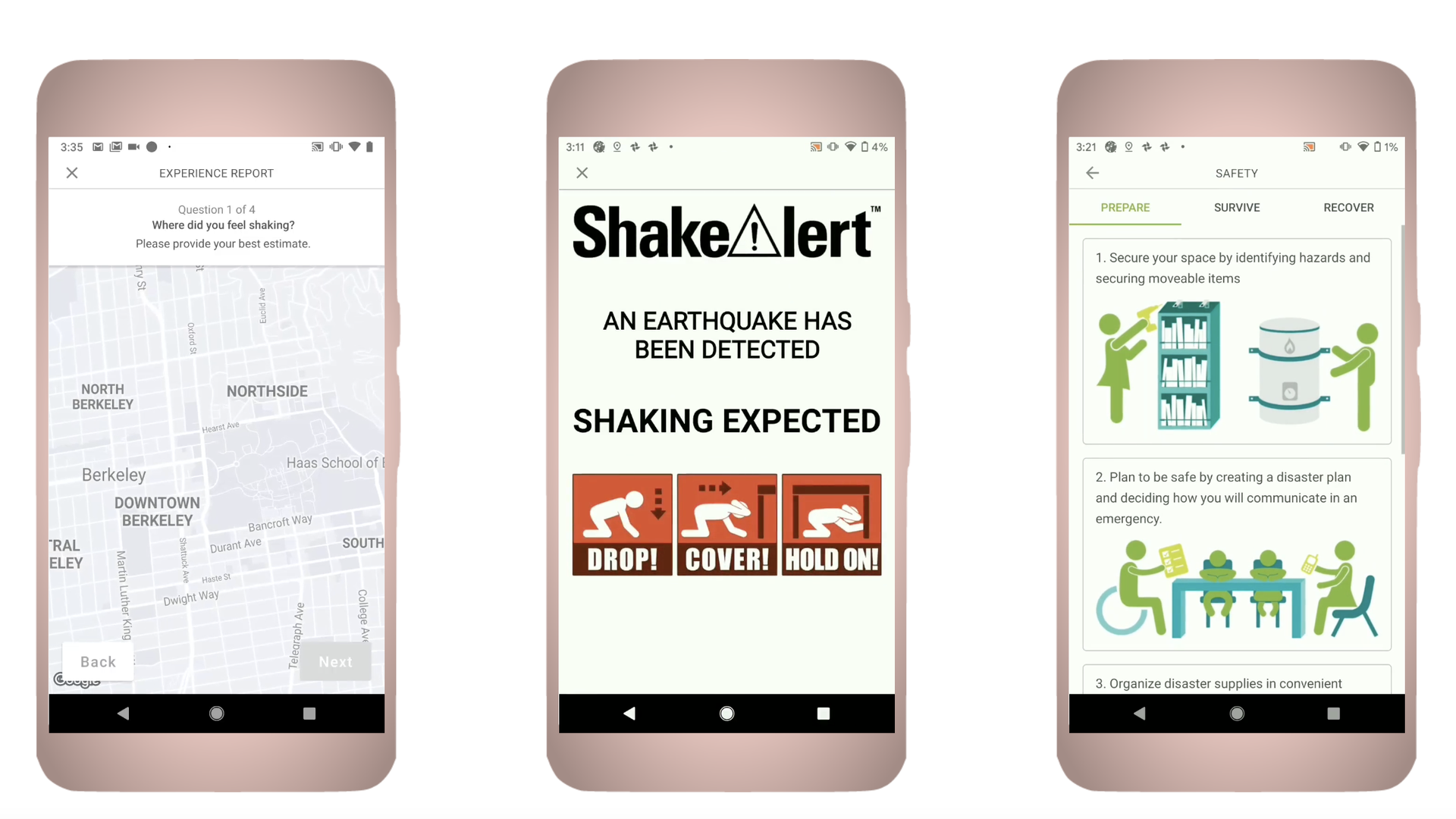
While many people in California felt a moderate earthquake Tuesday, some smartphone users actually got a heads-up before it happened thanks to technology developed at the University of California, Berkeley.
Why it matters: Android warned users just a few seconds before the quake, but experts hope the technology will eventually give people enough time to find shelter or to duck and cover.
How it works: Researchers at Berkeley released an app called MyShake that can offer a brief earthquake warning by detecting the signals of an earthquake just before they are felt. Think of it like how you can see lightning before you hear thunder.
- The app works on both iPhone and Android, but Google announced in 2020 it would implement Berkeley's technology directly into Android, allowing far more people to benefit.
As often happens after an earthquake, people turned to Twitter after the Magnitude 5.1 quake. But some reported getting the alert first.
- "Got the earthquake alert on my Android phone a few seconds before I felt it," Google's Dieter Bohn said in a tweet.
3. Microsoft sees PC slump continuing


Strong growth in its cloud business allowed Microsoft to narrowly top quarterly earnings estimates. However, the company warned that it saw a noteworthy drop in PC sales and ad spending in September and expects both trends to continue in the current quarter.
Why it matters: Microsoft offers a look into a wide swath of the economy, with its Xbox unit tied to consumer spending, Azure cloud and Office linked to business spending and its Bing business providing insight into online ad spending.
What they're saying: "In this environment, we're focused on helping our customers do more with less, while investing in secular growth areas and managing our cost structure in a disciplined way," Microsoft CEO Satya Nadella said in a statement.
The big picture: On a call with analysts, Microsoft CEO Satya Nadella said the company is focused on investing in places that either help customers do more with less or where it can help drive digital spending to grow as a percentage of GDP, all while keeping an eye on its own costs.
- Microsoft had a small number of layoffs last week, as we reported.
- Microsoft CFO Amy Hood also noted that the PC demand drop was particularly notable in September, as was a decline in ad spending.
- Hood said Microsoft expects those trends to continue into the current quarter, with PC demand materially weaker than it had been.
By the numbers:
- Revenue was $50.1 billion (up 11% year-over-year and it would have been up 16% had the dollar remained stable).
- Net income was $17.6 billion (down 14% year over year, 8% in constant currency).
- Cloud revenue was $25.7 billion (up 24% year-over-year and up 31% in constant currency). Notably, cloud revenue accounted for more than half of total sales.
- Windows revenue from new PC sales, meanwhile, was down 15% year-over-year.
- GitHub has reached $1 billion in annual recurring revenue.
Separately: Google parent Alphabet missed quarterly estimates amid a drop in YouTube ad sales, though it, too, saw strength in its cloud business.
4. Take note
On Tap
- Facebook parent Meta is slated to report earnings after the markets close.
Trading Places
- The Autonomous Vehicle Industry Association named Jeff Farrah as its first executive director. Farrah was previously general counsel for the National Venture Capital Association.
ICYMI
- Internal Twitter documents report that the social media network is struggling to keep "heavy tweeters" engaged on the platform. (Reuters)
5. After you Login
Our item yesterday on pro soccer players failing in VR reminded faithful Login reader David Eckstein of that time Anthrax guitarist Scott Ian failed at playing Guitar Hero to his own song.
Thanks to Peter Allen Clark for editing and Bryan McBournie for copy editing this newsletter.
Sign up for Axios Login

Taking you inside the AI revolution, and delivering scoops and insights on the technologies reshaping our lives.

