Axios Latino

Bienvenidos!
🙋🏽‍♀️ Our Ipsos-Axios poll of U.S. Latino adults is out today, and we've got some interesting tidbits for you below.
🪅 Thanks for joining us, and please don't forget to submit your pachanga nomination by replying to this email!
👀 En español 👀
This newsletter, edited by Astrid Galván, is 1,406 words, a 5-minute read.
1 big thing: Biden-Trump gap narrows
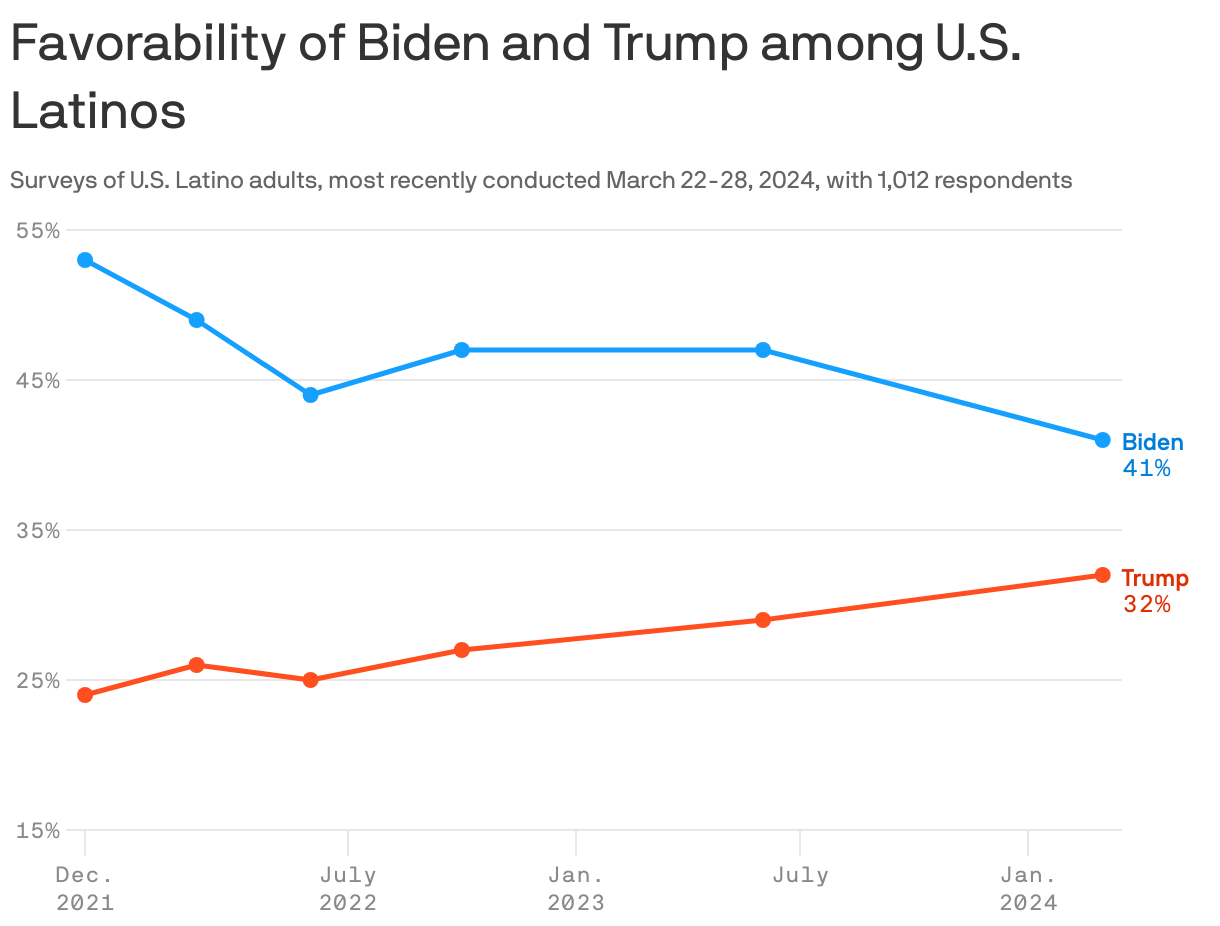
U.S. Latinos have steadily soured on President Biden while warming to former President Trump — even as they still widely back Democrats over Republicans, Russell writes off the latest Axios-Ipsos Latino Poll in partnership with Noticias Telemundo.
The big picture: A 29-point lead Biden held over Trump in favorability after his first year as president has eroded to 9 percentage points amid frustrations over inflation and crime.
Why it matters: Latino turnout — and candidate choice — could be decisive, especially in the battleground states of Arizona and Nevada. Voters choose individual candidates for president, not just political parties.
- "In almost every case, Trump performs better than the Republican brand and Biden or performs worse than the Democratic brand," says Ipsos pollster and senior vice president Chris Jackson.
- Latinos represent one of the nation's fastest-growing demographics.
By the numbers: A significant share of the overall respondents will not be eligible to vote in November. But of those who said they are registered to vote or expect to register in time, 31% said they planned to vote for Biden and 28% for Trump.
- Another 11% said they expect to vote for someone else and 28% said they were unsure. The poll did not ask specifically about independent candidate Robert Kennedy, Jr., who is seeking to get on the ballot in many states.
- Overall, 41% of Latinos surveyed said they had a favorable opinion of Biden, down from 53% in December 2021. 32% said they had a favorable opinion of Trump, up from 24% in December 2021.
- Respondents said they felt neither Biden (70%) nor Trump (66%) should be their party's nominee.
What they're saying: Latino Democratic leaders aren't reaching out enough to promote Biden's accomplishments, Houston-based Democratic political consultant Marc Campos tells Axios. "He helped create all these jobs. I still don't see that story being told to Latinos."
- Alex Veras, a GOP activist in Massachusetts, said Republicans could be doing better among Latinos if they bothered to do more voter outreach.
- "Trump is not going to be here forever, so this bump will be short-term," Veras said. "When he's gone, Republicans are going to be in trouble."
2. Even citizens fear Trump's mass deportations
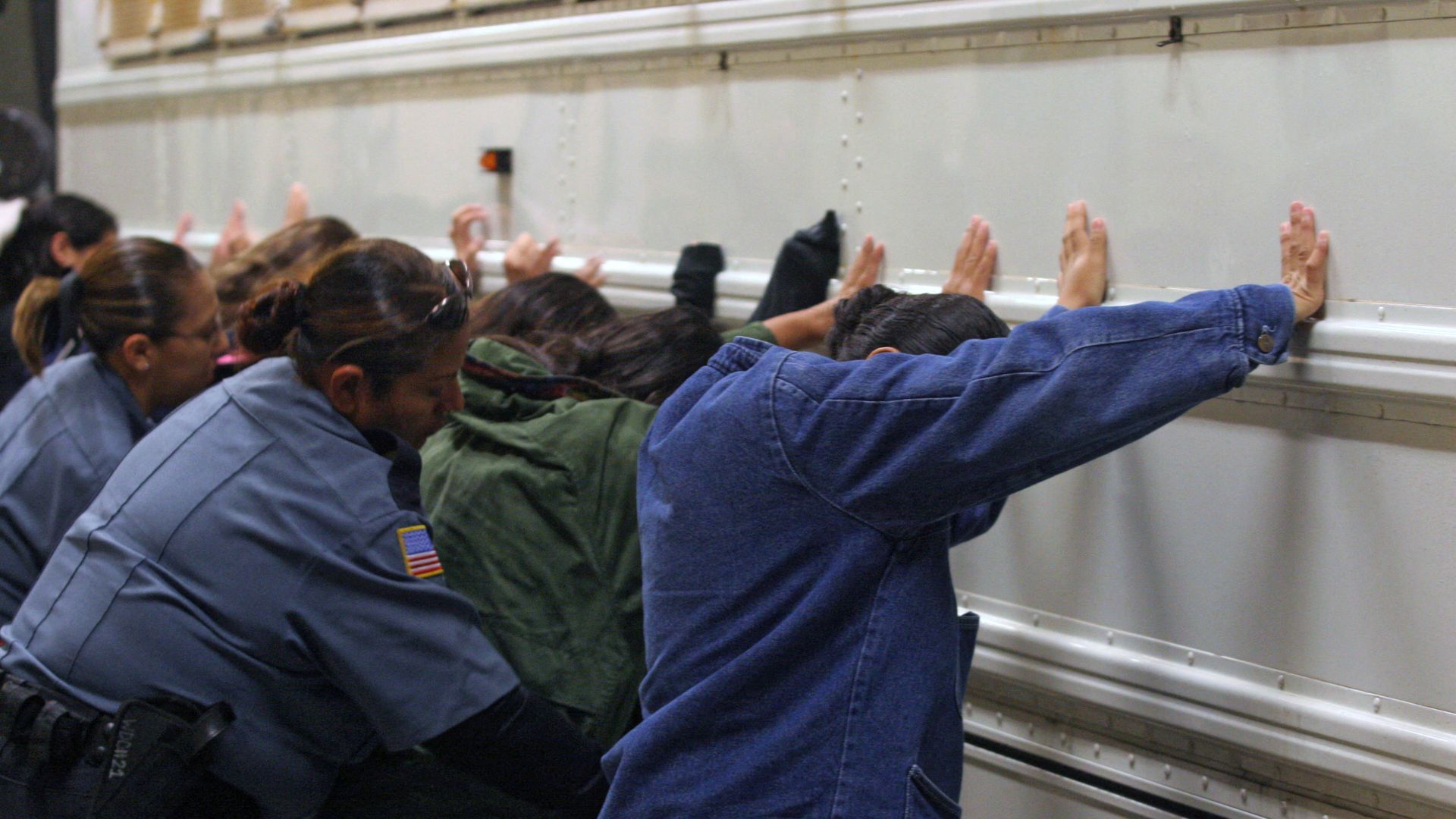
Salvadoran immigrants at Willacy Detention facility in Raymondville, Texas, are searched on Dec. 18, 2008 before being deported. Photo: Jose Cabezas/AFP via Getty Images
More than half of U.S. Latino adults worry any new mass deportations would target all Latinos regardless of legal status, Russell writes.
Why it matters: Former President Trump has promised mass deportations if he wins a second term, and past efforts have swept up U.S. citizens, creating generations of trauma.
By the numbers: 54% of Mexicans and Mexican Americans — the targets of mass deportations in the 20th Century — said they worried that any new mass deportation plan would target all Latinos, including U.S. citizens and lawful residents.
- 65% of Central Americans, who have been targets in recent deportations, said the same.
- So did 47% of Puerto Ricans — who are all U.S. citizens — and 37% of Cuban Americans, who have benefited from decades of Cold War-era "special treatment" and what some scholars say are unique immigration privileges.
- Overall, 52% of Latinos surveyed said they worry that all Latinos will be targets of the mass deportation of undocumented immigrants.
Catch up quick: Trump's plan to crack down on immigrants includes using a range of tools to deport millions of people, including obscure laws and military funds.
- Trump wants to mobilize ICE agents — along with the FBI, the Drug Enforcement Administration, federal prosecutors, the National Guard, and even state and local law enforcement officers — to carry out deportations, Axios previously reported.
- Fast-track deportations — now reserved for recent crossers encountered near the border — would be expanded to apply to anyone who illegally crossed the border and couldn't prove they'd been living in the U.S. for more than two years.
Flashback: State and local governments during the Great Depression "repatriation" pressured Mexicans and Mexican Americans to "return" to Mexico amid high unemployment in the U.S. and violent anti-Mexican sentiment. About a million people, most of whom were coerced, left.
- The Eisenhower-era "Operation Wetback" used military-style tactics to round up 1.3 million Mexicans and Mexican Americans across the country in the 1950s for the-then largest deportation operation in U.S. history. "Wetback" is a racial slur for Mexicans.
- Both mass deportations snatched up American citizens, including a future World War II hero and Holocaust survivor who had been racially profiled.
3. Latino support for Israel-Hamas ceasefire
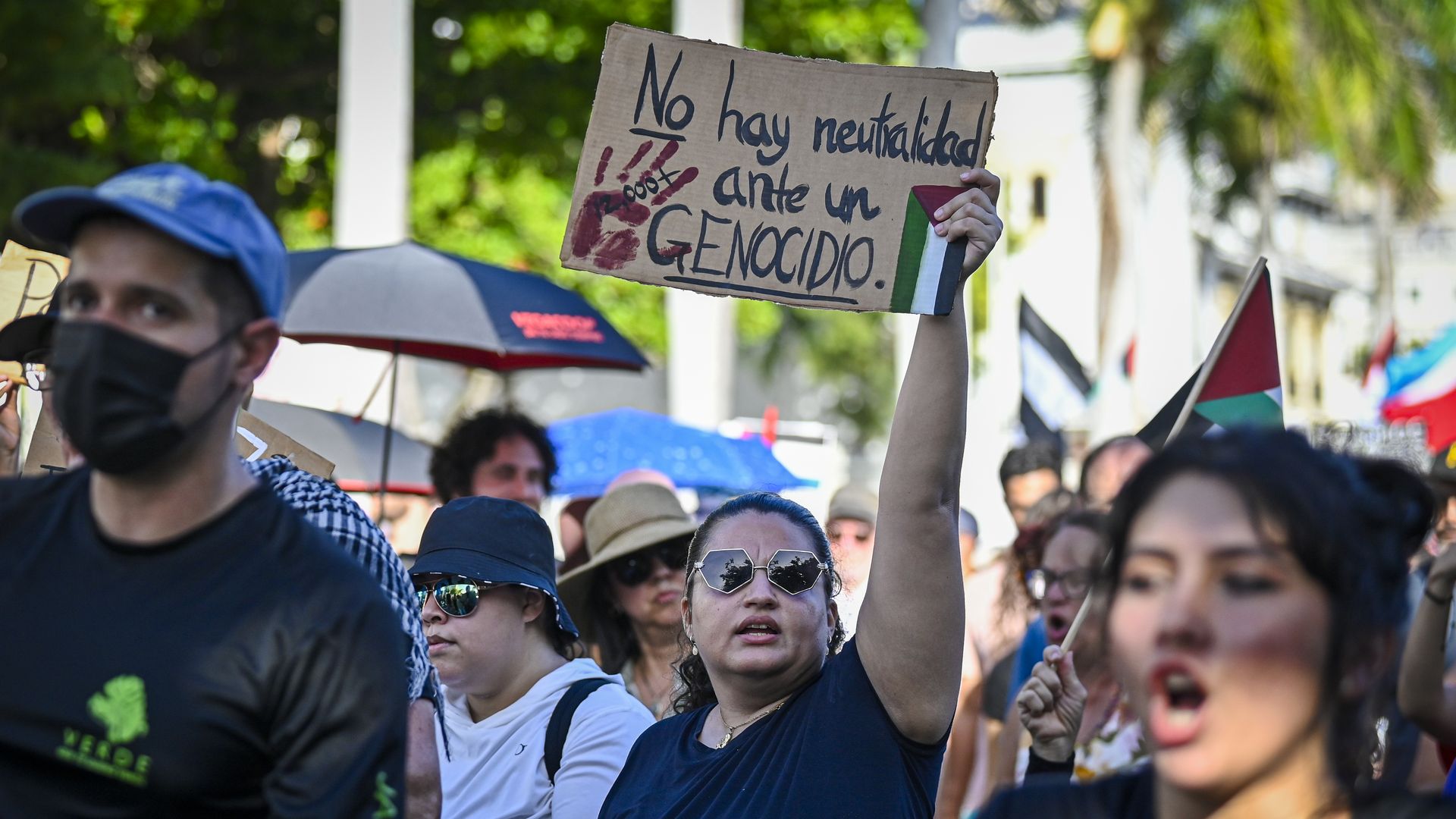
Pro-Palestine supporters rally in San Juan, Puerto Rico, on Nov. 12, 2023. Photo: Miguel J. RodrĂguez Carrillo/VIEWpress via Getty Images
Forty percent of Latino adults say the U.S. should push for an immediate ceasefire in the Israel-Hamas war, Astrid writes.
Why it matters: Latinos are part of a multi-ethnic coalition that President Biden needs to win re-election, and his support of Israel has become a vulnerability.
By the numbers: Just 16% of respondents said the U.S. should continue to support Israel with arms and funds.
- 39% said the U.S. should not be involved in the conflict.
What they're saying: Colorado state Rep. Tim Hernández, a Democrat who has been advocating for a ceasefire, says the support many Latinos show for Palestinians is driven by "a fundamental opposition to oppression."
- Hernández adds that many Latinos, especially young ones, are a driving force behind many of the nationwide protests and movements calling for a ceasefire.
- "I think it's really kind of emblematic of the way that Latinos are really expressing deep solidarity throughout many progressive movements in the U.S. right now."
Zoom in: Graciela I. Sánchez, director of the Esperanza Peace and Justice Center in San Antonio, says her organization has for years supported Palestinian causes.
- Many Latinos — especially those informed by the political oppression that gave rise to the Chicano/a movement and by civil wars in Central America — "have a perspective that's broader than just what's happening today," Sánchez says.
- Sánchez adds that the Israel-Hamas war has galvanized Latino youths in a way she'd never seen before.
- Many Puerto Ricans see the Palestinian cause as a familiar fight against colonialism.
The other side: Many Hispanics — in particular evangelical Christians — have expressed support for Israel.
- Dozens of Hispanic Christian leaders earlier this year signed a letter in support of Israel in the war.
4. Stories we're watching
Illustration: Natalie Peeples/Axios
1. Mexico yesterday said it filed a case against Ecuador in the International Criminal Court, arguing authorities violated international law when they stormed the Mexican embassy in Quito this weekend to arrest former Ecuadorian Vice President Jorge Glas.
- Glas, who previously served time in prison for a corruption conviction but was being charged again, was in the process of being granted political asylum at the embassy.
- Ecuador said its fight against crime should take precedence over global agreements on diplomatic relations.
- But nations across the Americas and the European Union condemned the unprecedented actions.
2. A court in Panama yesterday began trying 27 people on charges related to the Panama Papers scandal.
- The defendants include JĂĽrgen Mossack and RamĂłn Fonseca Mora, partners of the law firm at the center of the scandal who both deny illicit activity.
- The Panamanian attorney's office says it has thousands of pages worth of evidence and will ask for the maximum prison sentence of 12 years.
- The Panama Papers scandal broke in 2016, after hundreds of journalists from different countries analyzed leaked documents about undeclared offshore accounts and tax havens.
5.🌑 Smile to go: Hunting down totality

A father and son who dub themselves eclipse hunters were among those who enjoyed the totality view of yesterday's solar eclipse, Marina writes.
What's happening: In Burlington, Vermont, yesterday, the father, Félix Guzmán, said he'd seen two full solar eclipses in his life. The other was in 2017, though he didn't say where he watched that one.
- "Not everyone has the luck and the joy of experiencing this," he told Noticias Telemundo.
- The U.S. won't get a full solar eclipse again until 2044.
Russell is asking his journalism students to ask other students what they did during the eclipse.
Marina is re-reading "Tortuoso Arado" by Itamar Vieira Jr., as the English translation ("Crooked Plow") made it onto the International Booker Prize shortlist today.
🌑 Astrid was tending to a sick kid while working, so she missed the eclipse yesterday, womp womp.
Many thanks to Carlos Cunha, Alison Snyder and Axios Visuals for their many contributions!
Sign up for Axios Latino

Keep tabs on the stories that most affect the U.S. Latino community on both sides of the border, a collaboration with Noticias Telemundo.