Axios Hill Leaders

February 04, 2026

Buckle up for a newsy one. Tonight's edition is 1,268 words, 5 minutes.
- 📺 "Extremely rare" TV trial
- 🧊 What's next on the ICE fight
- ⚠️ Scoop: GOP's Maine warning
Situational awareness: Sen. Mitch McConnell (R-Ky.) was hospitalized last night after "experiencing flu-like symptoms" over the weekend, a spokesperson confirmed in a statement to us. "His prognosis is positive," the spokesperson added.
1 big thing: 📺 "Extremely rare" TV trial

The House Ethics Committee is poised to hold a rare public hearing on March 5 to consider charges of financial misconduct against Rep. Sheila Cherfilus-McCormick (D-Fla.), we have learned.
Why it matters: A public meeting of any kind is highly unusual for the secretive panel, which hasn't held a televised disciplinary hearing in nearly 15 years.
- As Cherfilus-McCormick's chief of staff Naomie Pierre-Louis put it to us: "Public ethics trials are extremely rare."
📺 The late Rep. Charlie Rangel (D-N.Y.) was the last House member to face a public hearing in 2010 over allegations of tax evasion.
- C-SPAN also broadcast hearings in 2002 (for former Rep. Jim Traficant), 1997 (for former Speaker Newt Gingrich) and 1989 (for former Speaker Jim Wright).
Driving the news: An investigative subcommittee of the Ethics panel released a 59-page report last week detailing a litany of financial misconduct allegations against Cherfilus-McCormick, most notably that she illegally funneled $5 million in taxpayer funds to her campaign.
- Cherfilus-McCormick rejects the findings of the report — along with the criminal charges filed against her for alleged money laundering — saying she lacked a "fair opportunity" to rebut them due to her ongoing legal battle.
- The panel is taking the unusual step of convening a separate "adjudicatory subcommittee" to "determine whether any counts in the [report] have been proved by clear and convincing evidence."
- Unlike typical Ethics Committee meetings, adjudicatory hearings are subject to House rules that require panels to meet in open session unless they specifically vote otherwise.
Zoom in: House Minority Leader Hakeem Jeffries, asked about a possible expulsion vote this week, stressed that Cherfilus-McCormick is "entitled to the presumption of innocence" and said he was a "'hard no' as it relates to the effort to expel her."
- Rep. Greg Steube (R-Fla.) opted not to force a vote this week under pressure from Republican leadership, who wanted to give the measure the best chance of obtaining the Democratic votes needed.
- Expulsion requires a two-thirds majority to pass, and Democrats have made clear they wouldn't vote to expel Cherfilus-McCormick at least until the Ethics Committee finishes its process.
The intrigue: Even the Ethics Committee's most high-profile investigations in recent years have not featured a televised hearing.
- That includes the truncated case of former Rep. George Santos (R-N.Y.), who was expelled from Congress in 2023 after an Ethics report accused him of a "complex web of unlawful activity."
- At the time, House Speaker Mike Johnson called the House vote to expel Santos "a regrettable day," arguing that Santos did not receive due process. Santos had been under indictment, but he had not yet been convicted.
What they're saying: "That hearing is generally an open hearing unless there is a request [by the defendant] to close it," Rep. Michael Guest (R-Miss.), the chair of the Ethics Committee, told us.
- "No decision has been made on whether the hearing will be closed at this point."
The other side: Pierre-Louis, asked if Cherfilus-McCormick has requested a closed hearing, told us, "We're letting the process do its thing."
- "If they open it, it's a decision they would have made on their own," she added, noting the matter "has not been decided."
— Andrew Solender and Kate Santaliz
2. 🧊 What's next on the ICE fight
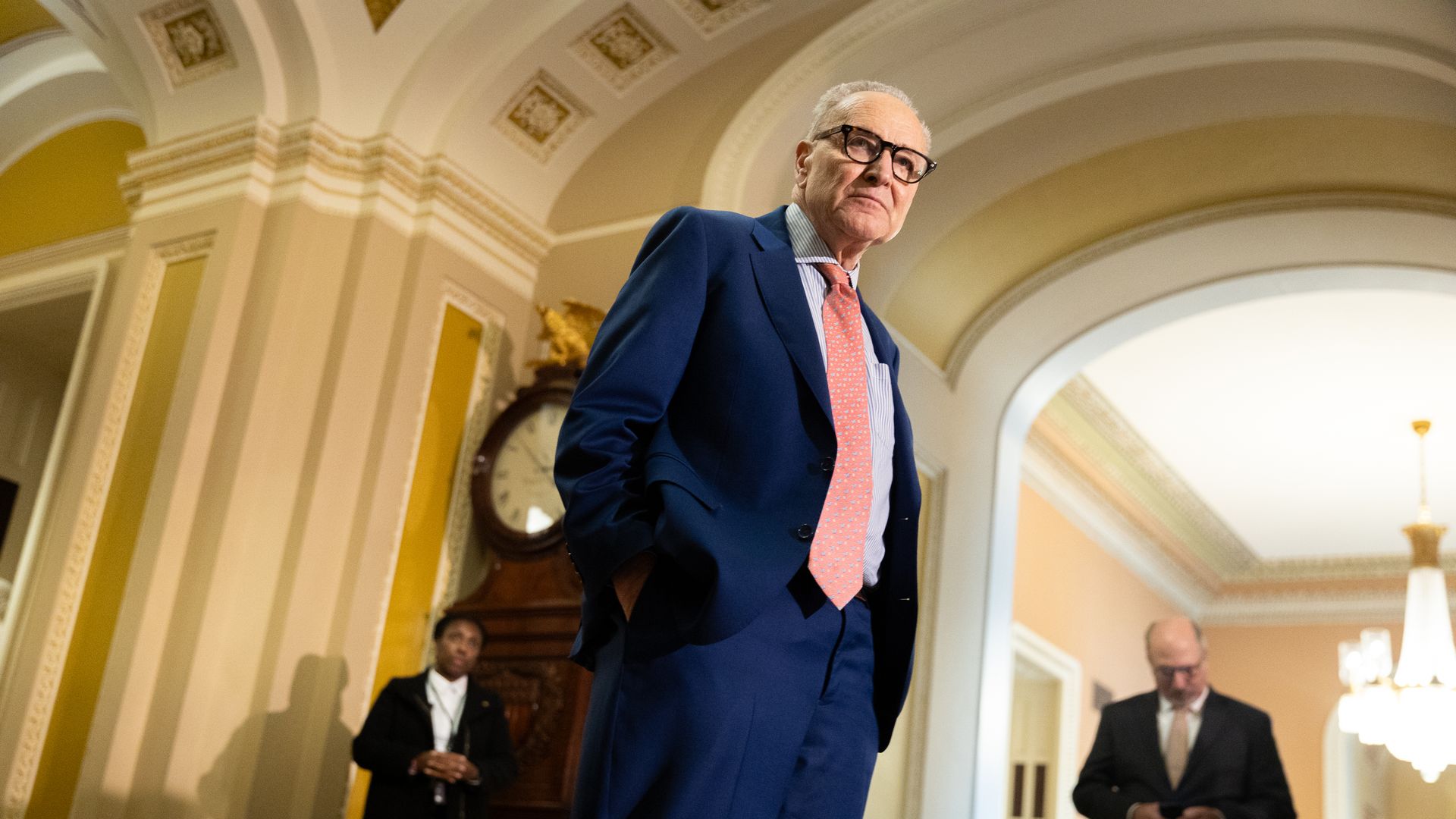
Optimism for the prospects of a bipartisan deal to reform ICE in just 10 winter days was in short supply in the Senate today.
Why it matters: Another shutdown for the Department of Homeland Security hangs in the balance.
- "We had a great meeting, and we both agree the Republicans got to get their act together," Senate Minority Leader Chuck Schumer told reporters after meeting with Jeffries.
- Democrats are "waiting for Republicans to take this seriously and give us a path forward," said Sen. Chris Murphy (D-Conn.).
Driving the news: After taking a victory lap on funding 96% of the government, Senate Majority Leader John Thune is outsourcing most of the negotiations over DHS to the White House.
- But he is also laying down clear parameters on what will have a difficult time passing the Senate.
- Alabama's "Katie Britt will lead that on our side, but ultimately, that's going to be a conversation between the president of the United States and the Democrats here in the Senate," Thune told reporters.
- "What I hope it doesn't devolve into is something that makes it harder, not easier, to deport and detain dangerous illegal aliens in this country."
The intrigue: Top Democrats in the House and Senate today indicated that another short-term funding package for DHS is off the table.
- Sen. Chris Van Hollen (D-Md.) floated a possible off-ramp to make the fight just about ICE.
- If Republicans don't agree to changes demanded by Democrats, then lawmakers should separate out funding for agencies like TSA, Coast Guard and FEMA to continue negotiations over ICE reforms, he told us.
The bottom line: "If people were committed to getting it done, there would be time," Sen. Jeanne Shaheen (D-N.H.) said.
- "It would help if they would start negotiating."
— Hans Nichols and Stephen Neukam
3. ⚠️ Scoop: GOP's Maine warning
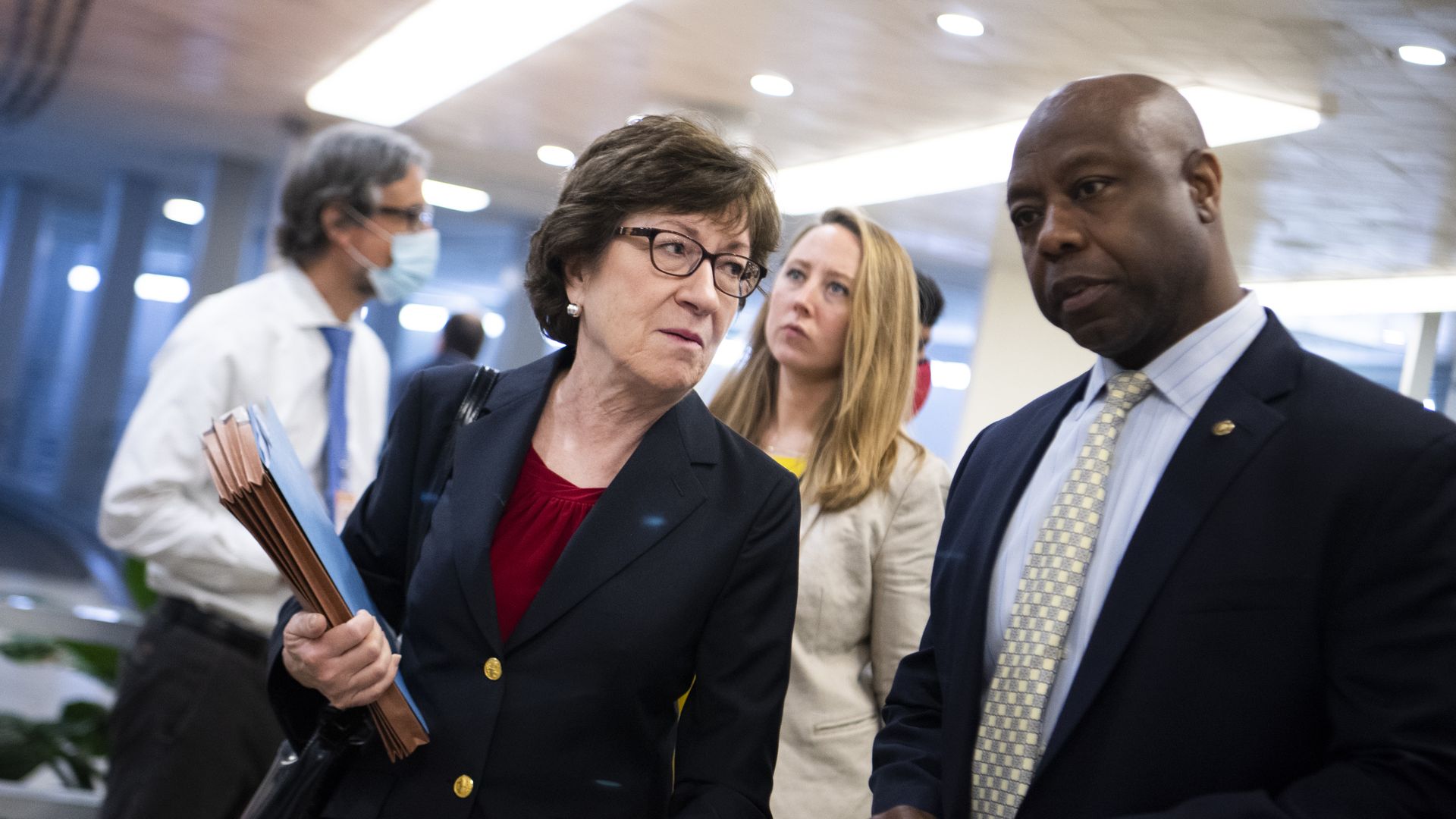
NRSC chair Sen. Tim Scott (R-S.C.) delivered a sobering message to his GOP colleagues today at a closed-door, off-campus briefing on how Democrats' six-point lead on the generic ballot could translate into individual midterm Senate races.
- The slides showed the GOP's toughest challenge, based on the generic ballot, is in Maine, where Sen. Susan Collins (R-Maine) is running for a sixth term.
Why it matters: Republicans have long suspected that the national environment for their party could be challenging in November.
- But today, they were formally put on notice — and forced to confront what a GOP drag could mean for their majority.
- "We've got some headwinds," said a person who attended the briefing.
- But the analysis painted a rosier picture in Texas and South Carolina.
What we're watching: Scott explained how Republican candidates could still prevail in November if they emphasize the tax cuts in the One Big, Beautiful Bill Act and focus on affordability issues.
- Scott also urged his colleagues to attack Democrats for not supporting the party's signature tax legislation.
Flashback: Scott isn't averse to giving his party some tough talk. Last April, he warned his colleagues that Democrats were on track to trounce them in the money game.
- Republican committees outraised their Democratic counterparts in 2025.
Zoom out: After the lunch, Thune, responding to a question about Democratic over-performance in a Texas state election over the weekend, said his party needed to do a better job selling its legislative accomplishments.
- "I think what happened in Texas should capture our attention and remind us that we need to up our game and do a better job," Thune said.
- "If you look at what we've accomplished in the last year, it's a terrific record."
Zoom in: Brendan Jaspers, the NRSC's political director, shared polling showing GOP Sen. John Cornyn would comfortably win a general election in Texas if he emerges from a contested three-person primary, as we reported yesterday.
- Jaspers also warned that if Cornyn were not the nominee, the party could be forced to spend hundreds of millions of dollars defending the solidly Republican seat, draining resources from other competitive races and potential pickup opportunities.
— Alex Isenstadt and Hans Nichols
This newsletter was edited by Justin Green and copy edited by Kathie Bozanich.
Sign up for Axios Hill Leaders