Axios Generate

March 25, 2024
๐๐พโโ๏ธHappy Monday, which everyone knows are for winners.
- All the energy/environment news that's fit to print, at 1,201 words, 4.5 minutes.
๐จ Situational awareness: Your regular authors Ben and Andrew are off this week โ meaning I, (Generate's trusty editor, Javier) will be stepping into the breach. There's a first time for everything.
- Like well-behaved children, the best editors should be rarely seen and never heard; nonetheless, yours truly will pinch-hit through Friday. Here's to hoping I don't break anything ... or tick you off too much.
๐บ๐พ In keeping with Ben's song-of-the-day theme, here's my walk-on song of choice ...
1 big thing: Biden's industrial carbon offensive

Illustration: Shoshana Gordon/Axios
The Energy Department plans to award up to $6 billion across 33 projects to wring carbon dioxide from heavy industries like metals, chemicals, and cement, Ben writes.
Why it matters: It's the "single largest industrial decarbonization investment in American history," DOE boss Jennifer Granholm told reporters.
- Industrial processes create roughly a fourth of U.S. CO2 emissions โ and even close to a third โ depending on how you slice the national pie.
- It's also the Biden administration's latest in a multi-pronged effort to tame domestic carbon emissions.
State of play: The projects are funded largely through the Democrats' 2022 climate law, with some cash from the 2021 bipartisan infrastructure law, too.
- They would together provide yearly emissions cuts that match the annual CO2 output of 3 million gasoline-powered cars, the agency estimates.
- It's a federal cost-share with companies, so officials see over $20 billion in total investment.
- Today's announcement also touts efforts to use union labor andย tackle environmental justice โ both key Democratic policy priorities.
The big picture: Making heavy industries climate-friendly is a tough nut to crack, as these sectors often need massive energy inputs and extremely high heat.
- And unlike the electricity system, a similarly large CO2 source, solutions are often lacking at commercial scale.
Zoom in: Examples of the 33 projects include:
- Converting a Constellium aluminum plant in West Virginia to use furnaces that can run on cleaner fuels including hydrogen.
- Installing a CO2 capture and storage system at a Heidelberg Materials cement plant in Indiana.
- Slashing process heat emissions from Kraft Heinz facilities in nine states by using various electrification technologies.
Yes, but: These are initial decisions subject to more grant negotiations.
- And if funded, a project faces "go/no-go" decision points at various phases, where the agency weighs progress and community benefits.
What's next: Officials hope this spurs use of cleaner tech in these industries more widely โ in the U.S. and worldwide.
- "The solutions that we are funding are replicable, and they're scalable," Granholm said.
2. Bonus: charting industrial emissions
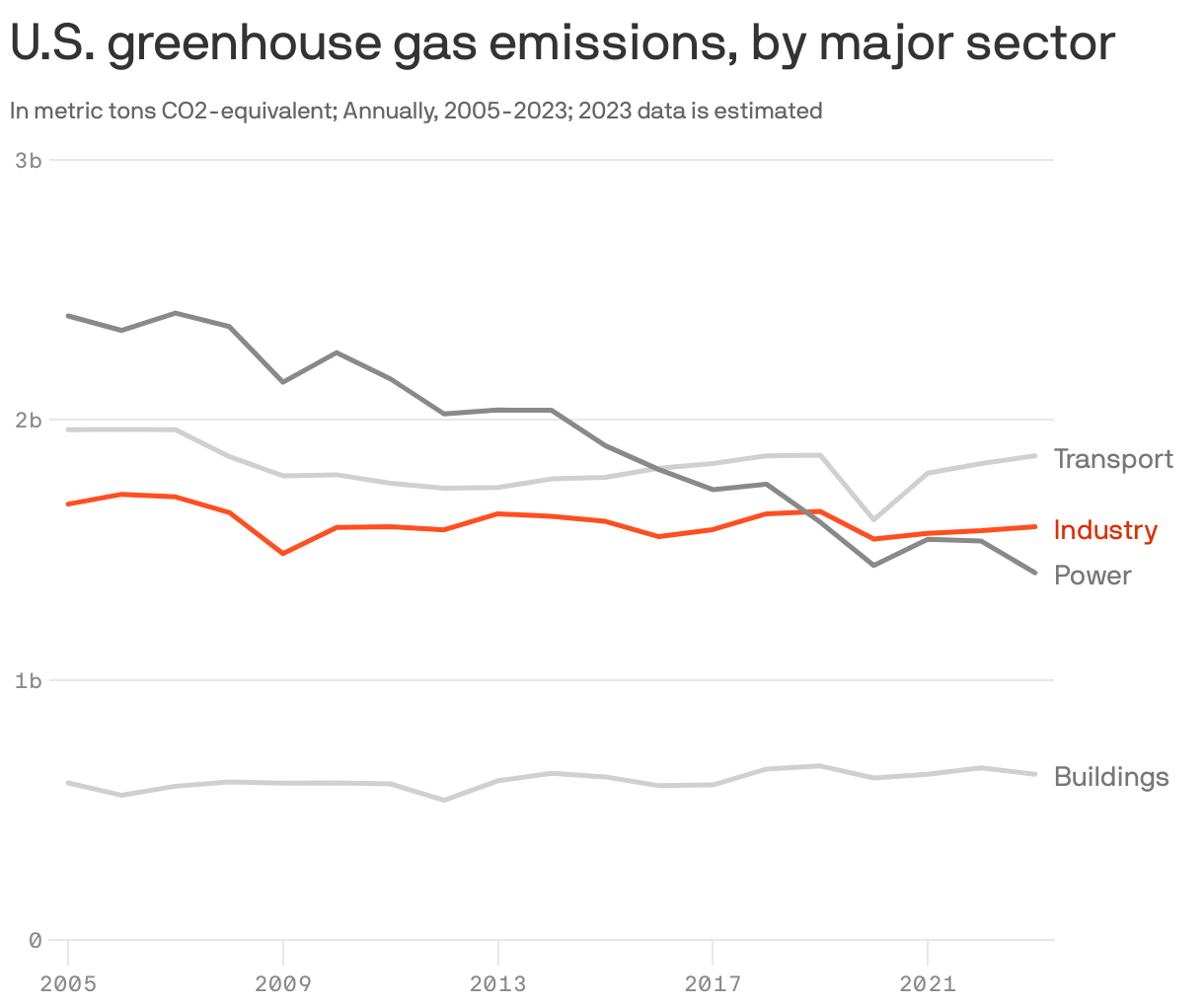
This graphic underscores why cutting industrial CO2 is so critical to wider U.S. climate goals, Ben writes.
3. The era of "Climateflation" is here
Illustration: Shoshana Gordon/Axios
It may be time to add human-caused climate change to the list of factors likely to worsen inflation, Andrew writes.
Why it matters: Published in Communications: Earth and Environment on March 21, the data suggests climate change is rippling through entire economies, instead of affecting the availability or price of particular goods.
Zoom in: Increasing average temperatures, more intense and frequent heat waves and other factors are already driving up the prices of food and other goods worldwide, the study shows.
- These trends are likely to worsen through 2035, the researchers from the Potsdam Institute for Climate Impact Research and the European Central Bank, concluded.
- The study shows that food inflation could increase by as much as 3 percentage points per year in the next decade due to "climateflation," while overall inflation climbs by between 0.3 percentage points per year to about 1.2 percentage points per year.
- Some of the biggest inflation increases overall are likely to be seen in warmer countries, the study finds.
- And during the summer months, extratropical regions, such as the U.S. and Europe, are vulnerable to more sudden inflation increases from extreme heat events. This was seen in Europe during its record-hot summer of 2022.
What they found: The study underlines the finding, also shown in many other studies, that climate change is getting increasingly costly.
Context: This is not the first study to note the economic toll of climate change, or even the inflationary pressures of increasing temperatures and extreme weather events.
- But it is extremely detailed and answers key questions that had not yet been addressed, including how the relationship between climate change and inflation may play out in the coming decades.
What they're saying: "'Climateflation' is all too real, and the numbers are striking," said Gernot Wagner, a climate economist at Columbia Business School who was not involved in the study.
- "The key bit this study shows: Climateflation does not just affect food prices, its effects reverberate through to core inflation numbers," he told Axios via email, pointing to the over 1% increase in overall inflation.
- "That 1% alone โ or even the study's lower bound of 0.3% โ is enormous," Wagner said, pointing to the Fed's goal of stabilizing inflation at 2%.
4. And miles to go before I sleep...

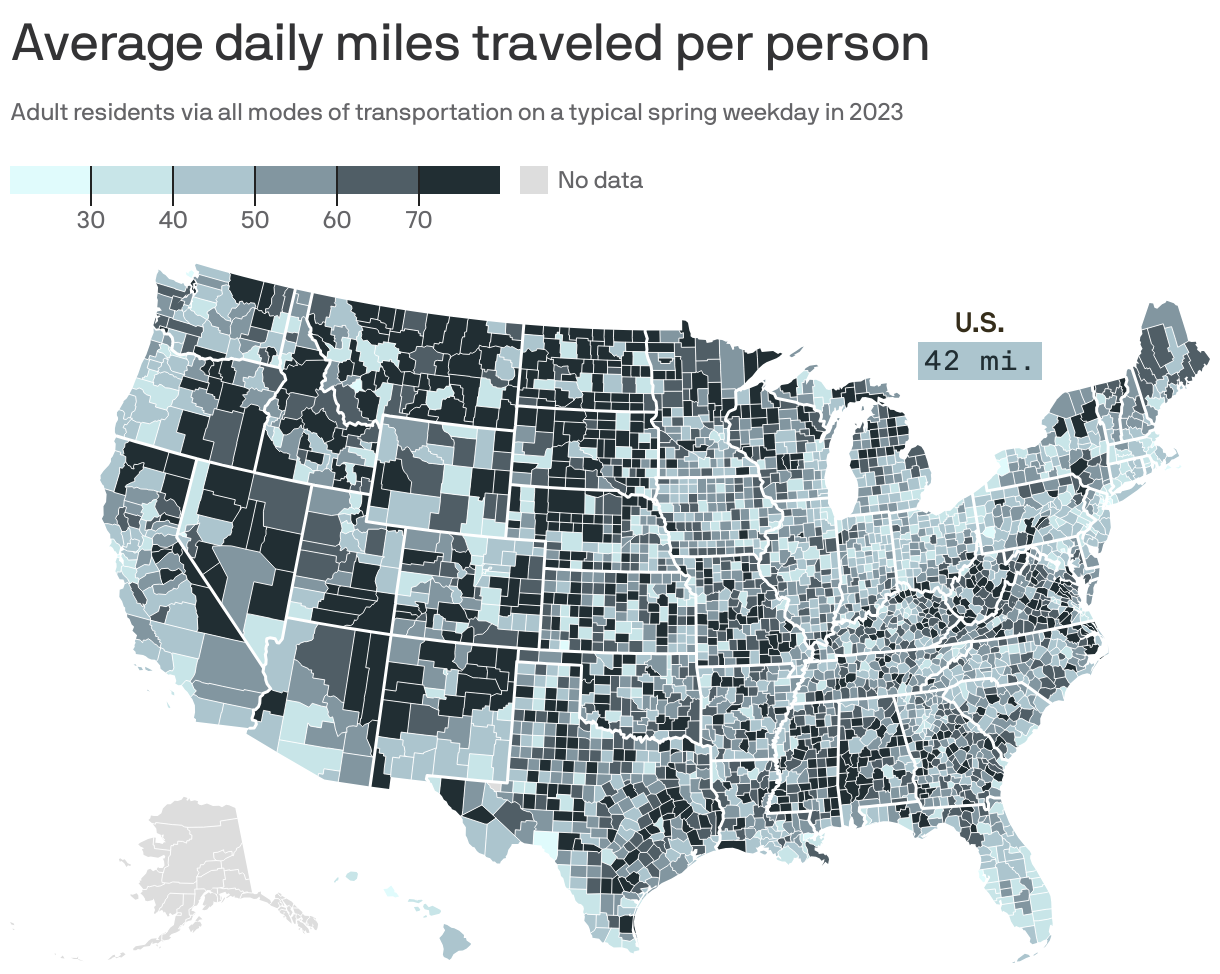
People in the U.S. travel a nationwide average of 42 daily miles, Axios' Alex Fitzpatrick and Alice Feng write.
Driving the news: Those findings come from mobility analytics platform Replica, which is based on anonymized mobile device info, roadside sensors, transit agencies and more.
- Residents in Monroe County, Pennsylvania (70 miles), Coconino County, Arizona (68.6), and Parker County, Texas (66.7) travel the most daily miles per person among counties with more than 100,000 residents.
Yes, but: New York City accounts for all three counties with the lowest number of daily miles traveled โ no surprise there, given the area's density.
- It's 12.9 miles for New York County (Manhattan), 15.5 for Kings County (Brooklyn) and 16.6 for Bronx County.
Why it matters: These numbers offer a compelling snapshot of differing mobility trends and needs across the country.
- The data can also help policymakers, transit advocates and others figure out what transportation solutions or changes make the most sense for their communities.
How it works: Replica's estimates are based on a typical spring weekday in 2023.
- They factor in all forms of transportation, including personal vehicles, public transportation, taxis/rideshares, walking, and biking.
5. Catch up quick

Illustration: Lindsey Bailey/Axios
๐ต LanzaTech Global and Technip Energies are in talks to receive up to $200 million in DOE funding as part of the broad $6 billion in decarbonization money announced this morning by the Biden administration, Javier writes.
- State of play: Called SECURE โ short for Sustainable Ethylene from CO2 Utilization with Renewable Energy โ the joint LanzaTech-Technip project was first announced last July and utilizes captured carbon dioxide.
โ๏ธ Chinese EV maker BYD is slashing prices on virtually all of its electric and hybrid models, part of an aggressive effort to undermine big automakers like Toyota and Volkswagen, Bloomberg reports.
- Why it matters: Slumping EV sales and a fierce price war are hammering sector leader Tesla. BYD's move, which affects over 100 of its models, shows the company is taking the fight to other auto companies active in China's EV market.
- Via Bloomberg: "โฆBYD's all-out price cuts are aimed at persuading drivers to ditch their gasoline cars and go electric, while also seeking to win customers in smaller cities and rural areas who previously couldn't afford an EV."
โก๏ธ Japan's largest power company is weighing a team-up with ExxonMobil to develop a low-carbon hydrogen and ammonia project in the U.S., according to Reuters.
- Driving the news: Last September, Exxon announced a $2 billion expansion of a chemical production unit in Baytown, Texas. If a deal is completed, JERA may invest in the project and buy around 500,000 tons of low-carbon ammonia, the report notes.
6. Quote of the day
"Alaska is the solution to all of America's [energy] problems ... if we can get the permitting straightened out."โ Gov. Mike Dunleavy, expounding on the state's energy bounty at CERAWeek in Houston, and his problems with federal resource development policy.
๐ฌ Did a friend send you this newsletter? Welcome, please sign up.
๐ Thanks to Chris Speckhard and Javier E. David for edits to today's edition, along with the brilliant Axios Visuals team.
Sign up for Axios Generate

Untangle the energy industryโs biggest news stories