
Axios Generate

December 12, 2024

β Thursday. We've got an expansive but quick tour of the landscape, with 1,064 words, 4 minutes.
π¨ Situational awareness: Google plans to buy 200,000 tons of CO2 removal credits from Terradot and announced an equity investment in the startup.
- Why it matters: The tech giant called it the largest removal deal yet for "enhanced rock weathering" β that is, speeding up CO2 uptake in minerals. Bloomberg has more.
π₯ Happy birthday to drummer-singer-songwriter (and frequent Prince collaborator) Sheila E., who has today's intro tune...
1 big thing: U.S., Europe look to break China's grip on key minerals
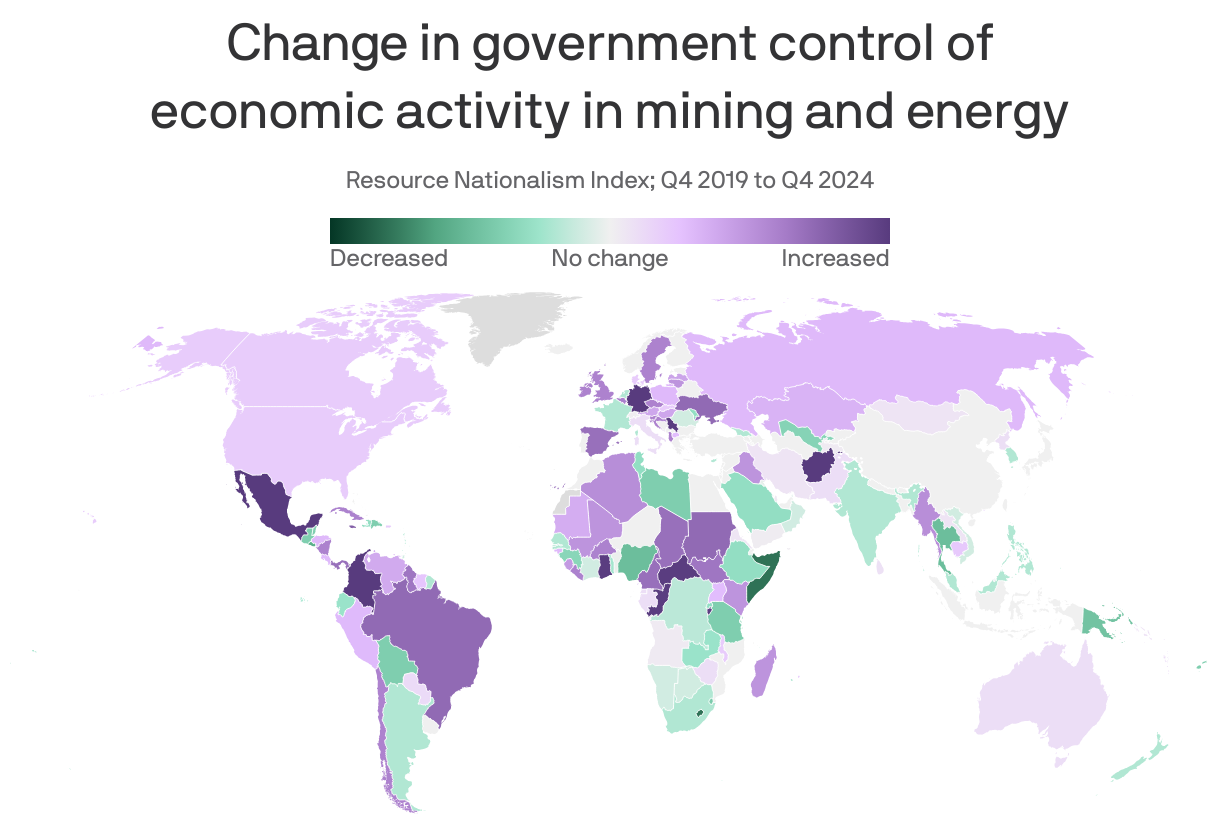
New analysis puts fresh data behind a major global trend: Rising resource protectionism β especially with minerals needed for clean energy and defense tech.
Why it matters: The U.S. and European nations are looking to shore up supply chains and erode China's dominance.
- But there may be tradeoffs between greater control on one hand, and the cost and speed of climate tech deployment on the other.
π’ Driving the news: "Geopolitics are fueling a dual rise in state intervention and protectionism at levels not seen since the first half of the 20th century in Western democracies," risk intel firm Verisk Maplecroft's report finds.
- Its "Resource Nationalism Index" β which tracks energy and minerals in 198 countries β finds that 72 saw a "significant increase" in the last five years.
π€Ί Friction point: The "driving force" is European and North American governments "looking to safeguard their access to critical resources amid mounting national security concerns," they find.
- But the trend spanning producers and buyers is much wider, as you can see above.
- It all creates a "complex risk landscape for investors," Verisk notes.
The big picture: "The fracturing geopolitical landscape and the fallout from major shocks like the pandemic and Russia's invasion of Ukraine have spurred an acceleration of policies aimed at acquiring the minerals needed to power the tech and defence industries, as well as the green transition to bolster energy security," chief analyst Jimena Blanco said in a statement.
β½ State of play: Members of the House China committee yesterday unveiled three bipartisan bills aimed at bolstering friendly mineral supply chains, my Axios Pro: Energy Policy colleagues report.
- They're markers for the next Congress on domestic mineral production and countering Chinese influence in the global industry.
- One of them would let the Interior secretary enter into agreements with foreign governments on mineral supply chains.
Catch up quick: U.S.-China resource tensions are already high.
- China this month barred shipment of certain minerals to the U.S. β including some with energy uses.
- It came in response to new Commerce Department export controls on chip manufacturing equipment, software tools and more that officials said have advanced weapons and military AI uses.
- And just yesterday Biden trade officials announced higher tariffs in Chinese solar wafers, polysilicon and tungsten.
π What we're watching: What happens when Donald Trump enters the chat.
- He wants to scale back the IRA, which is stuffed with funding and provisions that encourage domestic and ally-heavy supply chains.
- OTOH he's very keen on tariffs and promoting U.S. resource extraction projects.
2. π¨ Breaking: New endeavor eyes Pentagon electrified flight

Defense contractor Anduril Industries and Archer Aviation are developing a hybrid-power vertical takeoff and landing aircraft that they hope wins the Pentagon's favor.
Why it matters: Climate change concerns, fuel-hauling challenges and battlefield advantages are pushing the U.S. military closer to alternative power sources for its arsenal.
- The in-the-works M1E3 Abrams tank, for example, will be the Army's first hybrid-electric combat vehicle, according to service leadership.
Driving the news: Archer, a prominent electric flight startup, today also announced a $430 million equity capital raise for this plan and its wider corporate development.
- Participants in this equity round include United Airlines, Stellantis, Wellington Management and Abu Dhabi's 2PointZero.
Zoom in: Anduril and Archer were cagey about sharing aircraft details. But Archer CEO Adam Goldstein told Axios, "You can imagine things that helicopters do are the things that we're building toward."
- Archer's work on the project falls under its new defense division led by Sikorsky alum Joseph Pantalone.
- The company this summer delivered its Midnight aircraft to the Air Force for evaluation under the Agility Prime program.
The big picture: The companies said the project will combine Archer's aircraft development experience with Anduril's expertise in AI, autonomy and more.
Catch up quick: Anduril is on a partnering spree, linking up with Microsoft, OpenAI, Palantir Technologies, Impulse Space, Apex Space and FlackTek in recent weeks.
What we're watching: Specifics about the envisioned aircraft, which are in short supply now.
Go deeper: In remote Texas, Anduril probes future of drone warfare
3. π° Bonus tech finance notes: Microsoft and trucks
βοΈ Acadia Infrastructure Capital is teaming up with Microsoft β and others in the future β to spur development of at least 5GW of renewables projects over the next five years.
- Why it matters: The just-launched Climate and Communities Investment Coalition is looking to attract fresh capital with an eye on community benefits.
- The big picture: Acadia tells Reuters it's looking to develop a $9 billion pipeline of projects across the country.
π EPA has tentatively selected dozens of applicants nationwide to receive a combined $735 million to buy over 2,400 zero-emissions heavy-duty vehicles.
- Why it matters: Replacing large trucks and buses that run on diesel helps cut CO2 and air pollution that worsens respiratory and cardiovascular health.
- State of play: Examples include over $35 million for Boston Public Schools and $10.5 million for Oakland's port department to replace 60 delivery trucks and provide charging.
4. π Catch up quick on oil and gas: supply and sanctions
π The oil market is expected to be "comfortably" supplied in 2025 despite OPEC+ delaying production hikes and slowing their planned phase-in, the International Energy Agency said.
- Why it matters: The latest monthly analysis highlights the hurdles facing the group, even though IEA slightly raised their 2025 demand growth forecast. Reuters has more.
βοΈ Via Bloomberg, "Treasury Secretary Janet Yellen said that a softer global oil market might create an opportunity for further action against Russia's energy sector, as the US continues its efforts to impair Moscow's ability [to] wage war against Ukraine."
5. π© Term of the day: "Peak steel"
/2024/12/11/1733958054247.gif?w=3840)
It's "likely" that global steel demand has already peaked, HSBC analysts said in a note.
Why it matters: Steel industry CO2 accounts for 8% of total energy system emissions, per IEA estimates.
State of play: "China has a large property sector overhang and there are concerns about manufacturing overcapacity too," HSBC finds.
- Growing demand in emerging economies is unlikely to fully offset China's path, they estimate.
- And the energy transition is putting greater focus on recycled steel.
What's next: "Over 30% of steel is produced through recycling scrap, and this share is likely to increase over time, weighing on new steel demand," it writes.
6. π’οΈQuote du jour
"I don't think the Saudis are going to love this presentation."β Oil analyst Paul Sankey, quoted in the FT about Exxon revealing plans to boost production by roughly one-fifth this decade
π¨ Did a friend, colleague or even a frenemy send you this newsletter? Welcome, please sign up.
π Thanks to Chris Speckhard and Chuck McCutcheon for edits to today's edition, along with the brilliant Axios Visuals team.
Sign up for Axios Generate