Axios Generate

April 25, 2023

🕺 Let's do this! There's a lot happening — big battery news, a Capitol Hill exclusive and more — but today's newsletter still has a Smart Brevity count of just 1,281 words, 5 minutes.
🚨 President Biden this morning announced he's running for reelection, setting up a 2024 clash over his energy and climate policies.
🎶 At this moment in 2007, Timbaland (feat. Nelly Furtado & Justin Timberlake) were #1 on Billboard's Hot 100 with today's intro tune ...
1 big thing: Major VCs link arms in new climate push

Illustration: Natalie Peeples/Axios
Big names in the venture capital world are launching a first-of-its-kind group to ensure startups begin life on a climate-friendly pathway — and stay that way as they scale, Ben writes.
Driving the news: The new Venture Climate Alliance is designed to align firms' portfolios with a "net zero" emissions future, and help individual companies they finance do the same.
- The group's membership already includes roughly two dozen VC firms in the U.S. and Europe.
- Among them: Prelude Ventures, Capricorn Investment Group, DCVC, Energy Impact Partners, Fifth Wall, and S2G Ventures, to name a few.
Why it matters: It fills a void. Existing efforts bring large companies and industries — banks, for instance — together around "net zero" goals and charting their progress.
- But small, venture-backed companies eventually become big ones. The collective impact of products, services and tech they provide other industries will matter a lot.
How it works: The VCA will help provide venture firms and their portfolio companies with methods and resources to analyze and report not only their own emissions, but climate impact more broadly.
- The group is a project of Rockefeller Philanthropy Advisors.
The big picture: Prelude Ventures principal Alexandra Harbour said the goal is to "bridge the gap" between startups and climate targets already common among large public companies.
- Early stage innovation "has the potential to decarbonize legacy industries through a combination of better products, more efficient processes, and lower costs," said Harbour, the VCA chair and co-founder, in a statement.
What they're saying: Daniel Firger of Great Circle Capital Advisors, notes big Fortune 500 companies have plenty of staff and money to analyze their climate effects and hire consultants.
- "Startups don't have that luxury. Budgets are tight. Bandwidth is really constrained," Firger, who is advising the new group that he helped launch, tells Axios.
- "So providing ... support for those portfolio companies and founders is very much of a vision for what the VCA will help members to do."
The bottom line: "Venture [capital] has a lot to contribute to the conversation," Harbour tells Axios.
- "And we have a fiduciary duty to our LPs and to our portfolio companies to prepare them for exiting into a market environment in 2030, 2040, 2050 that looks fundamentally different than it does today."
2. California's "Big Melt" to accelerate during heat wave
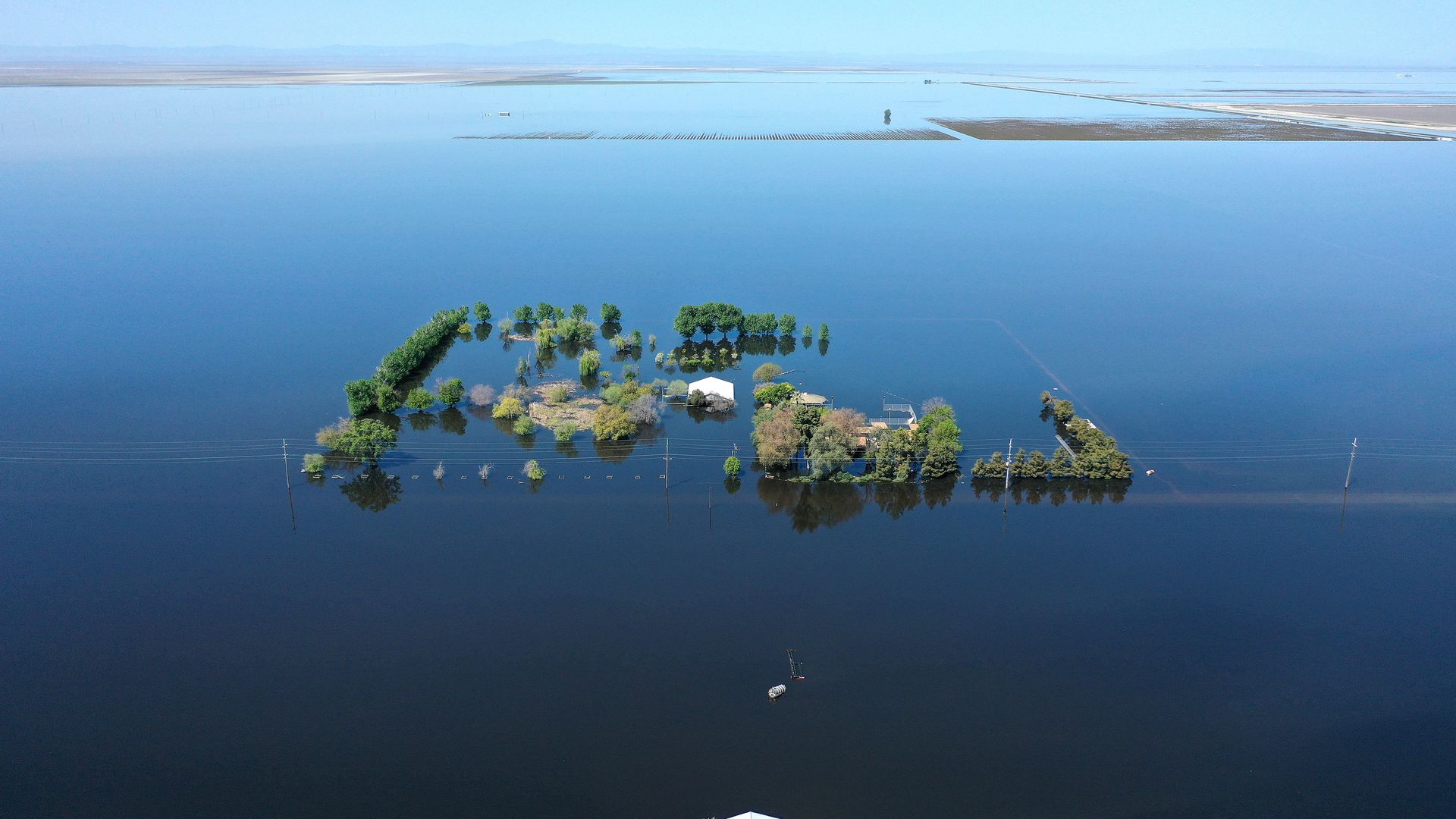
An aerial view of a home surrounded by floodwaters in the reemerging Tulare Lake, on April 14 in Corcoran, Calif. Photo: Mario Tama/Getty Images
The first heat wave of the spring is on tap in California this week, accelerating the “Big Melt” of the state’s record mountain snowpack, Axios' Rebecca Falconer and Andrew write.
Why it matters: The near-record warm weather, which is forecast to last through the weekend, will bring a surge of meltwater into the state's rivers and reservoir system during this period.
Threat level: The greatest flood risk may be in the San Joaquin Valley, where the Southern Sierras drain.
- These mountains currently have the thickest snowpack compared to normal, with an average snow water equivalent that was 322% of average as of Monday.
- Snowmelt from here will flow into the San Joaquin River, testing the levees under prolonged periods of stress.
Zoom in: Tulare Lake, which was once the largest freshwater lake west of the Mississippi River, is refilling after being drained in the 1920s to make way for farm lands.
- It is poised to grow, threatening communities.
What they’re saying: "This week is really going to be our first substantial increase in that snowmelt throughout the state and especially in that San Joaquin southern part of the Central California Central Valley," Benjamin Hatchett, a meteorologist at the Desert Research Institute in Reno, Nevada, told Axios.
3. GM, Hyundai unveil billions of dollars in U.S. battery plans

Illustration: Aïda Amer/Axios
The expanding U.S. "battery belt" is getting even more notches, major announcements this morning reveal, Ben writes.
Driving the news: GM and Korea's Samsung SDI this morning said they're investing $3 billion-plus in a new U.S. battery manufacturing plant.
- The location of the factory slated to begin operations in 2026 was not disclosed.
- Separately, Korea's Hyundai Motor Group and SK On announced a $5 billion venture to build a large battery plant in Georgia.
- It will produce enough batteries annually to power 300,000 EVs, they said.
Why it matters: The plans bolster what's already a surge of battery investments as companies expand EV production and manufacturers tap incentives in the U.S. climate law.
4. 👀 First look: Top GOP lawmaker weighs Kerry subpoena

U.S. special climate envoy John Kerry at a virtual meeting of the Major Economies Forum (MEF) on Energy and Climate on April 20, 2023, in Washington, DC. Photo: Drew Angerer/Getty Images.
House Oversight and Accountability Committee chairman James Comer signaled he's prepared to subpoena special climate envoy John Kerry's office, if it doesn't cough up documents he's seeking, Ben writes.
Driving the news: In a new letter to Secretary of State Antony Blinken, Comer, re-ups document demands, arguing the Biden administration has long "refused" to provide info.
- If they don't comply, the panel "will have to consider other means, including compulsory process."
Why it matters: It's an escalation of GOP efforts to learn more about the work of Kerry, the former secretary of State who's occupying a powerful position within the Biden administration as a climate super-diplomat.
Zoom in: The letter seeks a range of documents on budgets, communications with outside governments and advocacy groups, and much more by May 9.
The big picture: The letter attacks Kerry's work alongside the demand for documents.
- It alleges Kerry's activities "skirt congressional authority, threaten foreign policy under the guise of climate advocacy, and could undermine our economic health."
The other side: Kerry's has been working to corral more aggressive climate commitments from other countries — including China, the world's largest emitter — and the private sector.
- Administration officials, including Kerry, emphasize that failing to stem global emissions will bring damaging economic consequences.
Bonus policy notes: Pipelines and solar
👍 Energy Secretary Jennifer Granholm is backing the long-proposed Mountain Valley Pipeline (MVP), a natural gas project that's a major priority for Democratic Sen. Joe Manchin of West Virginia, Ben writes.
- Driving the news: Projects like MVP "can help ensure the reliable delivery of energy that heats homes and businesses, and powers electric generators that support the reliability of the electric system," she wrote in a letter to the Federal Energy Regulatory Commission.
🖋️ President Biden vowed to veto House legislation that would quickly impose suspended tariffs on solar panel imports from several southeast Asian nations.
- Catch up fast: Biden announced the reprieve last June amid a Commerce Department probe into whether Chinese companies were doing an end-run around import duties.
- Why it matters: The House is slated to vote this week on the measure. It's part of wider disputes over how to balance support for domestic manufacturing with rapid deployment of climate-friendly tech that's often imported. Reuters has more.
5. Supreme Court declines to hear Big Oil venue plea
Illustration: Aïda Amer/Axios
The Supreme Court declined an oil industry petition aimed at ensuring climate-related lawsuits against big companies by U.S. states and cities are heard in federal courts, Ben writes.
Driving the news: The justices, without comment, said Monday they would not take a case about the venue for lawsuits against Exxon, Chevron and other firms.
The order noted Justice Brett Kavanaugh wanted to take the case, while Justice Samuel Alito did not take part.
Why it matters: State courts are seen as a friendlier battleground for litigants in Colorado, Maryland, Hawaii and elsewhere seeking damages from oil giants over the impacts of climate change.
The big picture: The denial of the certiorari petition is a win for local officials and state litigants who have filed cases in state courts.
- But the decision not to take a case on venue does not address the merits of their claims in the ongoing cases.
- Industry officials, in filings with the court, have argued climate policy decisions should come from the executive branch and Congress.
What they're saying: "The Supreme Court may still yet be the final word on the merits of the climate liability cases — several years from now," the research firm ClearView Energy Partners said in a note.
📬 Did a friend send you this newsletter? Welcome, please sign up.
🙏 Thanks to Lisa Hornung and Javier E. David for edits to today's edition.