Axios Generate

March 26, 2025

πͺ Halfway. Today's newsletter is an action-packed 1,342 words, 5 minutes.
πΉ Happy birthday to the legendary Diana Ross, who has today's brilliant and influential intro tune...
1 big thing: Climate change taken off global threat list

For the first time in over a decade, climate change or environmental issues were missing from spy agencies' assessment yesterday of worldwide threats to the U.S.
Why it matters: The change β which drew public pushback from one Senate Intelligence Committee member β reflects the new priorities of the Trump administration and the de-emphasis of climate change across agencies.
- It also marks a departure from President Trump's first term, when former Director of National Intelligence Dan Coats cited climate in his annual threat assessment reports.
Zoom in: Yesterday, Director of National Intelligence Tulsi Gabbard's annual threat assessment and testimony to the Senate panel omitted mention of "climate change" or "environment" as natural security threats.
- Gabbard appeared before the panel along with the heads of the FBI, CIA, National Security Agency and Defense Intelligence Agency to discuss global threats.
- The hearing was dominated by discussion of the Signal group chat that mistakenly included the editor of The Atlantic.
- Prior annual reports dating back to at least 2009, along with a National Intelligence Estimate on climate change in 2021, had highlighted climate change as a threat to the U.S. and American interests abroad.
The intrigue: At the hearing, Sen. Angus King (I-Maine) questioned Gabbard on why climate change was omitted.
- "Has global climate change been solved?" King asked. "Why is that not in this report? And who made the decision that it should not be in the report when it's been in every one of the 11 prior reports?"
Gabbard responded that the report was "focused very directly on the threats that we deem most critical to the United States and our national security."
- "For the intelligence community, being aware of the environment that we're operating in is a given," she said.
- "What I focused this annual threat assessment on, and the IC focused this threat assessment on, are the most extreme and critical direct threats to our national security."
- Gabbard said she hadn't instructed the intelligence community to avoid mentioning climate change in the report.
Context: The military β as well as the CIA and other agencies that make up the intelligence community β has long viewed climate change as a "threat multiplier."
What they're saying: "Unfortunately, we cannot wish away the security threats associated with climate change," said Erin Sikorsky, director of the Center for Climate and Security.
- "As a former intelligence officer, I fear that by eliminating climate threats from the [threat assessment], the DNI will create a chilling effect across the intelligence community," Sikorsky told Axios via email.
2. βοΈ Renewables surged globally in 2024, new data shows


Renewable energy capacity around the world surged last year β particularly in the U.S. and China, according to a new report.
Why it matters: The data shows that renewables, such as wind, solar, geothermal, and hydroelectric power sources are growing at far faster rates than traditional power sources such as coal and natural gas.
Zoom in: The report from the International Renewable Energy Agency shows that 585 gigawatts of renewable energy capacity were added worldwide, accounting for more than 90% of total power expansion last year.
- One gigawatt is enough to power around 876,000 households for one year.
- While the rate of growth hit a record high of 15.1%, that fell short of the 16.6% annual rate of growth required to meet a global goal to triple installed renewable energy capacity by 2030.
Yes, but: Renewables are still far from meeting the majority of global electricity needs.
- In addition, significant geographical differences remain in the trajectory of renewable energy, with almost 64% of the global added capacity taking place in China.
- The G7 and G20 countries accounted for 14.3% and 90.3% of new capacity last year, respectively.
What they're saying: "Each year [renewables] keep breaking their own expansion records, but we also face the same challenges of great regional disparities and the ticking clock as the 2030 deadline is imminent," IRENA Director-General Francesco La Camera said in a statement.
What we're watching: If β and to what extent β the Trump administration's pro-fossil fuel policies and a continued global emphasis on energy security slow the rate of growth of renewables worldwide during the next year.
3. π Tesla's rough patch by the numbers

Here are some data points that highlight Tesla's struggles amid rising competition and backlash to CEO Elon Musk's alliance with President Trump.
Why it matters: Tesla is by far the U.S. EV market leader, but it's in uncharted waters with Musk moonlighting as Trump's chief government-cutter.
πͺπΊ Tesla's EU sales are down 49% in the first two months of 2025 compared to the same period last year, per new European Automobile Manufacturers' Association data.
- Tesla's 2025 sales in China and the U.S. are also slumping, though not as steeply, per a Morgan Stanley summary of third-party data.
π Tesla's share price is down 24% this year despite some recovery lately, though it's all relative, with a market cap nine times GM's and Ford's combined.
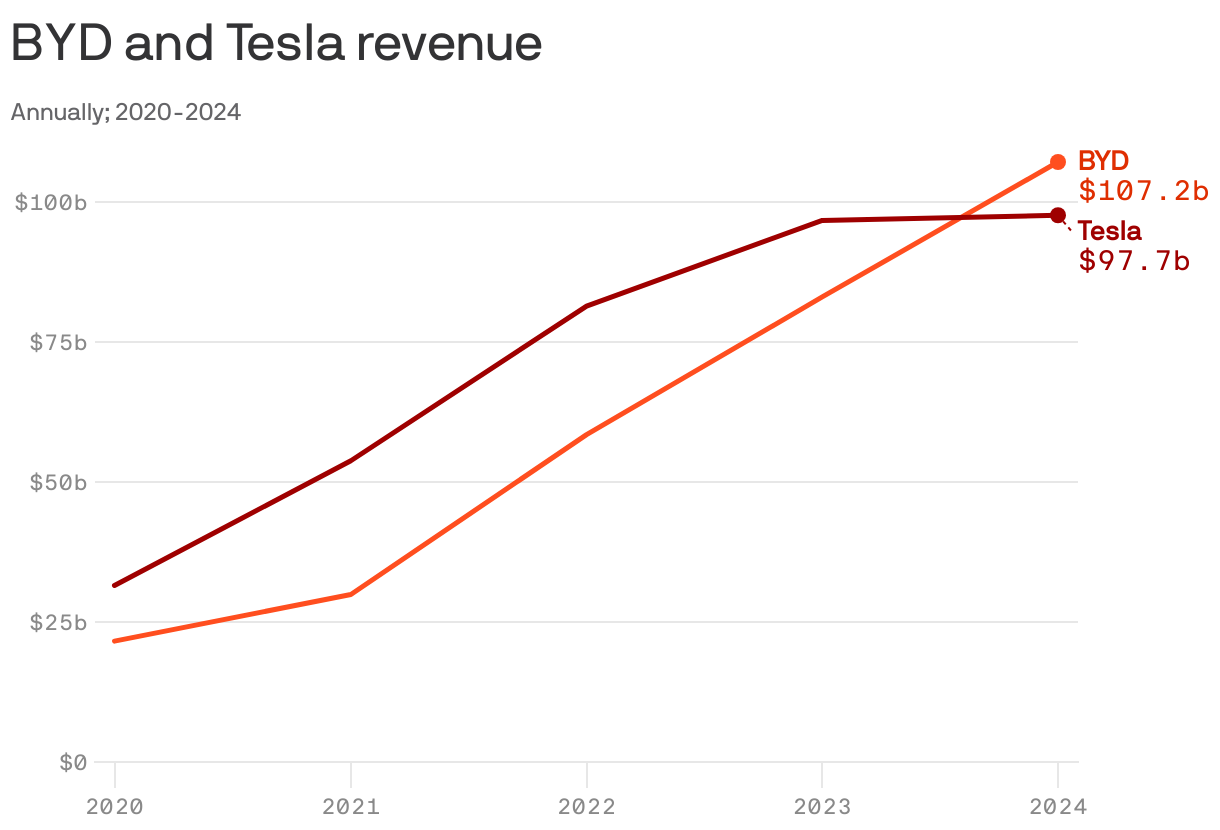
π¨π³ China's BYD has surpassed Tesla in revenue, and will likely move ahead in sales this year, Axios' Nathan Bomey reports.
- BYD already sells more if you include plug-in hybrids (which Tesla doesn't offer).
The other side: Some analysts remain quite optimistic.
- This requires faith in Musk's view that Tesla's true potential comes in AI, automation and robotics.
What's next: Tesla's Q1 delivery numbers arrive in early April and Q1 financials land weeks later.
- Morgan Stanley's Adam Jonas remains bullish on Tesla but expects Q1 deliveries, a proxy for sales, to be 9.3% below Q1 2024.

4. π» On my screen: EV politics and Permian growth
π» Electric pickup sales are somewhat less concentrated in Democratic counties than cars, but the link is still pretty strong, a new paper finds.
- Why it matters: Success in red and blue areas alike would eventually be needed for EVs to achieve very high market share.
- Driving the news: The working paper shows that from 2021-2023, 35% of electric truck registrations were in the 10% most Democratic counties, while for cars it was over 47%.
- Catch up quick: The truck data surfaced in an update of the same authors' 2023 analysis of heavy EV concentration in the bluest areas.
- What we're watching: Electric trucks haven't been around very long, so we'll see if things even out.
π’οΈ The Texas oil boom gets more attention, but New Mexico's side of the Permian Basin has been even hotter of late, Dallas Fed analysis shows.
- The big picture: New Mexico's oil production rose from 900,000 barrels per day in 2019 to 2 million in 2024, while Texas went from 5.1 mbd to 5.7 mbd in the same stretch.
- The intrigue: Roughly two-thirds of output on the Permian's New Mexico side now comes from federal lands, despite claims that Biden officials restricted production.
5. πCatch up quick: international edition
βοΈ Via the FT, Ukrainian President Volodymyr Zelensky said the U.S. has proposed a more detailed version of the minerals agreement.
πͺπΊ The UN's climate chief is pressing EU leaders to "seize" the moment with a strong new Paris Agreement pledge and robust funding.
- Why it matters: Simon Stiell's speech in Berlin today comes amid debate in the bloc over climate policies' effects on industrial competitiveness, and the U.S. pullback from Paris. Full speech...Bloomberg coverage.
6. π§ Bonus policy notes: FEMA, permits, AI
π House lawmakers have revamped a bipartisan push to make FEMA a Cabinet agency even as the Trump administration talks about eliminating it entirely, Axios Pro's Nick Sobczyk reports.
ποΈ "The Army Corps of Engineers is developing a process to quickly approve fossil fuel projects in response to President Donald Trump's declaration of an 'energy emergency,'" E&E News reports from documents obtained by the Environmental Integrity Project.
β The Senate confirmed Michael Kratsios to lead the White House Office of Science and Technology Policy by a 74-25 vote yesterday.
- What's next: Kratsios is joining an office with a looming July deadline to come out with an AI "action plan," Axios Pro's Maria Curi reports.
7. π’οΈQuote of the day: Trump and oil edition
"[I]f the tone of the administration's rhetoric is any indication, for oil and for markets generally, low prices are not the administration's real priority. US industrial primacy is."β Financial Times columnist Robert Armstrong, arguing that Trump's tariff, sanctions, and U.S. production policies hold sway over his energy price goals
π§ Did a friend, colleague or an AI chatbot send you this newsletter? Welcome, please sign up.
π Thanks to Chris Speckhard and Chuck McCutcheon for edits to today's edition, along with the brilliant Axios Visuals team.
Sign up for Axios Generate