Axios Generate

November 04, 2024


🏝️ We're just chilling with a slow week ahead. Oh wait. Anyway, we've got 1,221 words, 4.5 minutes.
🎹 RIP to the massively influential producer and composer Quincy Jones, whose Midas touch includes today's intro tune...
1 big thing: "Finance COP" to be shadowed by election, geopolitics

The upcoming UN climate summit in Azerbaijan, which begins Nov. 11, will focus on perhaps the thorniest topic in the history of such talks: money.
Why it matters: Getting countries to provide the funds required to meet the challenge head-on will be a stretch, given the shadow of an uncertain U.S. election, war in Ukraine and conflicts in the Middle East.
- Yet anything less than a significant scaling up of climate finance would further lock the world into a path to exceed Paris Agreement targets.
Driving the news: The world needs a massive course correction on greenhouse gas emissions and climate finance to meet the objectives of the Paris Agreement, which recent reports have warned are slipping away.
- The stakes couldn't be higher, particularly for developing nations suffering from climate disasters, sea level rise and other effects.
Friction point: At COP15 in Copenhagen in 2009, a group of major industrialized countries pledged $100 billion annually by 2020 to developing nations to help them adapt to climate change and lower their emissions.
- That goal was finally met in 2022, two years after the deadline — a delay that sowed distrust between developing and industrialized nations.
- Now, a new goal — this time much greater than $100 billion annually — needs to be negotiated.
- Getting to a higher number, which is likely to total at least $200 billion to $300 billion, will require a mix of funds ranging from multilateral development bank financing to pledges from individual countries and private capital.
What they're saying: A "strong" agreement at COP29 is crucial, World Resources Institute CEO Ani Dasgupta said on a call with reporters last week.
- "A strong outcome in Baku, a finance outcome, is possible," he said.
- He said success would propel the world toward more stringent emissions reduction commitments.
- "This COP actually is a basis for the next COP," Dasgupta said. "Without finance, you can't really have a lot of ambition."
Threat level: COP29 and COP30 could affect the world's ability to prevent potentially catastrophic climate change outcomes.
- Just last week, one of the deadliest flash flood disasters in Spain's history killed more than 200 people.
What we're watching: Expectations for the summit are low compared to other recent confabs, particularly last year's COP28 in Dubai.
- This will translate into a smaller presence from major corporations and civil society organizations.
Yes, but: Muted expectations doesn't mean consequential work won't be carried out at COP29, experts told Axios.
- The U.S. plans to urge China to start contributing to the new global finance goal. China has been reluctant to do so, since it's long been treated as a developing country in the UN climate system.
2. 🔍 Regulators scrutinizing data center use reject Amazon bid


Energy regulators are trying to determine how to respond to the wave of deals between nuclear plants and data centers that some worry could threaten grid reliability and raise utility bills.
Why it matters: Tech companies are seeking direct tie-ups and power purchase agreements with nuclear plants as they clamor for zero-carbon, round-the-clock power supplies to feed their facilities.
Driving the news: The Federal Energy Regulatory Commission late Friday rejected a proposal that would have allowed an Amazon data center to co-locate with an existing nuclear power plant in Pennsylvania.
- The 2-1 decision was published at the end of a FERC conference with utilities, consumers, grid operators, and state regulators about how to smooth the process for new grid connections without straining the grid.
- The commission should be encouraging development of data centers and semiconductor manufacturing as national security and economic development priorities, said FERC Chairman Willie Phillips, a Democrat who dissented on the order.
Zoom in: Amazon wants to build a data center next to Talen Energy's Susquehanna nuclear plant and draw power directly from it.
- Neighboring utilities AEP and Exelon challenged the novel arrangement, arguing it would unfairly shift costs of running the broader grid to other consumers.
- FERC's order Friday found the region's grid operator, PJM Interconnection, failed to show why the proposal was necessary and prove such a deal would be limited to the Susquehanna plant given the widespread interest in placing data centers next to power plants.
Talen said the ruling would have a chilling effect on the region's economic development and that it's weighing its options. Amazon didn't immediately respond to a request for comment.
3. ☀️ Meet the newest link in the U.S. solar supply chain
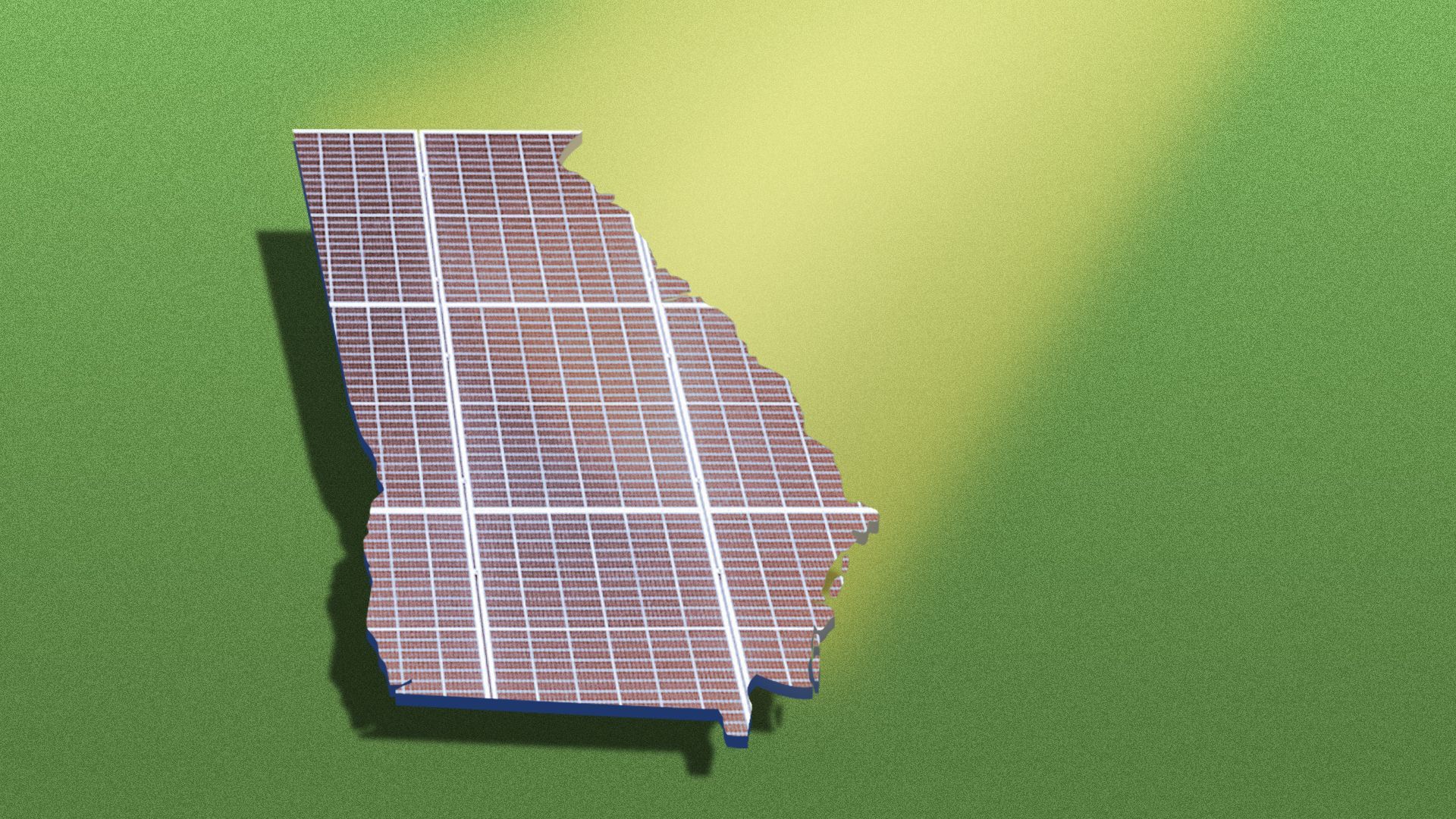
A Georgia factory begins producing a critical solar material this month and began output of a related product in August, Qcells tells Axios.
Why it matters: Production launch of materials that line and protect solar cells — encapsulate and backsheet — is another step in the onshoring of solar supply chains.
🗞️ Driving the news: Qcells' Scott Moskowitz tells me its sister company, Hanwha Advanced Materials Georgia, is now producing encapsulate at the Bartow County, Ga., plant.
- Backsheet starts rolling off the line this month. He also disclosed that the factory's output will be 10 gigawatts, which is larger than the initially envisioned 8-plus.
- That will help supply other companies' panel manufacturing beyond Qcells' needs, said Moskowitz, the company's VP of market strategy and industry affairs.
State of play: The $147 million project is tethered to the IRA in two ways. Solar energy project developers get larger incentives for using domestic content.
- On the supply side, backsheet production is eligible for domestic manufacturing credits (called 45X), Moskowitz notes.
- The factory will employ 200 people, according to Qcells, which is part of the Korea-based industrial giant Hanwha Group.
- Qcells has invested several billion dollars in Georgia factories for making panels and other solar equipment.
The bottom line: "It's really a sign of the resurgence in solar manufacturing in general," Moskowitz said, noting the investments "would not have been possible several years ago."
4. 🔋 Exxon reveals wider push into battery materials
Exxon sees a "massive opportunity" in making feedstocks for synthetic graphite used in EV battery anodes.
Why it matters: It expands Exxon's emerging bid to parlay its expertise into EV markets, following plans to extract lithium from subsurface brines in Arkansas.
📢 Driving the news: The firm developed proprietary tech to derive graphite feedstock from heavy fuel oil, it announced Friday.
- "This innovative material has the potential to improve EV battery range by 30% and enable faster charging," CEO Darren Woods said on the Q3 earnings call.
- He touted a "massive opportunity" in the market for battery anode materials that could reach $30 billion by 2030.
🏈 State of play: It's part of a wider "Carbon Materials Venture" that eyes products derived from changing the molecular structure of low-value heavy fuel oil from refining.
Yes, but: Exxon isn't yet making huge capital investments in carbon materials and its Proxxima resins product, which also has battery uses.
- Right now it's about demonstrating the "value proposition" they see, and rapid growth could follow, Woods said.
🔍What we're watching: More detail at Exxon's wider strategy update next month.
5. 💬 Quote of the day: OPEC+ edition
"OPEC+ once again proved its penchant for plot twists with the gang of 8 hitting the pause button yet again on the planned taper of its 2.2 [million barrels per day] cut."— RBC Capital Markets' Helima Croft on the decision to delay the unwinding of voluntary production curbs
The weekend announcement comes amid soft demand growth signals and projections of robust supply.
What we're watching: Saudi Arabia, Russia and six others said the voluntary curbs will now extend just one more month through December.
- But nobody would be shocked by another delay.
📨 Did a friend, colleague or even a frenemy send you this newsletter? Welcome, please sign up.
🙏 Thanks to Chris Speckhard and Chuck McCutcheon for edits to today's edition, along with the brilliant Axios Visuals team.