
Axios Generate

January 16, 2024
🥞 Welcome back! Today's edition has a Smart Brevity count of 1,279 words, 5 minutes.
🎶 Happy birthday to Helen Folasade Adu, better known as Sade, whose band has today's intro tune...
1 big thing: Climate policy's stormy waters

Illustration: Natalie Peeples/Axios
As climate scientists debate whether the pace of global warming is accelerating, policymakers face myriad obstacles this year as they try to curb greenhouse gas emissions and scale up climate finance, Andrew writes.
Why it matters: Rapid emissions cuts are required to avert the most dangerous impacts from climate change, studies show. In light of this, time is increasingly of the essence.
The big picture: Geopolitical chess pieces are moving in such a way that it's difficult to see how 2024 advances the agreements struck last year, including COP28's declaration to "transition away from fossil fuels."
Zoom in: Jason Bordoff, who heads Columbia University's Center on Global Energy Policy, said 2024's most important climate work may get done on the national level, in order to better implement commitments that are way off track.
- "The better job we're able to do at taking national action consistent with international agreements, the easier future international agreements, and more meaningful future international agreements will be," he said.
The intrigue: Another factor that may contribute to a world that treads water on climate action this year is the uncertainty surrounding the U.S. presidential election.
Between the lines: The selection of Baku, Azerbaijan, as the site of the next climate summit means that a second petro-state in a row will be the host, raising questions about its impartiality.
- Much remains to be implemented after COP28, including operationalizing the climate loss and damage fund to provide money to developing nations hit hard by climate impacts.
Yes, but: According to climate and energy expert Amy Myers Jaffe, countries are increasingly recognizing the need to decarbonize their economies and are pondering major steps to getting there, regardless of the COP process.
What they're saying: "I really do believe that the narrative that somehow all this progress has to come about through these nationally determined pledges, is is kind of old thinking," Myers Jaffe tells Axios.
2. Three things to watch as John Kerry heads for the exits

Photo illustration: Shoshana Gordon/Axios. Photo: Jeff J Mitchell/Getty Images
By now you've probably heard U.S. climate envoy John Kerry is leaving, so here's what we're watching from a post-Kerry Biden administration, Ben writes.
🇨🇳 U.S. climate relations with China. Kerry's longtime Chinese counterpart, Xie Zhenhua, just retired. So there's big change on both sides.
- Why it matters: China and the U.S. are the world's two largest emitters of carbon dioxide.
- One big question: Whether the two nations do — or don't — breathe life into a November 2023 agreement to bolster joint work on methane curbs and other areas.
🆕 The succession plan isn't clear. The White House and State Department did not provide comment on who will replace Kerry.
- State of play: President Biden could seek another high-profile name for the role. But Kerry also has seasoned lieutenants in Sue Biniaz and Rick Duke.
- The intrigue: A new law since Kerry got the job requires Senate confirmation for many special envoys — a huge hurdle for any Biden pick. That could apply to a new climate diplomat, depending on how the job is structured.
🗳️ Kerry hopes to help Biden politically. Keep an eye on how Kerry may be deployed in the 2024 campaign to sell Biden's climate policies.
3. Big in finance: $5 billion for batteries

Illustration: Aïda Amer/Axios
🔋 Northvolt, the Swedish battery firm, this morning announced $5 billion in debt financing to expand its production and recycling plant there, Ben writes.
- Why it matters: The company called it the "largest green loan raised in Europe to date." Participation from the European and Nordic Investment Banks — alongside commercial firms — shows how the bloc is keen to build a regional supply chain as EVs grow.
- Driving the news: The agreement also features "certain guarantees combined with direct funding" from the Swedish National Debt Office, the Export-Import Bank of Korea and others. Today's announcement includes refinancing of a $1.6 billion debt package in 2020.
- Catch up fast: Northvolt has offtake contracts with customers including BMW, Scania, Volvo and Volkswagen.
- The bottom line: Via the WSJ, the deal is "accelerating a race to build more batteries outside China and take advantage of a tidal wave of clean-energy subsidies."
4. Bonus business notes: Shell and General Atlantic
🛢️ Shell today announced the sale of its Nigerian onshore oil business for up to $2.4 billion to a consortium of companies that are mostly based there, Ben writes.
- The big picture: Bloomberg notes that for decades, Shell has been "at odds with local communities over oil spills and accusations of human rights violations, something that increasingly clashed with its broader efforts to become cleaner and greener."
- Yes, but: The energy giant will maintain a Nigerian presence via its deepwater and integrated gas businesses there.
💰 Private equity giant General Atlantic is acquiring U.K.-based sustainable infrastructure investment firm Actis.
- State of play: They did not disclose terms, but adding Actis' $12.5 billion in assets under management means roughly $96 billion in AUM combined, and they said the deal bolsters their energy transition work.
- How it works: Actis will "become the sustainable infrastructure arm within General Atlantic's global investment platform" and retain independence over investment decisions, they said.
5. Catch up fast on policy: EPA and Exxon

Illustration: Annelise Capossela/Axios
📝 The Environmental Protection Agency is closer to imposing fees on oil and gas industry methane emissions that are mandated under the 2022 climate law, Ben writes.
- Driving the news: The agency floated draft rules Friday that set an escalating fee on "wasteful" emissions that begins at $900 per metric ton.
- Why it matters: Methane is a powerful planet-warming gas, and oil and gas operations are a large source.
- How it works: The rule covers facilities with over 25,000 tons of CO2-equivalent methane emissions annually. But companies complying with separate Clean Air Act methane rules would be largely exempt.
🛢️ Via E&E News, Exxon has quit the Independent Petroleum Association of America, alleging the trade and lobbying group has inadequate climate policies.
- What they're saying: Exxon revealed the split in a report on its lobbying, saying IPAA lacks emissions-cutting policies overall and citing its work against "strong methane regulations."
6. 2023 shattered records for ocean heat content (again)
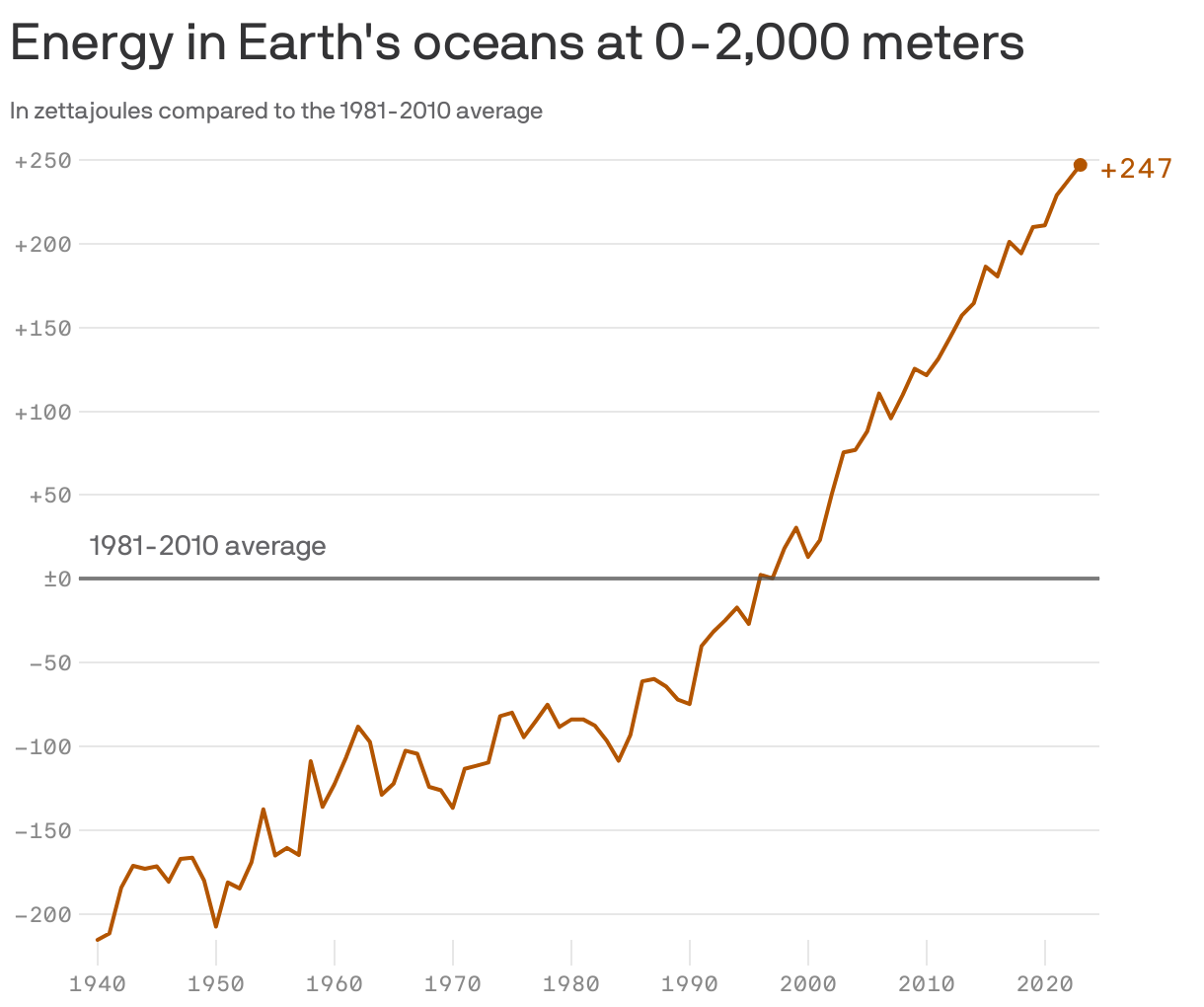
Last year broke a record for the most heat content present in the upper 2,000 meters (6,562 feet) of the oceans, Andrew writes.
Why it matters: The findings come from newly released NOAA data and a related new peer-reviewed study. The oceans absorb about 90% of the extra heat in the Earth system trapped by greenhouse gases, making the metric a striking indicator of human-caused global warming.
By the numbers: The five highest values of annual ocean heat content have come in the past five years, according to NOAA.
The big picture: "If you want to know how fast and how far global warming is going to go, the answer is in the oceans," study coauthor John Abraham told Axios.
- Sea surface temperatures were also off the charts in 2023, which helped drive extreme weather on land, too. However, surface temperatures are only a small part of the heating that took place in deeper waters, Abraham said.
- Parts of every ocean had record warm sea surface temperatures, particularly in the North Atlantic and equatorial Pacific.
The bottom line: According to the temperature tracking group Berkeley Earth, "[n]o places on Earth experienced a record or near-record cold annual average" in 2023.
7. BlackRock's ESG voting decline
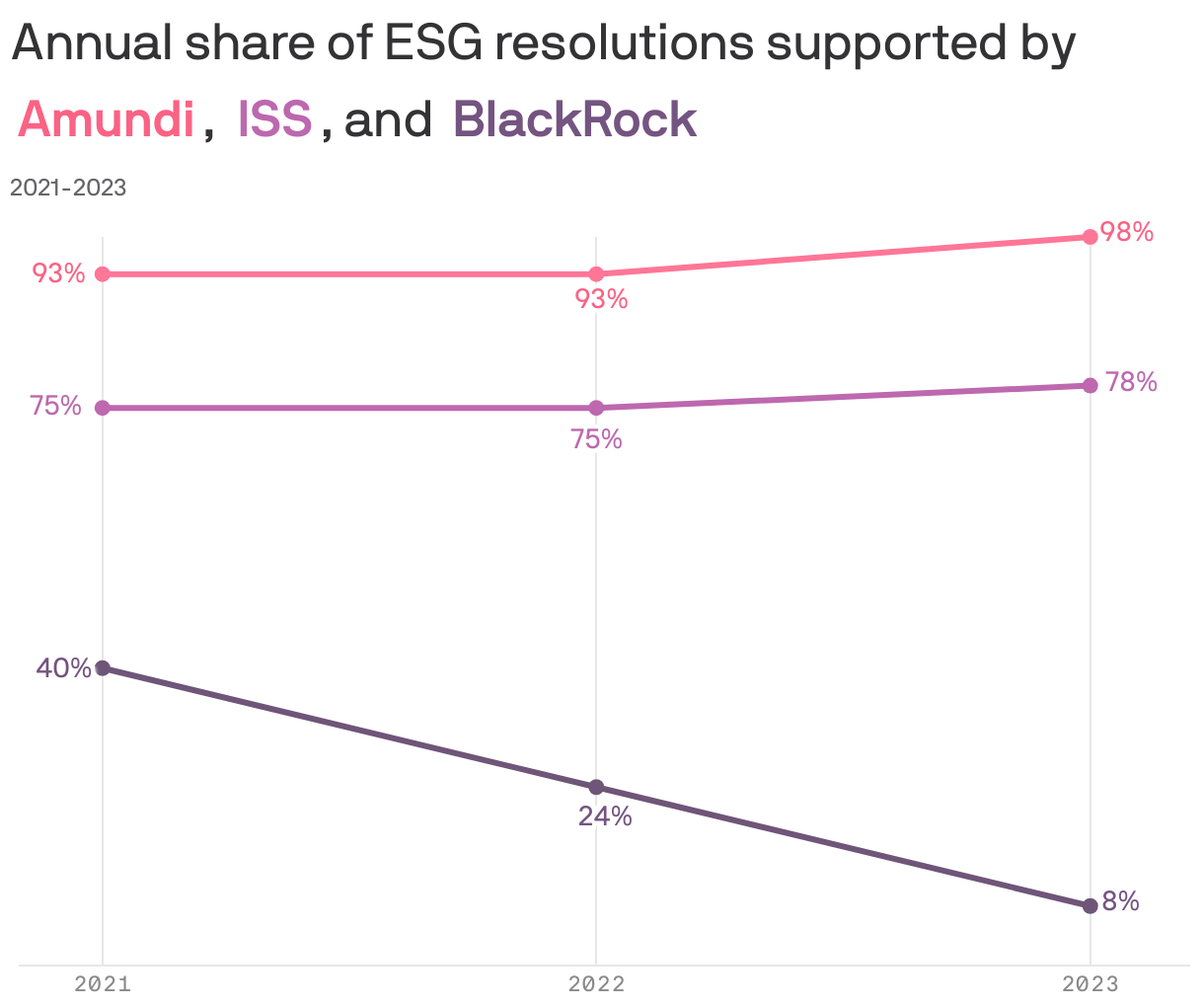
The European lead in terms of ESG investing has widened substantially over the past two years, according to a new analysis by ShareAction that echoes similar findings from Morningstar, Axios' Felix Salmon reports.
Why it matters: The U.S. is home to the largest fund managers in the world — none more so than BlackRock, a company that turns out to have largely stopped voting for ESG resolutions over the past two years.
The big picture: Although the decline at BlackRock is particularly dramatic, a similar voting trend can be seen at substantially all of the major U.S. fund managers.
📬 Did a friend send you this newsletter? Welcome, please sign up.
🙏 Thanks to Chris Speckhard and Javier E. David for edits to today's edition, along with the talented Axios Visuals team.
Sign up for Axios Generate

Untangle the energy industry’s biggest news stories


