Axios Generate

March 27, 2023

🥯 Welcome back! Today's edition has a Smart Brevity count of 1,157 words, a 4.5-minute read.
🗓️ Axios’ 2nd What’s Next Summit is Wednesday, March 29, in Washington, D.C.! Hear from music producer Timbaland, White House science boss Arati Prabhakar and more on the trends shaping our future. Watch LIVE
🎶 This week marks 40 years since the late, legendary Al Jarreau released a self-titled album that provides today's intro tune ...
1 big thing: Carbon capture divides so it can grow

Illustration: Sarah Grillo/Axios
An "important shift" is afoot in the carbon capture and storage industry, as companies increasingly specialize in specific links in the development chain, Ben writes.
The big picture: It's an evolution from earlier days of the sector marked by "full-chain" projects — a single operator controlling capture at an industrial site, but also transport and injection.
Why it matters: Growing segmentation may bolster deployment of carbon capture, utilization and storage (CCUS), International Energy Agency analysts write in new commentary.
- While the "full-chain" made sense for first-of-their-kind projects, they "suffer from high investment, cross-chain risks and liabilities born by a single developer," the IEA stated.
- "Breaking up the CCUS value chain can help mitigate these hurdles as CCUS scales up."
How it works: Now "part-chain" projects are being linked via planned development "hubs" that spread costs and enable economies of scale.
- Oil companies remain key players, but "specialized" actors are emerging too, such as gas transport companies moving into CO2 pipelines.
- Another example: chemical and engineering companies providing proprietary tech to buyers.
Zoom in: In its commentary, the IEA also name-checks specific startups.
- For instance, Carbon Clean and Svante offer "capture-as-a-service" to industrial polluters as developers and operators, or licensing tech.
- Companies like Storegga and Summit Carbon Solutions offer transport and storage solutions.
- Specialization can "bolster innovation and boost cost reductions in parts of the chain."
Reality check: CCUS has not scaled nearly as much backers have hoped for many years, and current operations only remove and sock away a tiny fraction of global CO2.
Yes, but: IEA analysis offers reasons for tempered optimism, that much more scale is still possible.
- Over 140 projects were announced worldwide last year, increasing planned storage capacity by 80% and capture by 30%.
- Historically, plans are only a very rough proxy for actual projects, as financial and technical hurdles have persisted. But IEA notes 2022 brought 15 final investment decisions.
- There's also growing policy support, including expanded incentives in the U.S. climate law. It raised tax credits from $50 to $85 per ton for carbon captured from industrial sites and permanently stored.
Bonus: The medium-term future of carbon capture
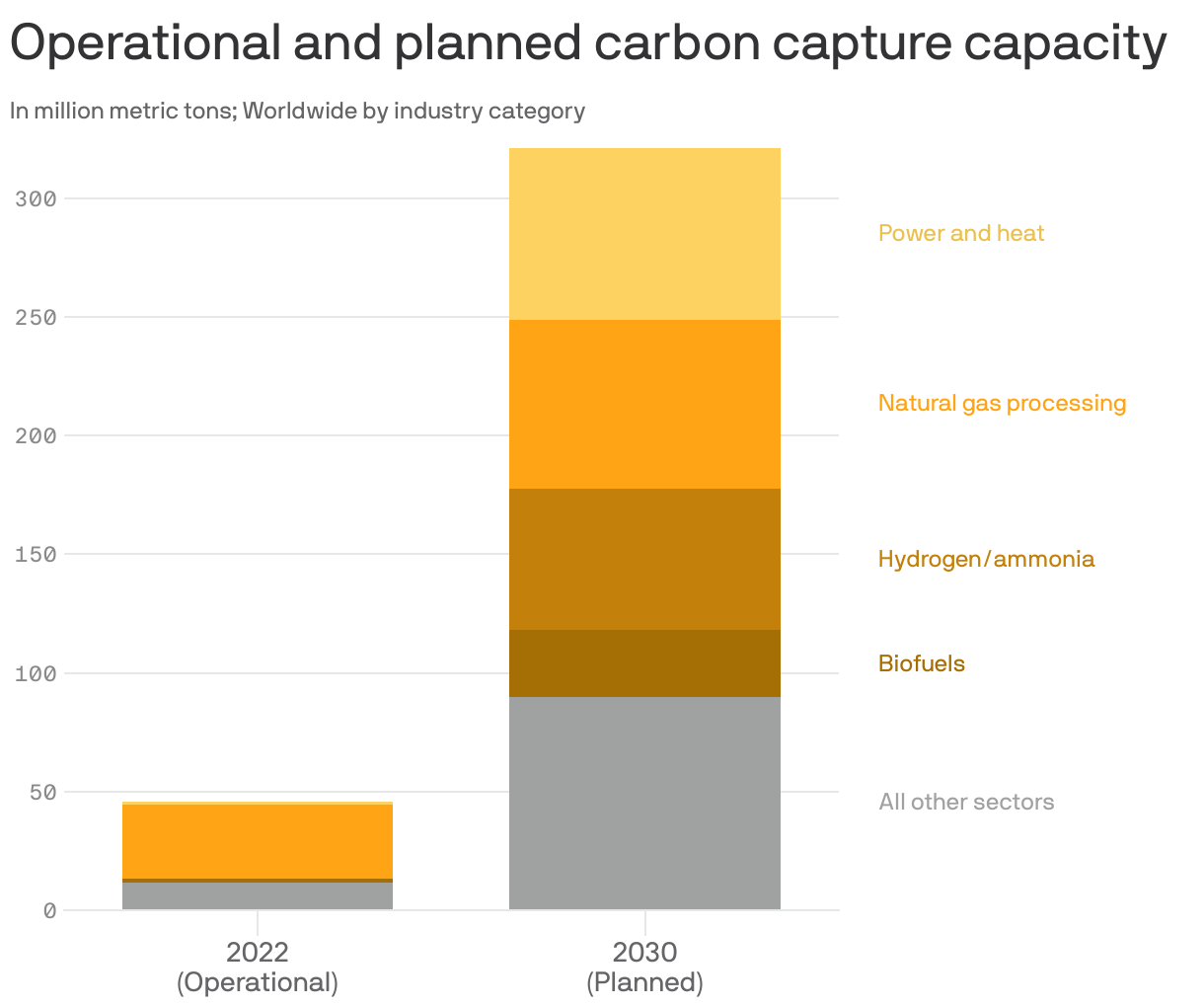
IEA also launched a new online database of carbon capture plans and projects worldwide.
Of note: It lists projects with at least 100,000 metric tons annually of capture capacity, and omits ones with "low climate benefits," like CO2 used for drinks.
2. Permitting reform fault lines

Illustration: Sarah Grillo/Axios
K-Street powerhouses led by the U.S. Chamber of Commerce are linking arms with renewables lobbyists to urge Congress to speed permitting for energy projects, Ben writes.
Driving the news: This morning brought the release of a Chamber-led letter from a wide range of groups, calling on Congress to act by summer's end.
- It has business interests like the Business Roundtable; oil, chemical and mining industry groups, among others; and several unions.
- The main groups representing the renewables industry also signed, such as the American Clean Power Association and the Solar Energy Industries Association.
What we don't know: Whether the Chamber-led permitting overhaul campaign can thread the political needle.
- Any bills with a plausible chance of passage in the divided Congress would need to speed fossil fuel and renewables projects alike.
- That's a deal that renewables and other low-carbon companies will take as they look to capitalize on climate law incentives.
Yes, but: Progressive Democrats and green interests are extremely wary of anything that helps build gas pipelines and other fossil projects.
Why it matters: The breadth of the organizations signals how permit streamlining is emerging at the top of the policy agenda for companies looking to build ... really, almost anything.
The big picture: The letter doesn't back specific bills, but offers broad "principles."
- "Certainty regarding the scope and timeline for project reviews," including judicial review.
- Project backers and the public should have "visibility" into permitting milestones and schedules.
3. Bomb cyclone part 2 in California, heavy rains in South

Illustration: Annelise Capossela/Axios
The second bomb cyclone to hit California in a week will affect the state Monday through Wednesday, as two storms combine off the West Coast and rapidly intensify, Andrew writes.
Threat level: The storm combo includes a low pressure area rotating south from the Gulf of Alaska and subtropical moisture moving east.
- Unlike last week’s damaging and deadly storm, it will reach its peak intensity over the ocean, rather than making landfall in the Bay area. The low will gradually weaken as it slides south through midweek.
- Still, high winds, heavy rains and mountain snows of 1 to 4 feet are forecast, particularly in northern and central California.
- With a record snowpack already, the state is headed for an all-time record on April 1, the typical seasonal peak.
Zoom in: The extreme weather in the West is occurring at the same time as the Southeast continues to see flash flooding and the threat of severe thunderstorms Monday after deadly tornadoes struck Mississippi and Alabama this weekend.
- Three to seven inches of rain fell overnight across parts of Georgia and Alabama with more to come, associated with a stalled frontal system. This has caused widespread flash flooding.
- Warmer than usual water temperatures in the Gulf of Mexico may be helping to fuel the heavy rains.
- In general, human-caused climate change is leading to more frequent and intense precipitation extremes.
4. Big this week: A critical EV decision for Biden

Illustration: Annelise Capossela/Axios
The Treasury Department this week will release its interpretation of climate law tax subsidies for electric vehicle purchases, Ben writes.
Why it matters: It sounds wonky but it's a really big deal. The "guidance" will determine which EVs are eligible for up to $7,500 in consumer purchase subsidies.
The specifics of the heavily lobbied interpretation will also affect which companies in the global battery supply chain benefit most — or lose out.
Zoom in: The law sets escalating percentages for battery components sourced from North America and critical materials sourced, processed or recycled domestically or from free-trade partners.
What we're watching: Bloomberg reports that one key question surrounds what qualifies as a critical material vs. a battery component, given that the latter must come from a narrower range of countries.
Also key: Parrallel talks with European allies about new free-trade agreements that would enable companies there to qualify for the critical materials provisions.
5. Catch up fast on business
🔋 LG Energy Solution will invest roughly $5.5 billion to build a major battery manufacturing complex in Arizona aimed at serving the EV and stationary storage markets, Ben writes.
- The big picture: The Korea-based company said the battery sourcing requirements in climate law EV tax credits were a driver of the decision to boost U.S. investments. The NYT has more.
⛽ "Saudi Aramco, the world’s biggest oil producer, has agreed to buy a 10% stake in a giant oil complex in China for 24.6 billion yuan ($3.6 billion), in a deal that will significantly expand its refining presence in China." (Bloomberg)
⚡ "Australia's Origin Energy Ltd on Monday inked an A$15.35 billion ($10.21 billion) takeover offer from a consortium led by Canada's Brookfield." (Reuters)
⛏️ Mining giant BHP on Monday announced an agreement with the huge Chinese steelmaker HBIS Group to pilot carbon capture and utilization at HBIS operations.
📬 Did a friend send you this newsletter? Welcome, please sign up.
🙏 Thanks to Lisa Hornung and Javier David for edits to today's edition.
Sign up for Axios Generate
Untangle the energy industry’s biggest news stories