Axios Generate

January 06, 2025

🥶 Good morning from snowy Washington, D.C. We cover a lot of ground today in a crisp 1,330 words, 5 minutes.
🎸 Happy birthday to Alex Turner of the Arctic Monkeys, who have today's intro tune...
1 big thing: Biden throws wrench in Trump's fossil fuel ramp-up
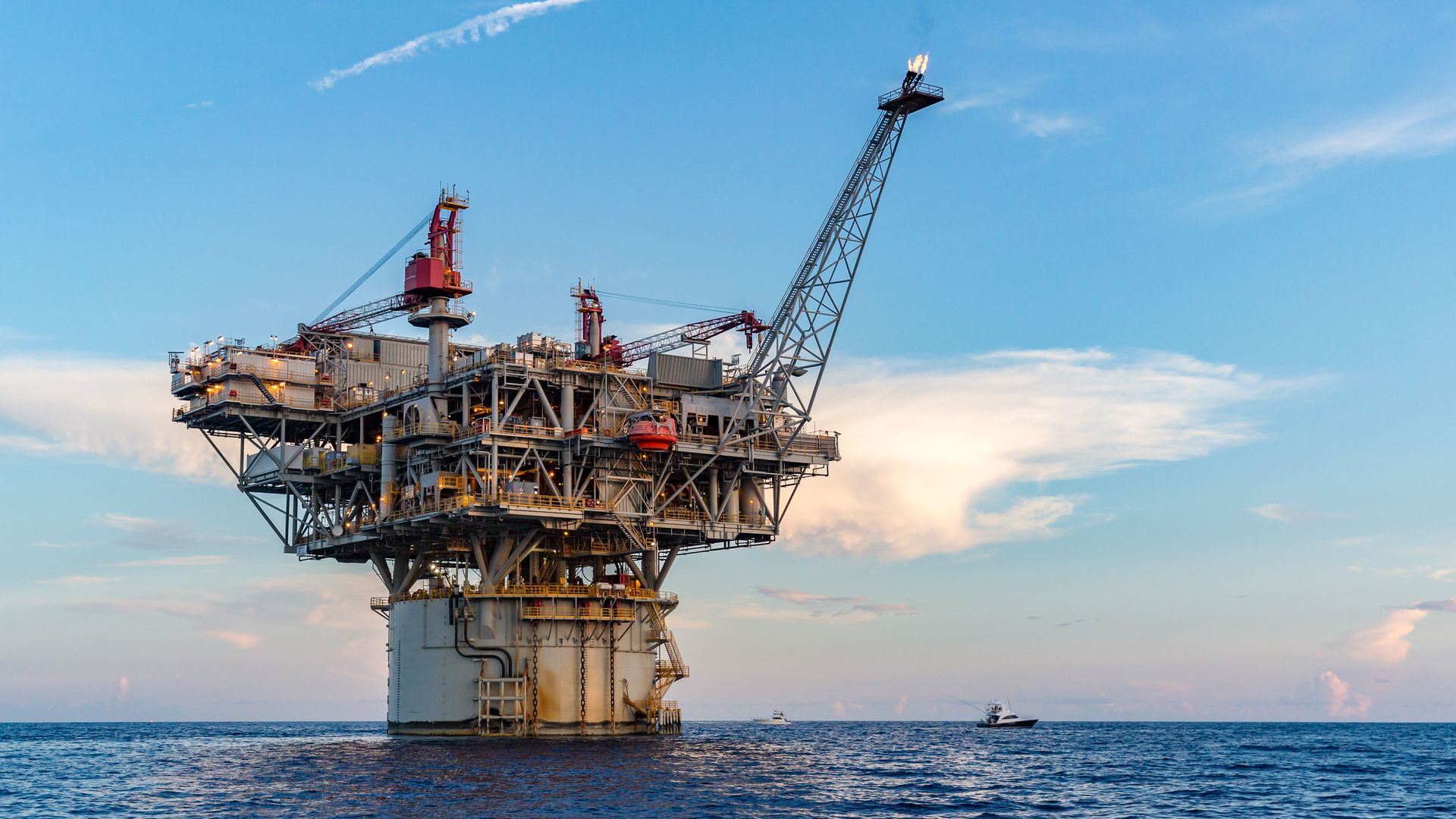
The Biden administration's announcement this morning that it will block about 625 million acres of offshore areas from future oil and gas drilling is a sweeping — yet somewhat symbolic — move to solidify its environmental legacy.
Why it matters: The moves — which cover an area equivalent to the states of Alaska, California and Colorado combined — may hinder President-elect Trump's push to quickly scale up fossil fuel production.
- Affected areas are in the northern Bering Sea, up and down the West Coast from California to Oregon, the eastern Gulf of Mexico, plus the Atlantic coast from Maine to Florida.
Driving the news: The White House says the policies are designed to permanently protect relatively pristine offshore areas, to the benefit of states dependent on fisheries and tourism, and to protect wildlife.
- By curtailing drilling, they may also limit greenhouse gas emissions that are causing global warming.
- Unlike an executive order, which Trump could easily overturn, Biden's actions will rely on an open-ended provision in a 72-year-old law: The 1953 Outer Continental Shelf Lands Act.
- This statute governs energy leasing activities for submerged lands under U.S. control that are beyond 3 miles from shore.
A provision in the act allows the president to permanently withdraw parts of the Outer Continental Shelf from leasing activities, without providing a way for another president to undo it.
- Biden cited climate change in a statement released this morning, noting the country is "transitioning to a clean energy economy."
What they're saying: "Congress and the incoming administration should fully leverage the nation's vast offshore resources as a critical source of affordable energy, government revenue and stability around the world," American Petroleum Institute President Mike Sommers said in a statement.
- "We urge policymakers to use every tool at their disposal to reverse this politically motivated decision."
Between the lines: Kevin Book of research firm ClearView Energy Partners told Axios in an email that congressional Republicans could include a provision reinstating some or all of the offshore areas in any filibuster-proof budget reconciliation bills.
Yes, but: Many of the regions that would be protected are places that either the oil and gas industry had not shown strong recent interest in for development, or are near states that have exhibited stiff resistance against offshore drilling.
- This especially applies to California, North Carolina and Florida, where lawmakers have long sought offshore drilling bans.
- During Trump's first term, he exempted a region from North Carolina to Florida from drilling for 10 years in the face of political opposition.
The industry has largely backed off from expensive forays into offshore Arctic drilling, including the Bering Sea.
- However, human-caused Arctic climate change is making the Far North more accessible for development and shipping routes and could entice companies to explore for fossil fuel resources in coming years.
2. 🌡️ Starting temperature data week with a look at the U.S.
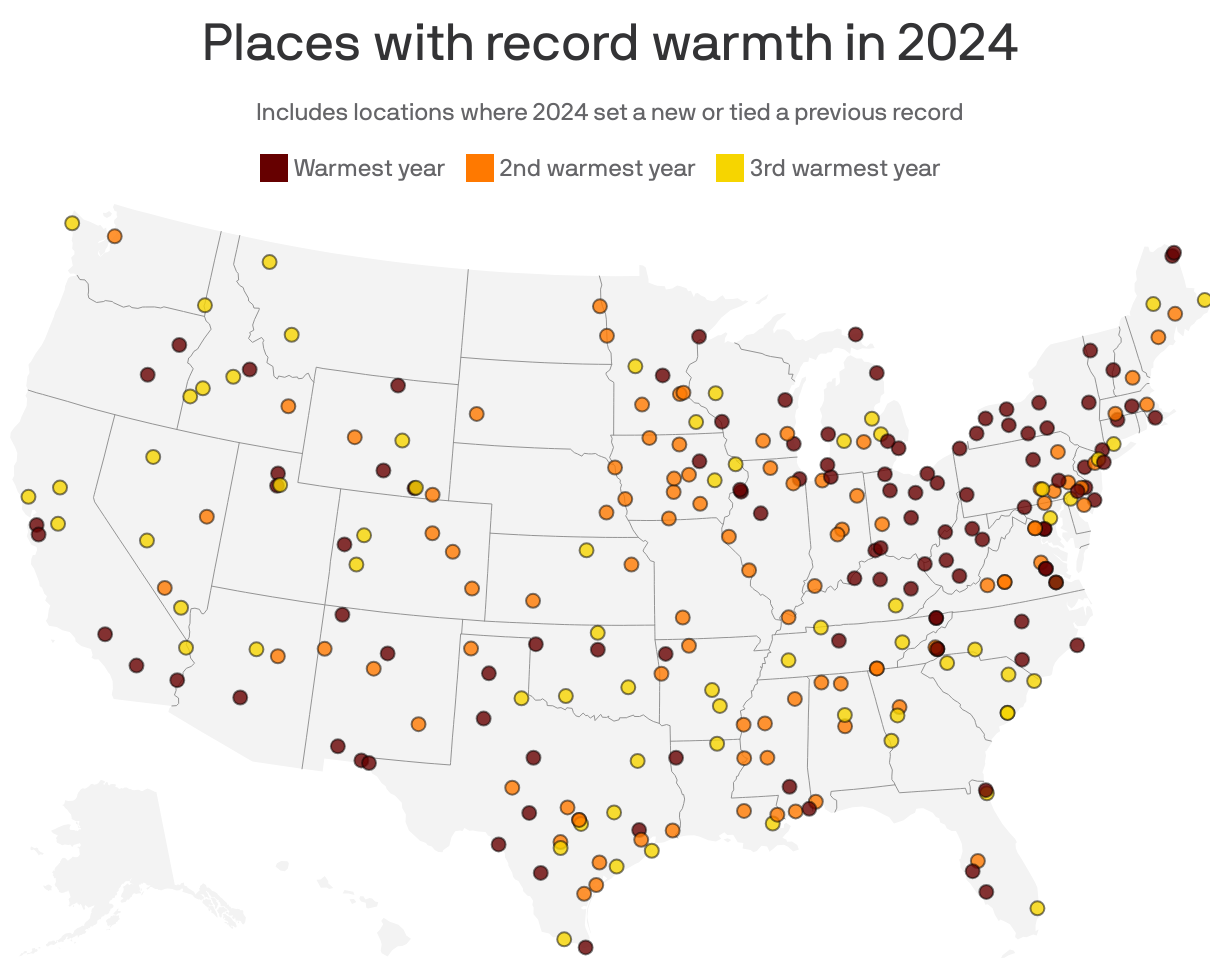
It may be frigid, snowy and icy in parts of the U.S. now, but communities from coast to coast saw record warmth during 2024, with many locations crushing milestones set just the year before.
Why it matters: The year's record hot temperatures include periods of extreme heat, which is a deadly hazard, and demonstrate how long-term, human-caused climate change is playing out locally.
Zoom in: Phoenix, for example, had an average temperature for the year of 90.5°F.
- The city set a record for the most days with highs that reached at or above 110°F, with 70 such occurrences, smashing the previous record of 55 days.
- Numerous locations in the Midwest and East had record warmth as well, with still more communities making the top 3 warmest year list.
- Chicago Midway Airport had its hottest year, as did Milwaukee.
- Nashville saw record annual warmth, as did Washington, Pittsburgh, Philadelphia and Burlington, Vermont.
Even the northernmost reaches of Maine were record warm, such as Caribou and Houlton near the U.S.-Canada border.
The intrigue: The contiguous U.S. as a whole either had its hottest year or second-hottest year in the instrument record during 2024.
- The unusually high domestic temperatures match global trends, since last year will be the hottest year on record worldwide, unexpectedly beating 2023 handily.
- Last year demonstrated how global warming is loading the dice in favor of more destructive outcomes, from Hurricane Helene's flooding to a period during the summer when global average temperatures spiked to unheard-of levels.
What's next: On Friday, the data for 2024's record warmth will be simultaneously released by each tracking center worldwide, from NASA to the EU's Copernicus Climate Change Service.
Our thought bubble: It is getting difficult to find fresh ways of saying that the previous year was the warmest on record worldwide, given how frequently records have been exceeded during just the past decade.
- Perhaps the most powerful way to tell this story is to show how what is going on globally is also happening at the local level.
3. 🏭 How Trump might rewire Bidenomics

The outgoing Biden administration has pointed to its investments in U.S. manufacturing as signature economic achievements. One big question now is how much of that the new Trump administration will change or scrap.
- An 11-month-old paper offers a preview.
Why it matters: The man tapped to be President-elect Trump's top White House economist published a detailed critique of President Biden's industrial policies last February.
- It offers a sense of the strategies for reindustrializing the U.S. economy sought by those with the president-elect's ear.
- Stephen Miran, Trump's designee to chair the Council of Economic Advisers, argued that industrial policy should focus on supply-side reforms that make it easier for companies to invest in factories, and be driven by demand from the defense industry.
- He is critical of heavy subsidies for electric cars and labor, environmental, and other regulations that, in Miran's view, make the U.S. too inhospitable to manufacturing.
What they're saying: Bidenomics "imposes onerous costs on industry in various ways — from incentives for unionization to special environmental restrictions — that raise the cost of production and work against the stated goal of expanding our industrial plant," Miran wrote for the Manhattan Institute, where he is an adjunct fellow.
Zoom in: Among other specific policies he critiques as counterproductive are EPA rules governing chipmakers, the Davis-Bacon Act (which includes wage requirements for public projects) and Occupational Safety and Health Administration rules on worker safety that he argues go overboard.
Reality check: Miran's will be one voice among many seeking to influence Trump on industrial policy, and the CEA job is more advisory than responsible for carrying out programs.
4. ☃️ Far-reaching winter storm, Arctic blast hit U.S.
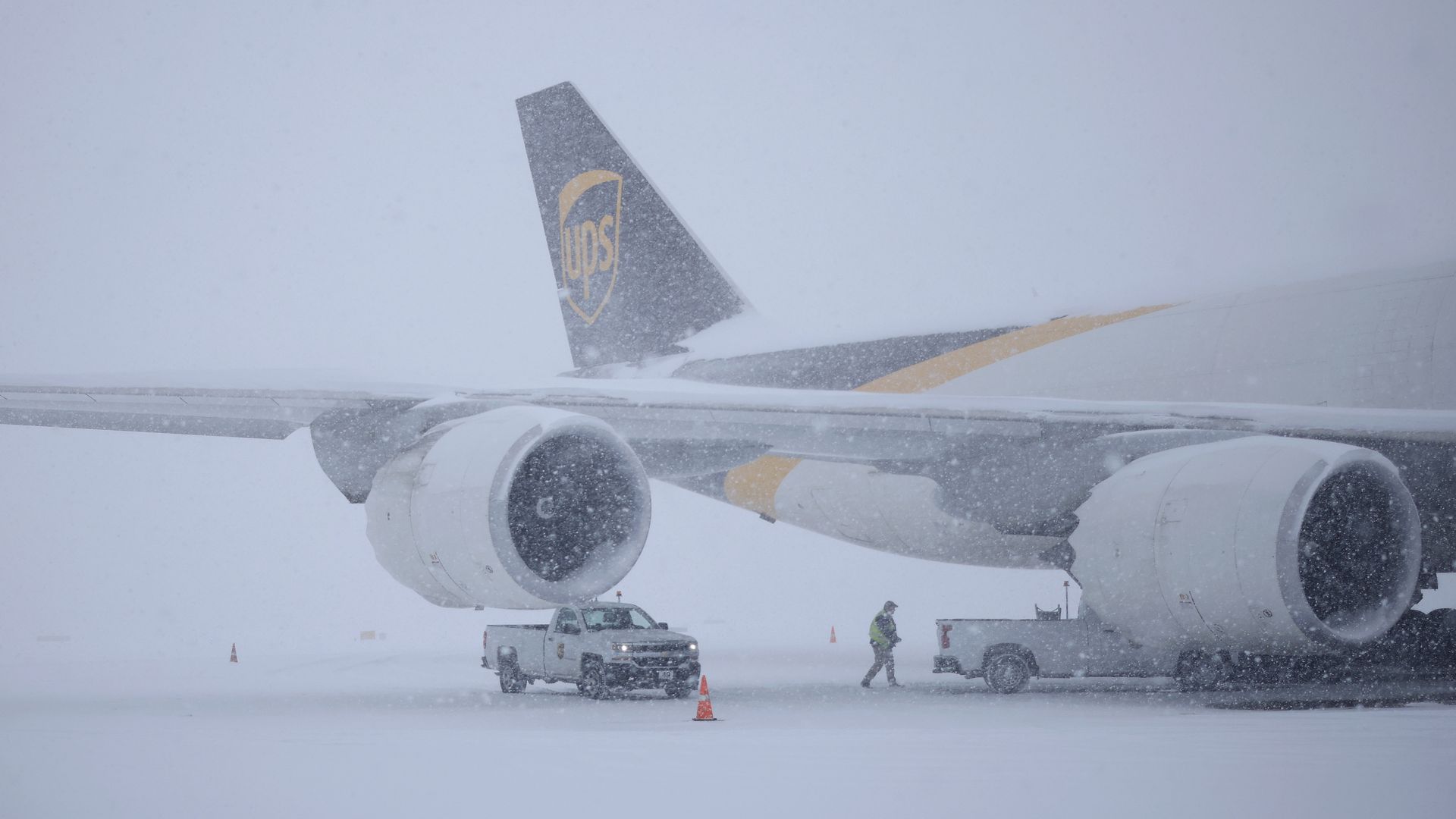
A powerful winter storm continues to traverse the country from west to east, knocking out power, snarling travel and bringing the nation's capital to a virtual standstill.
Threat level: The Arctic air moving in behind the storm is sending temperatures plunging in Texas, leading the operator of the Lone Star State's grid to declare a "Weather Watch" through Friday.
- Ice on trees and power lines cut power to nearly 290,000 customers across six states as of this morning.
- Kansas City saw its 4th-largest single-day snowstorm on record, with 11 inches of snow.
- The Washington, D.C., area is forecast to see its largest snowstorm since 2019, with six to 12 inches falling by early tomorrow morning.
What's next: With frigid air from the Arctic locked in place across the U.S. east of the Rockies, some computer models are projecting the possibility of a southern snow and ice storm that could affect Texas to the Carolinas late this week.
- This storm could intensify into a nor'easter off the Mid-Atlantic and Northeast coast next weekend.
Context: The post-storm Arctic outbreak is tied in part to a north-south stretching of the polar vortex, which is an area of low pressure in the upper atmosphere and the air circulation around it.
- The polar vortex is present each winter in the Northern Hemisphere.
- Other weather features have also opened the Arctic's refrigerator door.
- There have been studies linking rapid, human-caused Arctic climate change with shifts in the polar vortex, though this an active debate.
Go deeper: Winter storm in photos; Axios D.C.
📨 Did a friend, colleague or a LinkedIn contact you barely know send you this newsletter? Welcome, please sign up.
🙏 Thanks to Chris Speckhard and Chuck McCutcheon for edits to today's edition, along with the brilliant Axios Visuals team.
Sign up for Axios Generate