Axios Generate

June 08, 2023

1 big thing: El Niño makes a comeback


El Niño, the ocean and atmosphere cycle in the tropical Pacific that can supercharge global extreme weather, is officially back after about a four-year hiatus, Andrew writes.
Why it matters: The system, which NOAA announced Thursday morning, holds large sway over global weather patterns. It is likely to increase global average temperatures, leading to an all-time record warm year in 2023 or 2024, surpassing the El Niño year of 2016.
- El Niño will also contribute to heat waves, droughts, floods and other weather extremes, which already are worsening from human-caused climate change.
- It is influencing the North Atlantic hurricane season, making for an especially uncertain outlook.
Zoom in: El Niño events are characterized by unusually warm sea surface temperatures in the equatorial tropical Pacific, particularly across the central and eastern Pacific.
The intrigue: Some climate scientists and meteorologists told Axios they are looking toward the coming months to a year or more with trepidation and curiosity, given that the oceans already are record-warm going into the event, and temperatures are likely to climb further.
- “The global oceans are very warm right now and I’m afraid that this is putting us into territory that we don’t have much experience with,” Michelle L'Heureux, chief of Climate Prediction Center's El Niño-Southern Oscillation team, said in an interview.
- And on land, scorching heat waves have struck large swaths of Asia this spring, while Canada is amid what is likely to be its worst wildfire season on record.
- Fires burning in Quebec turned the skies in New York City a bright, otherworldly orange on Wednesday.
Of note: The natural climate phenomenon now occurs against a backdrop of a rapidly warming planet being worsened by human emissions of fossil fuels. It makes the evolution and impacts more uncertain — and potentially more significant, experts told Axios.
- NOAA's Climate Prediction Center forecasts this El Niño has an 84% likelihood of exceeding moderate intensity and a 56% chance of reaching "strong" criteria.
Yes, but: While it's clear that ocean temperatures and atmospheric conditions now support the El Niño designation, it is not guaranteed to continue developing into a long-lasting event, L'Heureux cautioned.
What they're saying: Kim Cobb, director of the Institute at Brown for Environment and Society, is particularly concerned about El Niño's ocean-related effects.
- "Many ecosystems, including many coral reefs, are still reeling from the impacts of the 2016 El Nino-related marine heat waves," she said.
🛢️2. China, Saudis compete for crude traders' hearts

Illustration: Eniola Odetunde/Axios
3. A $1.5B close and more tech finance news

Illustration: Aïda Amer/Axios
4. COP28 goals start coming into focus
Illustration: Sarah Grillo/Axios
5. EVs' near-term future and long-term challenges
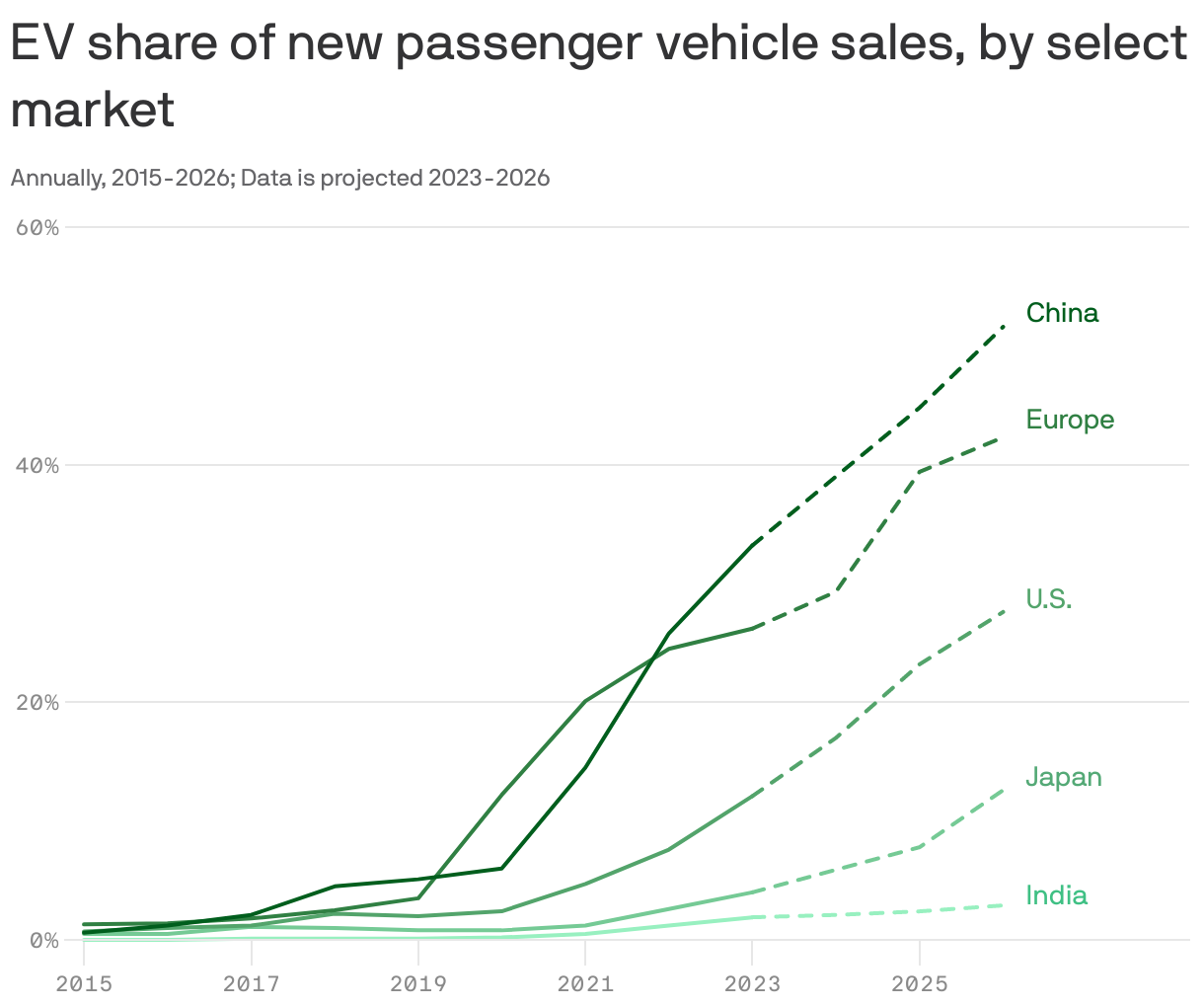
The outlook for U.S. electric vehicle adoption has brightened, the research firm BloombergNEF said, Ben writes.
Why it matters: EVs are a big tool for wringing CO2 out of transportation.
Driving the news: The outlook sees EVs — including plug-in hybrids — reaching 23% of U.S. passenger vehicle sales in 2025, 28% in 2026 and 51% by 2030.
- That's up from 16% in 2025 and 44% in 2030, in the 2022 edition.
- The increase reflects incentives in the new climate law, but also more offerings reaching the market.
The big picture: More from BloombergNEF's latest projections...
- On a global basis, EVs' share of passenger sales jumps from 14% last year to 30% in 2026, and far above that in China — the biggest market — and Europe.
- Looking further out, EVs reach 75% of new sales in 2040 in their base case.
Yes, but: As with lots of climate tech, growth is steep yet out-of-step with what's needed to reach net-zero global emissions in 2050.
- Passenger and "light commercial" vehicles — together almost two-thirds of road transport emissions — are on a "positive trajectory" under BloombergNEF's net-zero scenario.
- But medium- and heavy-duty commercial vehicles, another 30% of road emissions, are off track, with heavy trucks especially far behind.
Threat level: The analysis explores raw materials needed to support EVs.
- Lithium is the "most concerning" in their net-zero case, with demand growing by a factor of 22 in their net-zero case.
- But alternative battery chemistries could sharply cut that amount.
The intrigue: It warns of a battery range "arms race" that puts pressure on lithium, nickel and cobalt, among others.
- Instead, governments should boost support for "dense" public charging that gives drivers confidence.