
Axios Generate

March 29, 2023
🐪 That day already! Today's newsletter has a Smart Brevity count of 1,122 words, 4 minutes.
🎶 Exactly 25 years ago Montell Jordan was #1 on Billboard's R&B chart with an unstoppable groove that's today's intro tune ...
1 big thing: A new greenhouse gas balance sheet
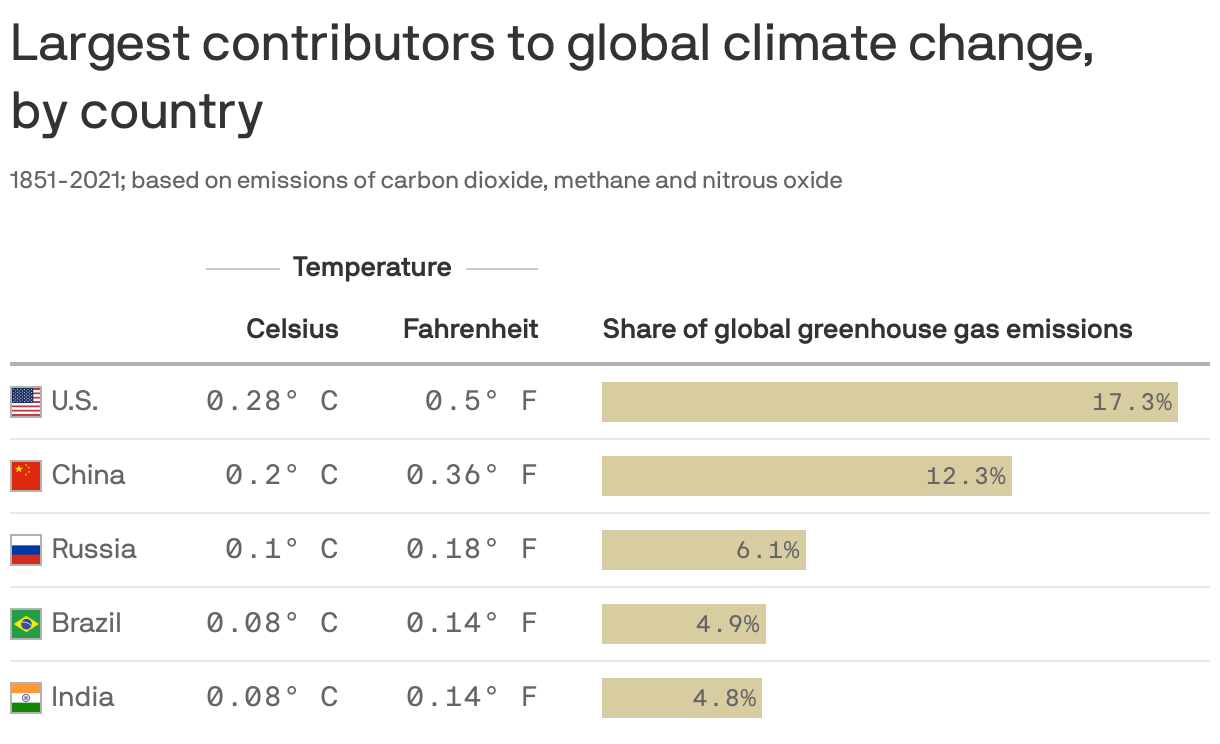
A new study out on Wednesday offers important new ways to view how individual countries have boosted global climate change, Andrew writes.
Why it matters: The study is aimed at informing the Global Stocktake, a process through which countries are being asked to consider aggressive emissions reduction pledges at the next U.N. Climate Summit later this year.
Zoom in: Published in the journal Scientific Data, the research is the first to assign responsibility — in the form of temperature increases — to individual countries and country groupings, rather than just emissions.
- The researchers also break new ground by including agriculture and deforestation in its accounting, as well as the three main global warming contributors: CO2, methane and nitrous oxide.
By the numbers: The study builds on data from the Global Carbon Project, as well as the most recent findings from the U.N. Intergovernmental Panel on Climate change.
- The U.S. alone is responsible for the largest share of global climate change, having caused 0.28°C (0.5°F) of warming from 1851-2021 (or 17.3% of the globe's temperature increase).
- The study allows climate negotiators to view emissions by country groupings, such as Brazil, South Africa, India and China, which are known as the BASIC group.
- These countries are behind 0.37°C (0.66°F) of warming during that period.
- This is well below the so-called Annex I countries, which include the major industrialized nations. This bloc is responsible for pushing global average surface temperatures upward by 0.72°C (1.3°F) since 1851.
- The study found that total warming from greenhouse gas emissions alone during the period was 1.4°C; but the IPCC noted actual warming has been 1.1°C (1.98°F) once cooling influences are included.
Between the lines: The shifting trajectory of global emissions is clear from the results, according to lead author Matthew Jones of the Tyndall Center for Climate Change Research in the U.K.
- Many industrialized countries that have the greatest historical burden of warming "have begun their journey towards de-carbonization," he told Axios via email.
- At the same time, emissions from now-industrializing countries, like China, are rising rapidly, he said.
The intrigue: "Half of the countries on Earth have contributed more to global warming through land use, land use change and forestry than by burning fossil fuels," Jones said.
- Jones said the authors plan to frequently update their climate change database, which is publicly available.
What they're saying: Outside researchers said the paper may have significant policy salience.
- The up-to-date information "makes it difficult for polluting countries to hide their contribution to the climate crisis, putting far more pressure on them to make reduction commitments that meet their obligations," climate researcher Michael Mann of the University of Pennsylvania told Axios via email.
2. 🏃🏽♀️ Catch up fast on policy
💰 House Speaker Kevin McCarthy told President Biden that Republicans want measures to lower energy costs and make the country "energy independent" on the table in debt ceiling talks, Ben writes.
🚗 "Washington has offered to make five minerals used in batteries eligible for subsidies under its green-tech promoting Inflation Reduction Act if they are mined or processed in the EU," the Financial Times reports.
- Catch up fast: The U.S. and Japan struck a deal this week on EV battery minerals that will likely enable Japanese companies to capture incentives in the climate law, we reported yesterday.
👀 SEC Chairman Gary Gensler huddled last week with three Democratic senators to discuss brewing regulations on corporate climate disclosures, a recently posted filing shows.
- Why it matters: The meeting with Sens. Brian Schatz, Elizabeth Warren and Sheldon Whitehouse — who back aggressive climate policies — shows conflicting pressures over the heavily lobbied rule.
3. World Bank pick: For climate, "it's trillions of dollars a year."
Photo illustration: Aïda Amer/Axios. Photo: Hollie Adams/Bloomberg via Getty Images
Ajay Banga, President Biden’s nominee to lead the World Bank, wants the bank to focus on poverty alleviation and climate change — and warns that the world needs massive private sector investment to address both challenges, Axios' Hans Nichols reports.
Why it matters: The bank is under pressure from rich countries, and the Biden administration, to do more to fight climate change — but less-developed countries worry it will do so at the expense of its focus on health, education and poverty reduction.
What they're saying: Banga wants the bank to do both.
- “I think it's a fallacious argument that says, either-or,” Banga told Axios. “I have every intention of focusing the bank and its people on the idea that this is an intertwined challenge.”
- “For climate change, it's trillions of dollars a year. For inequality and poverty alleviation and development, it’s trillions a year,” he said. "You just have to get the private sector to be a constructive part of the solution.”
4. One climate risk: Young coal plants
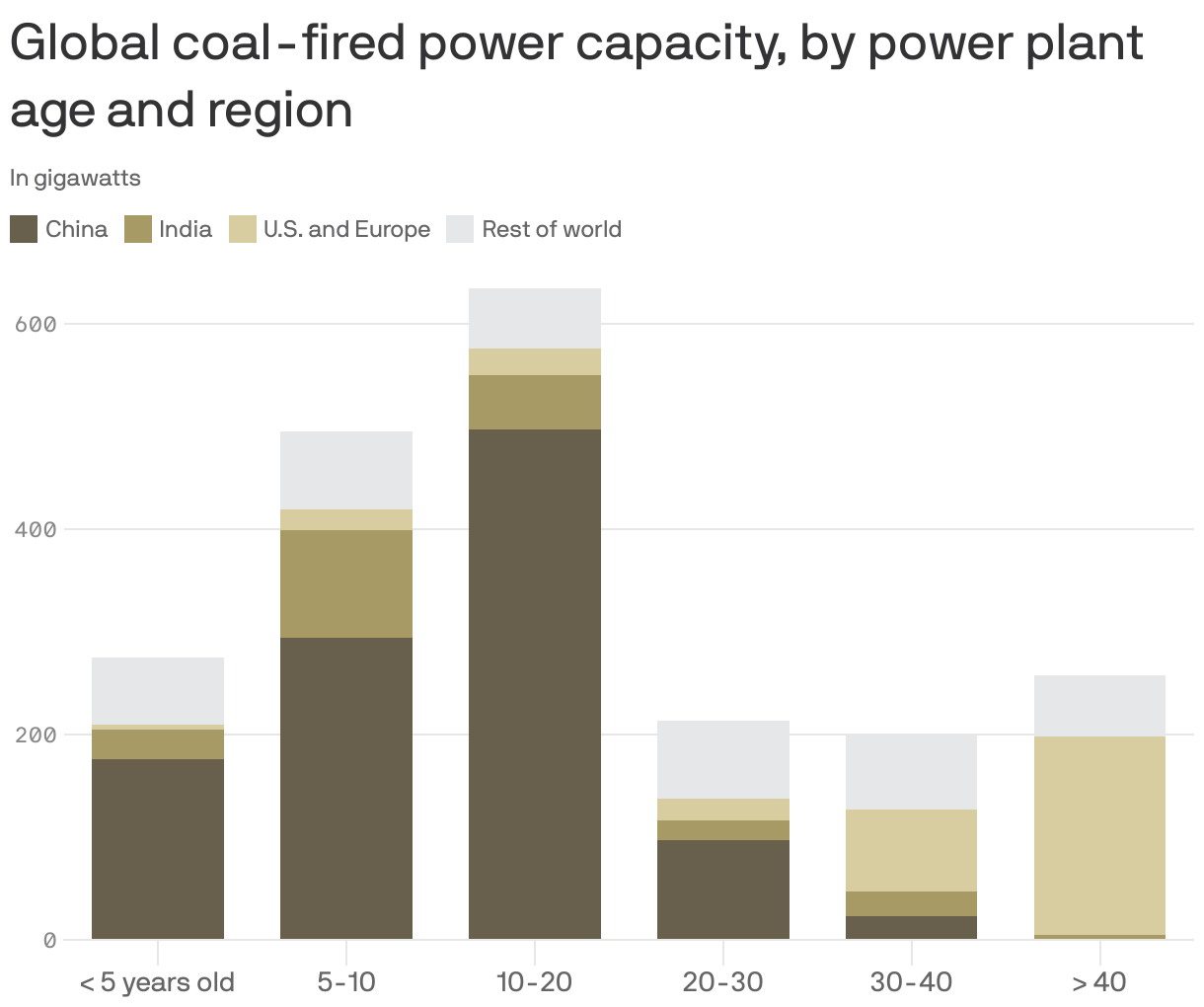
A brief new report marshals several lines of evidence to show how "the world is struggling to tame its appetite for coal," Ben writes.
The big picture: Global coal-fired electricity generation remains "stubbornly high," the research firm BloombergNEF notes.
China sourced more power from coal last year than before the pandemic, despite major COVID-19 restrictions.
Threat level: Almost 90% of China's coal-fired capacity is less than 20 years old. India's in a similar situation.
"[T]hese relatively young assets could conceivably keep running for decades before being retired."
5. One useful thing: apples-to-apples energy outlooks
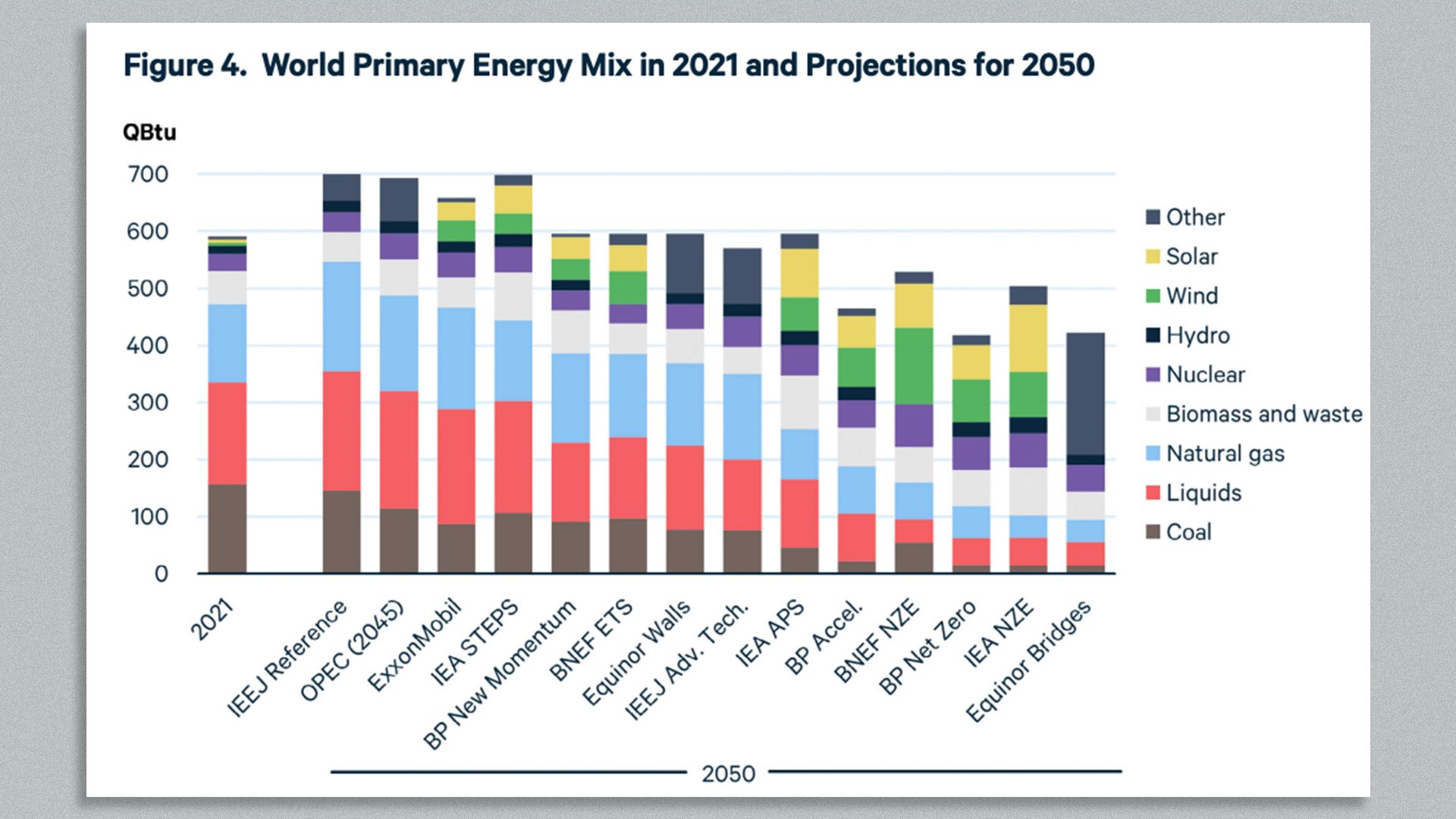
Image: Courtesy of Resources for the Future
This is cool: Resources for the Future is out with its latest comparison of long-term global energy outlooks and scenarios from prominent analysts, Ben writes.
Why it matters: Different bodies often use different metrics and baselines for energy use, sources, emissions and so forth, so having a harmonized look is helpful.
The nonpartisan think tank creates apples-to-apples comparisons of studies from oil majors, the International Energy Agency, OPEC and more.
The big picture: While investment in renewables and other low-carbon sources is growing, "[T]he world is mostly continuing its long history of adding to, rather than transitioning away from, older energy sources."
But some regions have entered a real transition, notably Europe, with Russia's invasion of Ukraine speeding moves away from fossil fuels.
Zoom in: RFF analyzes existing policies and hypothetical scenarios that are far more climate-friendly. Some examples of the findings...
Every scenario consistent with Paris Agreement goals sees a major role for "negative emissions" tech.
Elsewhere, it notes IEA and BP have revised oil consumption projections downward.
- "All of BP’s scenarios feature lower oil demand in 2025 than in 2019 ... suggesting that global oil demand may already be peaking."
- "By contrast, as recently as last year, BP’s highest-fossil case (New Momentum) had oil demand peaking in 2030."
6. 🧮 Number of the day: 18%
Electric vehicle startup The Lucid Group is cutting its workforce by roughly 1,300 workers, an approximately 18% reduction, as the company undergoes a restructuring plan, Ben writes.
Why it matters: Being a new automaker with an emerging technology is hard.
Go deeper: Lucid SEC filing ... Reuters coverage
📬 Did a friend send you this newsletter? Welcome, please sign up.
🙏 Thanks to Lisa Hornung and Javier E. David for edits to today's edition.
Sign up for Axios Generate

Untangle the energy industry’s biggest news stories

