Axios Generate

January 07, 2025


🌞 Good morning! Today we cover everything from global temperatures (stay tuned for more later this week) to enhanced rock weathering, and do it in a brisk 1,232 words, 4.5 minutes.
🚨 Situational awareness: President Biden today will designate two new national monuments in California totaling 848,000 acres.
🎸 This Radiohead song from "In Rainbows" has been in Andrew's head for years, and given Thom Yorke's climate activism, it is today's intro tune...
1 big thing: 🥵 Why scientists say hottest-year record shouldn't be ignored
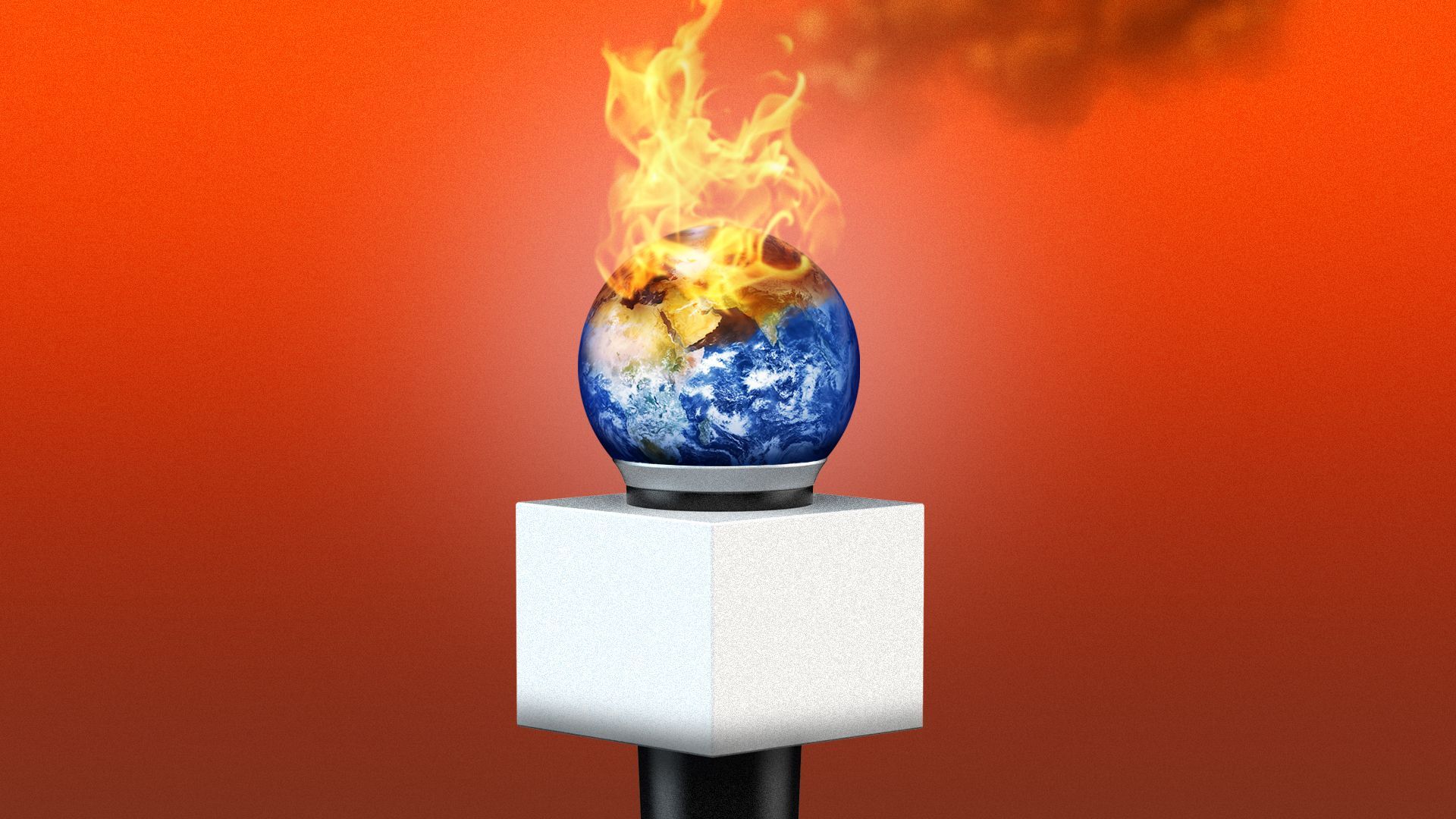
Official word will arrive later this week that the planet again recorded the hottest calendar year in recorded history. And for the fifth time this decade, journalists will try to convey the significance of a milestone that's become routine and predictable.
Why it matters: This year's record stands out from the pack in that it wasn't expected. That's prompted climate scientists to launch multiple studies investigating what led to the record heat.
- Still, one hottest year after the next is a climate communications conundrum.
- To put it simply — it's about as far from a "stop the presses" moment as one can get in climate news.
Zoom in: Don't take my word for it. Andrew Dessler, a climate researcher at Texas A&M University, has a form email that he replies to reporters with when he receives inquiries for comment on a hottest annual temperature record.
- "Thank you for emailing me asking for a comment about 20__ being one of the hottest years in the record," it states. "No, this is not surprising — it is exactly in line with predictions."
- The email goes on to note: "Every year for the rest of your life will be one of the hottest in the record."
Between the lines: Dessler was kind enough to elaborate in an email to Axios, and his point is backed up by peer-reviewed research on how people process a rapidly shifting temperature baseline.
- "People have no real understanding of how hot it's gotten because people's memories of weather are very short-term," he said. "I firmly believe that if you took someone from the 1970s and beamed them forward in time to today, they would be shocked at how hot it is."
Yes, but: Zeke Hausfather, climate research lead at Stripe, said 2024's record-breaking temperatures raise the question of "whether the era of rapid global warming that started in the 1970s is now speeding up."
- Some prominent climate researchers think the answer is yes.
- In addition, he said 2024 will be a less routine global record announcement because the majority of temperature datasets will likely show for the first time that the planet exceeded 1.5°C compared to preindustrial levels.
- "While a single year above 1.5°C does not mean that the world has passed that target," he told Axios via email, "it is certainly a sign that we are getting worryingly close."
The bottom line: While hottest-year records are a dime a dozen these days, 2024's is actually even more foreboding than one might expect.
2. 🔋 Beta Technologies expands its airport charging network

Beta Technologies, the Burlington, Vt.-based electric aerospace company, expanded its network of airport-based multi-use chargers by 30 last year, an annual increase of 200%, the company said this morning.
Why it matters: As electric aircraft increase in availability and use and airports shift to electric vehicle fleets, charging stations could be a second source of revenue for e-aviation companies.
- They could also lower the barrier to entry for potential customers.
Zoom in: The company, which is already churning out electric conventional takeoff and landing aircraft while working on its eVTOL version, now has a charging network at 46 sites across 22 states, with 23 more in development.
- Beta is placing its bet on charging interoperability, with its charger able to power electric planes and ground vehicles.
- This contrasts with other similar companies, such as Joby, which is building its own network of chargers.
- Some of the companies that have installed Beta's chargers include Signature Aviation, Atlantic Aviation, the state of Michigan and federal government agencies.
Thought bubble from Axios transportation expert Joann Muller: "Beta no doubt hopes to become the de facto charging network for electric aviation, but it's still early, and Joby has similar aspirations, setting up a potential technology battle.
- "Future electric aircraft, however, will likely require more powerful charging systems than either company has developed."
What's next: Beta plans to expand its infrastructure outside the U.S. this year and has developed a mobile charging device known as the MiniCube that can be used in aircraft hangars.
3. 🚜 Enhanced rock weathering gains ground

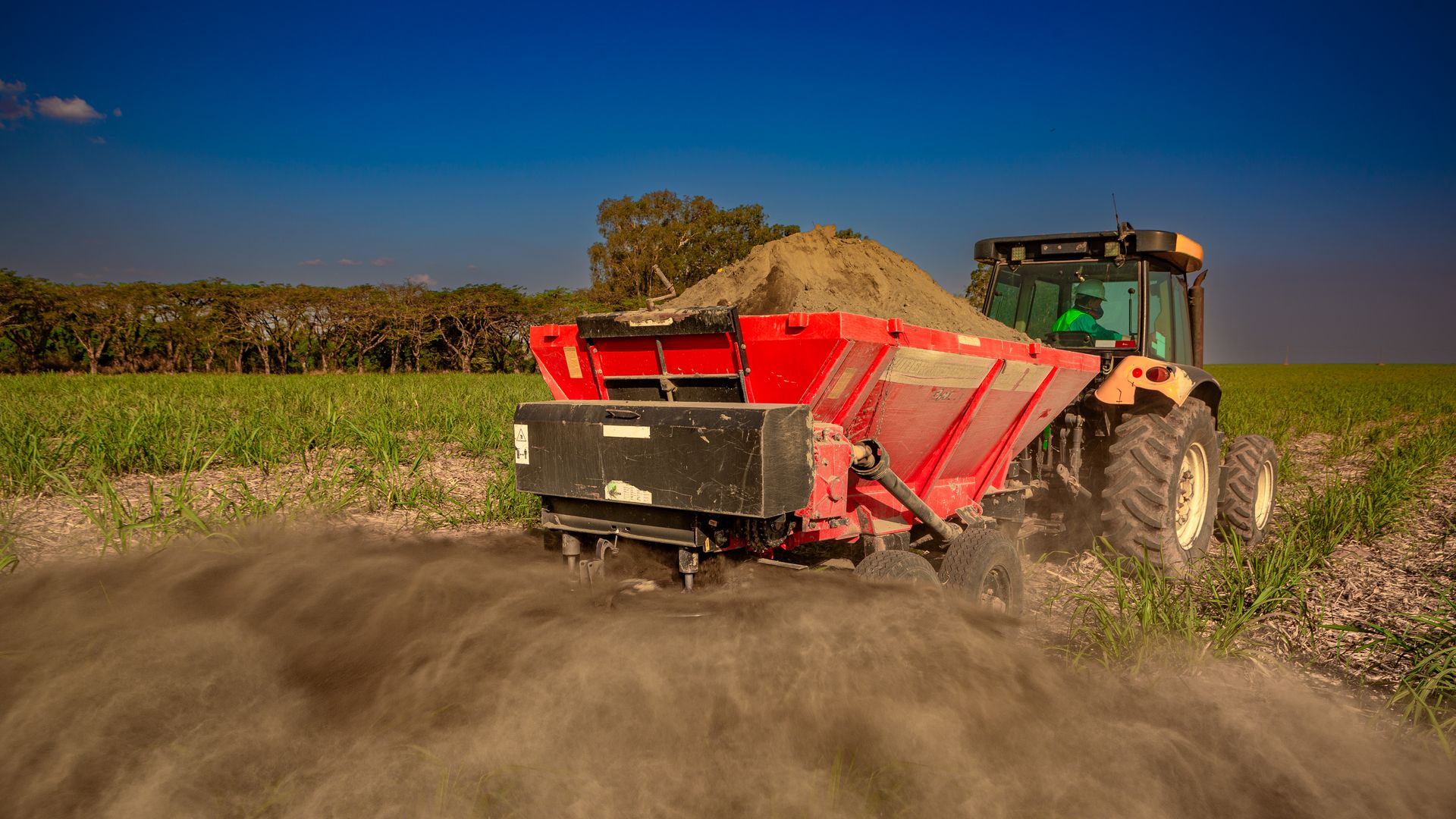
Spreading crushed rock over farmland is having a climate tech moment.
Why it matters: Investors and companies like Google are buying into the technique as a low-cost method of removing carbon from the atmosphere.
Catch up quick: So-called enhanced rock weathering (ERW) is a process of spreading pulverized limestone rock on cropland.
- The rock reacts with carbon dioxide in the soil and the CO2 is sequestered, while also making the soil healthier and increasing crop productivity.
Driving the news: Last month the first independently verified carbon removal credits for an ERW project were issued.
- Adyen, a Dutch financial services company, purchased the carbon removal credits, issued to project developer InPlanet. Carbon registry firm Isometric verified the credits and portfolio management company ClimeFi brokered the deal.
- The verified credits are "a huge moment for carbon removal," said Eamon Jubbawy, the founder and CEO of Isometric. They're key for "inviting more capital in," and for more buyers to start buying credits, said Jubbawy.
- Enhanced rock weather projects currently only make up 2% of carbon removal credits, with just 560,000 total tons purchased, according to research firm CDR.fyi. The sector has been held back by the lack of verification of projects.
Fun fact: Sixty-five percent of all ERW volume was contracted in 2024, says CDR.fyi.
- The largest announcement came from two deals totaling 290,000 tons for Google and buying group Frontier from ERW startup Terradot in December.
Our sister newsletter Axios Pro: Climate Deals has more. Consider subscribing for a steady diet of scoops and smart analysis.
4. 🔥 SoCal faces "as bad as it gets" fire weather threat

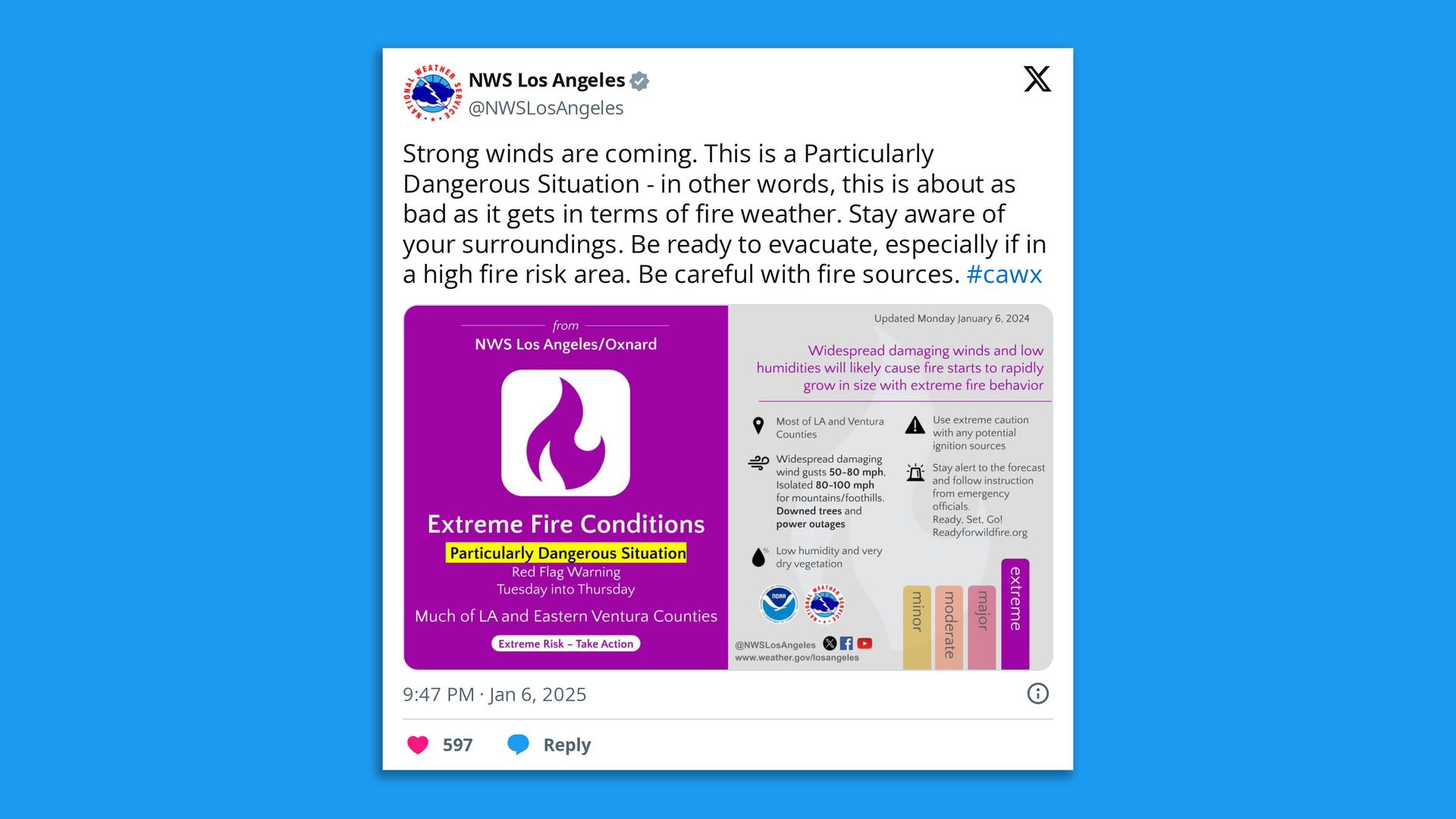
Southern California faces "extremely critical fire weather" with powerful winds that will likely result in "widespread" downed trees, power lines and electricity outages beginning today, the National Weather Service warns.
Threat level: Rare, late-season, "Particularly Dangerous Situation" red flag warnings were set to go into effect at noon PT today as the region faced a life-threatening, destructive and widespread windstorm after months of dry weather that could produce hurricane-force gusts of up to 100 mph in some areas, per the NWS' Los Angeles/Oxnard office.
- The NWS said it's a "Particularly Dangerous Situation" for Los Angeles and Ventura counties, where red flag warnings were in effect today through Thursday and fire weather watches were issued for Thursday night into Friday.
- "Strong winds are coming," the office stated on X. "In other words, this is about as bad as it gets in terms of fire weather."
Context: This wind event is "such a great fire weather threat" because it "still hasn't rained this season meaningfully in Southern California," said UCLA climate scientist Daniel Swain in a video briefing on yesterday afternoon.
- There is evidence that climate change "has already affected and will continue to accentuate changes in seasonal hydro climate, but not so much evidence, it's really affecting the winds themselves, or that it will necessarily in the future," Swain added.
- It's been "bone dry" in some places after "only a few sprinkles since last season," Swain said.
5. Quote of the day, Trudeau edition
"Canada is back, my good friends. We are here to help."— Canadian Prime Minister Justin Trudeau speaking to delegates at COP21 in 2015, his first year as the country's leader
Trudeau, who announced yesterday he would leave office, took many steps on climate change during his tenure, some of which, like a carbon tax, were highly controversial. At the same time, he struggled with the duality of his country's role as a major oil and gas producer.
Did a friend, colleague or a LinkedIn contact you scarcely know send you this newsletter? Welcome, please sign up.
🙏 Thanks to Chris Speckhard and Chuck McCutcheon for edits to today's edition, along with the brilliant Axios Visuals team. (Big H/T to Sara Grillo for the illustration at the top of the newsletter.)