Axios Generate

April 17, 2024

👨🍳 Today's menu is wide but won't fill you up. We've got 1,230 words, a 4.5-minute read.
⛔ Situational awareness: Biden officials plan to reject a proposed road needed to access big copper deposits in a remote Alaskan region, per Politico and others.
- It shows a "selective" approach to tapping energy transition minerals, WaPo notes with careful phrasing on the controversial topic.
🎹 This week in 1972, the late Bill Withers released a brilliant and timeless single that's today's intro tune...
1 big thing: Carbon removal company branches out
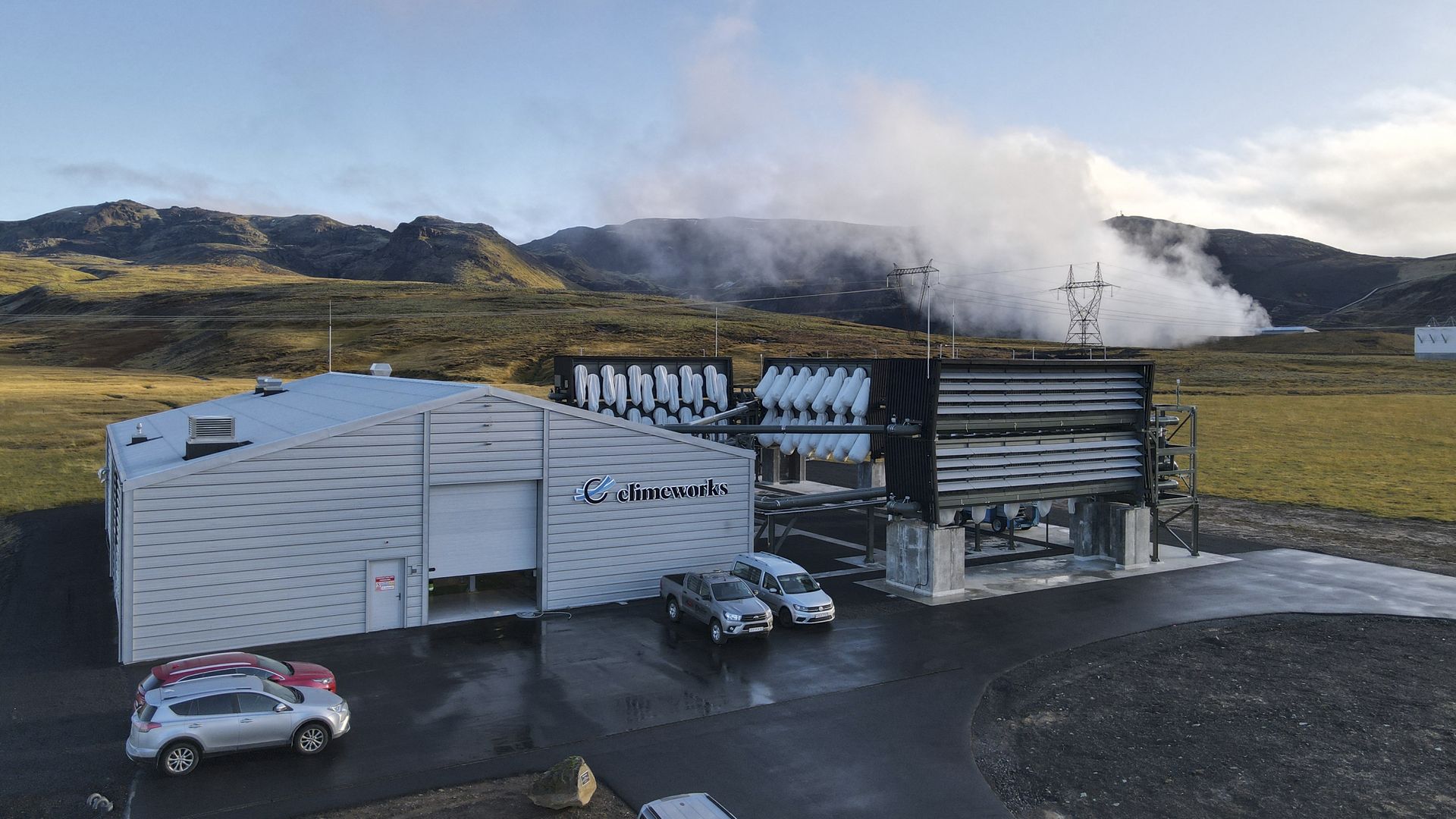
Climeworks' factory at the Hellisheidi power plant near Reykjavik. Photo: Halldor Kolbeins/AFP via Getty Images
Climeworks, one of the earliest and most prominent companies trying to draw carbon out of the air for a profit, is branching out via a carbon removal portfolio company called Climeworks Solutions, Andrew writes.
Why it matters: This move, announced today, allows companies to pay Climeworks for verifiable carbon removals from a range of technologies.
- It could herald similar pivots by other removal companies to take advantage of additional revenue streams.
The big picture: The company, headquartered in Zurich with a growing U.S. presence, is focused on scaling up direct air capture technologies.
- Company leaders described the new venture as an extension of its main air capture work.
- Constructing direct air capture facilities has given its staff insights into the effectiveness of this and other removal technologies, which gives it an advantage in helping other customers.
Zoom in: As of today, Climeworks no longer simply offers companies a way to contract for direct air capture solutions at its facilities in Iceland, for example. But it will instead also offer to construct and carry out carbon removal portfolios.
- These may consist of both engineered and nature-based approaches to carbon removal.
- It's akin to an investing company offering a mix of index and mutual funds — except instead of a portfolio of stocks and bonds, this involves different ways to remove carbon from the atmosphere.
How it works: Breitling, the luxury watchmaker popular among pilots, is Climeworks Solutions' inaugural customer, having signed a 12-year agreement.
- The new division is already in conversations with about 50 companies, said Adrian Siegrist, VP of Climeworks Solutions, during a media briefing yesterday.
Context: Many experts have doubts about how quickly, effectively and cheaply carbon removal technologies, such as direct air capture, can scale up.
- However, climate studies show that carbon removal will be necessary to limit global warming to the Paris targets.
- This is due to the sheer amount of long-lasting CO2 emitted by cars, trucks, power plants, deforestation and other sources to date. Also, global emissions are still increasing.
The bottom line: Climeworks' new division may be a natural outgrowth of its expertise in direct air capture, as it has seen increasing momentum in that market.
- "Companies are looking to purchase bundles or portfolios of different carbon removal approaches," Siegrist said.
2. White House wants new Chinese steel tariffs...

Illustration: Shoshana Gordon/Axios
President Biden is urging his trade policy chief to consider tripling tariffs on Chinese steel and aluminum, Ben writes.
Why it matters: Officials cast the move in economic but also climate terms. "American companies must lead the future of more sustainable steel," the White House announcement states.
Driving the news: U.S. workers face "unfair competition" from Chinese metals that are "among the world's most emissions-intensive," the White House said.
3. ...as Biden wants climate stitched into trade policy

Illustration: Aïda Amer/Axios
The White House is also launching a wider push to make global trade more emissions friendly, Ben writes.
Why it matters: Climate aide John Podesta said the current system built to promote open markets is ill-suited to fighting global warming.
- It's an "elephant in the room" he said yesterday, calling trade a massive emissions source.
Driving the news: Podesta announced the White House Climate and Trade Task Force. Goals include:
- Addressing carbon "leakage" — industries moving from nations with strong climate policies to nations with weak ones.
- Ensuring credible data and creating of internationally recognized measurement standards.
Threat level: His comments at a New York energy conference listed several ways today's system doesn't work.
- "There is no penalty for what I like to call carbon dumping — when high emissions in production are exported back into countries with stronger climate policies," Podesta said.
The intrigue: Podesta called out China, noting its massive aluminum output creates 60% more emissions per ton than smelters in the U.S., where the industry has shrunk.
- And he complained that "well structured" U.S. clean tech incentives are subject to a Chinese challenge at the World Trade Organization.
Podesta also said the task force would "draw lessons" from ongoing U.S.-EU talks over a "global arrangement" on steel and aluminum.
What's next: Task forces are common in Washington, so let's see if this can truly make trade any greener.
4. Chevron's new $500M tech fund

Illustration: Shoshana Gordon/Axios
Chevron's venture capital arm unveiled a new $500 million fund focused on climate-friendly tech, Ben writes.
Why it matters: It's Chevron Technology Ventures' largest fund to date and comes as oil majors are diversifying and under pressure to cut emissions.
The big picture: The Future Energy Fund III "aims to expand investment in the areas of novel low carbon fuels, advanced materials and transforming carbon to higher value products," the announcement states.
- It will also continue CTV's focus on areas like industrial decarbonization, mobility, and the "circular carbon economy."
What's next: CTV president Jim Gable said initial investments from the latest fund will be in the $1 million to $5 million range, targeting Series A through C rounds.
5. Bezos AI fund and more tech finance notes

Illustration: Aïda Amer/Axios
🧠 The big Bezos Earth Fund will provide up to $100 million in grants for projects that leverage AI to address climate change and nature loss, Ben writes.
- Why it matters: AI plays an uncertain role in the fight against climate change.
- The big picture: There's excitement around applications like battery materials development and extreme weather forecasting — and concern that huge power needs make decarbonization harder.
- What's next: Applications for the first round open in May. Initial funding focuses on sustainable protein development, biodiversity conservation, and grid optimization.
💵 SOSV, an early stage climate tech investor, has closed its fifth and largest fund, raising $306 million, Axios Pro: Climate Deals Katie Fehrenbacher reports.
- Why it matters: The haul underscores the continued demand from institutional investors around climate tech, particularly for VCs with a history of returns.
- What's next: Focus areas include renewable energy, biomanufacturing and rare mineral processing, managing general partner Sean O'Sullivan tells Bloomberg.
6. Catch up quick on oil: risk premiums and Iran

Illustration: Sarah Grillo/Axios
⚔️ A Eurasia Group note tries to quantify how much specific types of conflict escalation will boost the existing geopolitical risk premium on oil prices, Ben writes.
State of play: Starting from a $90 per barrel Brent baseline, it estimates more attacks on Russian oil assets would add another $1.
- Increased attacks on Western oil tankers in the Red Sea is another $1, while attacks on Iraqi oil assets with "Western links" would add $1-$2.
Moving up the ladder:
- Stricter enforcement of U.S. oil sanctions on Iran adds $2-$3 if the tougher enforcement removes 500,000 barrels per day from the market.
- "Sporadic" attacks on oil tankers in the Strait of Hormuz would add $4-$5. An unlikely "full scale" Iran-Israel war adds $50 or more.
🇮🇷 Speaking of Iran, Reuters has a good analysis showing why the White House is unlikely to ramp up sanctions enough to greatly cut its oil exports, despite Capitol Hill pressure.
- The bottom line: There's strong motivation not to push up prices or worsen relations with China, a major buyer of Iranian oil.
7. Bonus: charting China's oil thirst
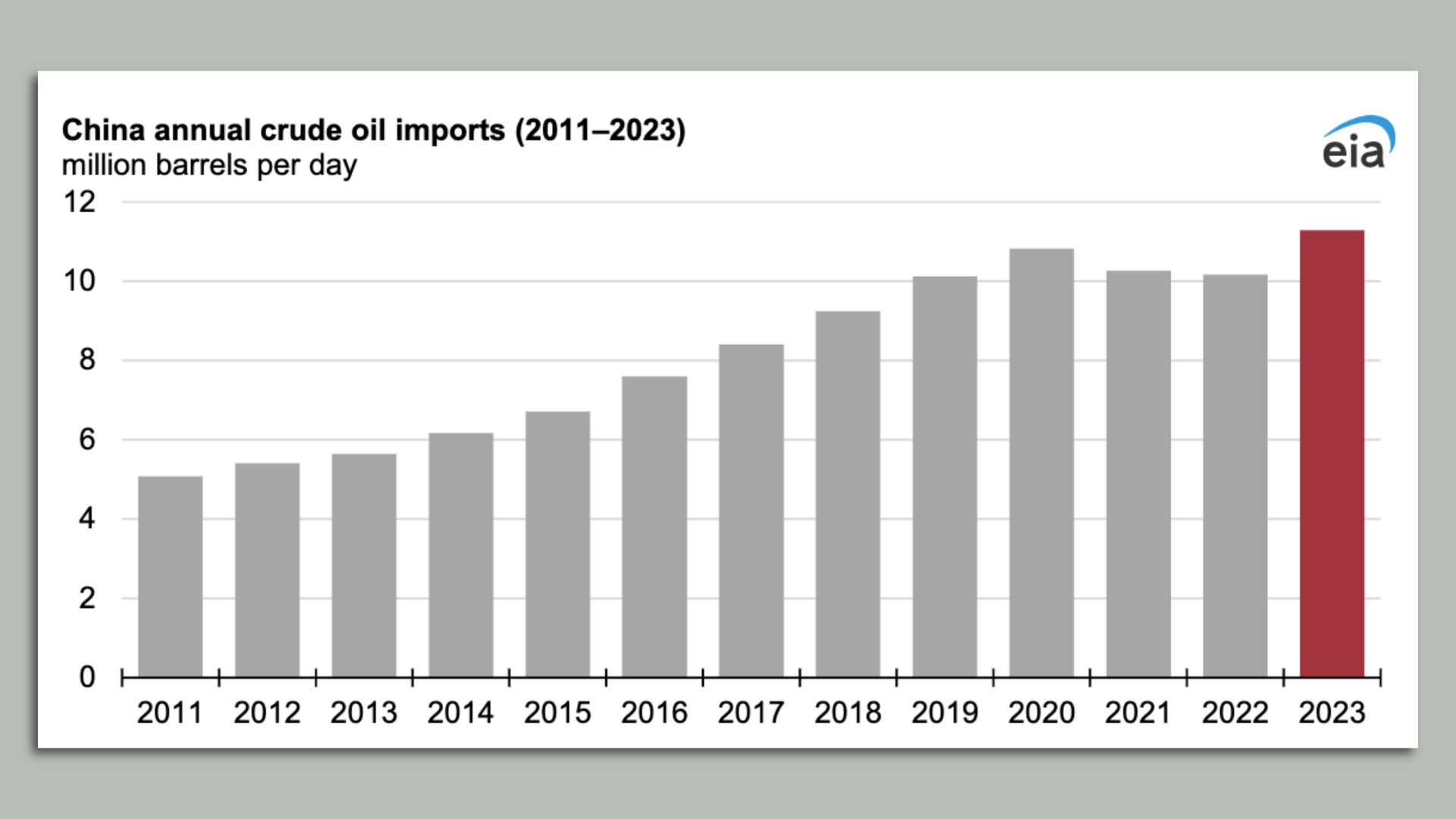
Image: Courtesy of the Energy Information Administration
China's crude oil imports hit a record last year, per a new Energy Information Administration primer, Ben writes.
Why it matters: The country is the world's largest oil buyer, so future versions of this chart will help show whether global demand is heading for a peak or at least plateau in coming years.
The big picture: EIA's primer also takes stock of geopolitically-driven market shifts. China's imports from Russia have jumped as Europe shuns Kremlin-backed barrels.
Russia accounted for almost 20% of Chinese supplies in 2023, displacing Saudi Arabia as the top source.
📬 Did a friend send you this newsletter? Welcome, please sign up.
🙏 Thanks to Chris Speckhard and Javier E. David for edits to today's edition, along with the brilliant Axios Visuals team.