Axios Generate

August 21, 2023

🍩 Good morning! Today's newsletter has a Smart Brevity count of 1,261 words, 5 minutes.
⛈️ Situational awareness: Flash flood warnings continue this morning for parts of California after historic amounts of rain fell from then-Tropical Storm Hilary.
🎶 This week marks the 25th anniversary of Lauryn Hill's brilliant album "The Miseducation of Lauryn Hill," which has today's intro tune...
1 big thing: Extreme weather summer escalates
Illustration: Natalie Peeples/Axios
The era of simultaneous climate disasters is here to stay, Andrew writes.
Why it matters: The new reality, now on full display from Texas to the Northwest Territories of Canada, is a mere preview of what the planet will look like after warming at least 1.5°C (2.7°F) above preindustrial levels.
- That has already been achieved, albeit briefly, due to the combination of human-caused climate change and an El Niño event.
The big picture: Most experts did not have these extreme weather events, all happening at the same time, on their climate change bingo card for 2023. During Canada's worst wildfire season on record, a complete evacuation of the largest city in the Northwest Territories was carried out, while Kelowna in British Columbia is threatened by advancing flames as well.
- At the same time, Tropical Storm Hilary made a rare incursion into Southern California, causing historic amounts of rain, flash flooding and unheard-of rainfall rates in the middle of the desert.
- Meanwhile, in the central U.S., an infernal heat dome is spiking heat indices to staggering territory between the Twin Cities and Houston.
- This is all occurring in the wake of the deadliest wildfire disaster in modern U.S. history, which may have had certain climate change links.
Between the lines: It's likely this summer's heat and wildfire scourges will stand out as the most impactful and unusual climate change-related extreme events, although climate change likely has boosted the rains in the Southwest.
- Some areas' heat waves have never fully relented since the spring, primarily among parts of Texas, Louisiana and South Florida.
- As of Monday morning, about 117 million people in more than a dozen states are under extreme heat alerts.
- During the past 30 days alone, the U.S. has seen 8,304 hot temperature records set or tied, compared to 1,321 cool temperature records, according to NOAA data.
Context: Climate change is causing heat waves to be more intense, longer-lasting and more frequent. Recent studies have shown that some extreme heat events would not have occurred in the absence of human-caused climate change.
What's next: While Hilary's remnants are forecast to inundate areas all the way to the northern Rockies, the record-strong heat dome is likely to only intensify this week.
- As for the fires in Canada, they may take until winter (or longer) to die down.
- Oh and by the way, the Atlantic hurricane season is waking up from a long slumber...
2. Bonus: Hilary's direct connection to the tropics
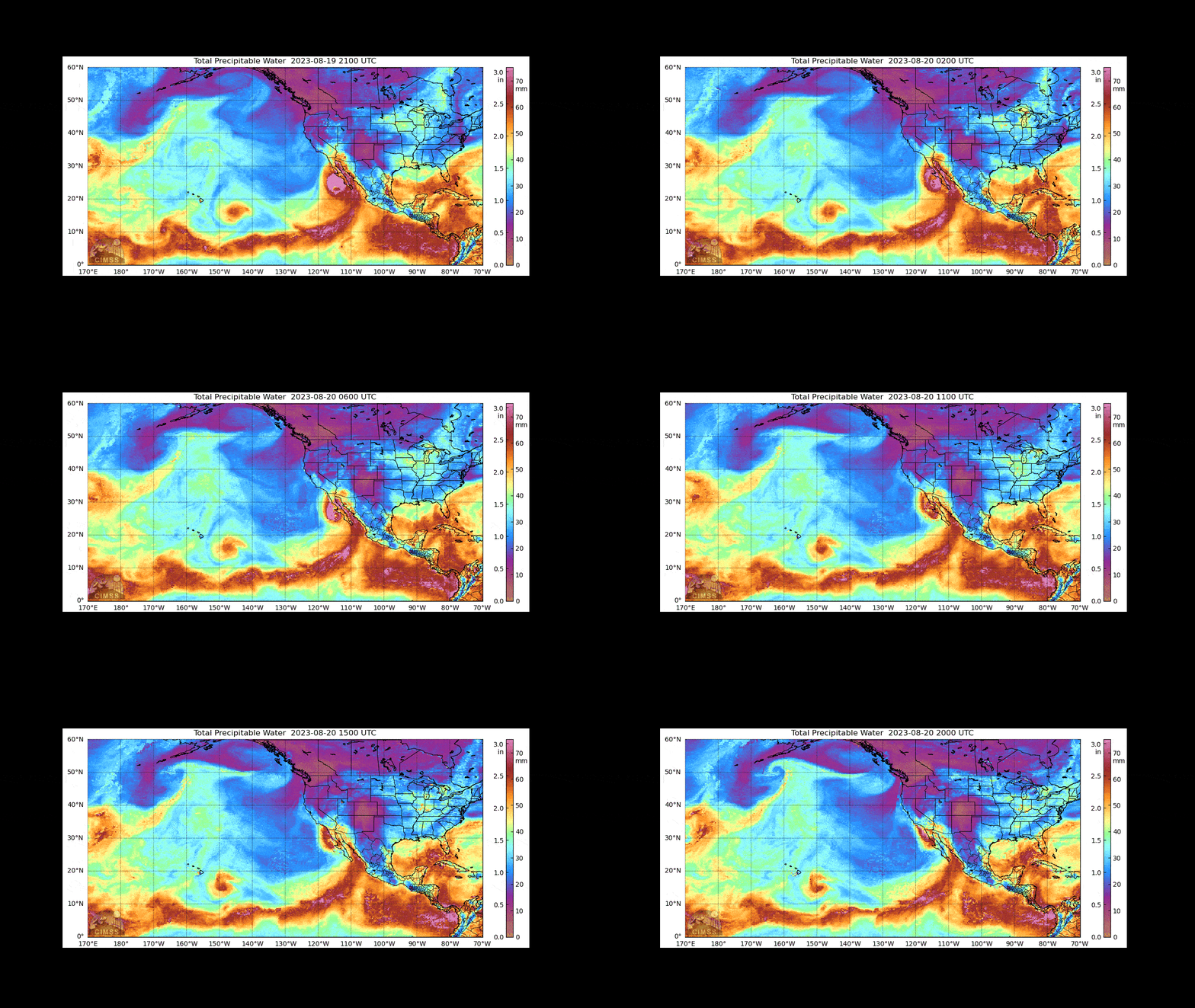
Animation of atmospheric water vapor on August 19 and 20, showing the tropical moisture feeding into then-Hurricane Hilary. Image: University of Wisconsin/CIMSS
The rainfall that made then-Tropical Storm Hilary so damaging came directly from the heart of the tropics, Andrew writes.
Zoom in: An animation of total precipitable water in the atmosphere is shown with Hurricane Hilary off the coast of Mexico on Saturday and Sunday.
How it works: A reddish tail depicting deep, tropical moisture arcs back from the storm's swirling core, to near the equator.
- There, warmer-than-average ocean waters associated with El Niño, along with ocean warming from climate change, fed it with huge amounts of water vapor.
- The storm concentrated this moisture and wrung it out in the form of flooding rains across parts of Mexico and the U.S.
3. Ocean carbon removal startup takes a step forward
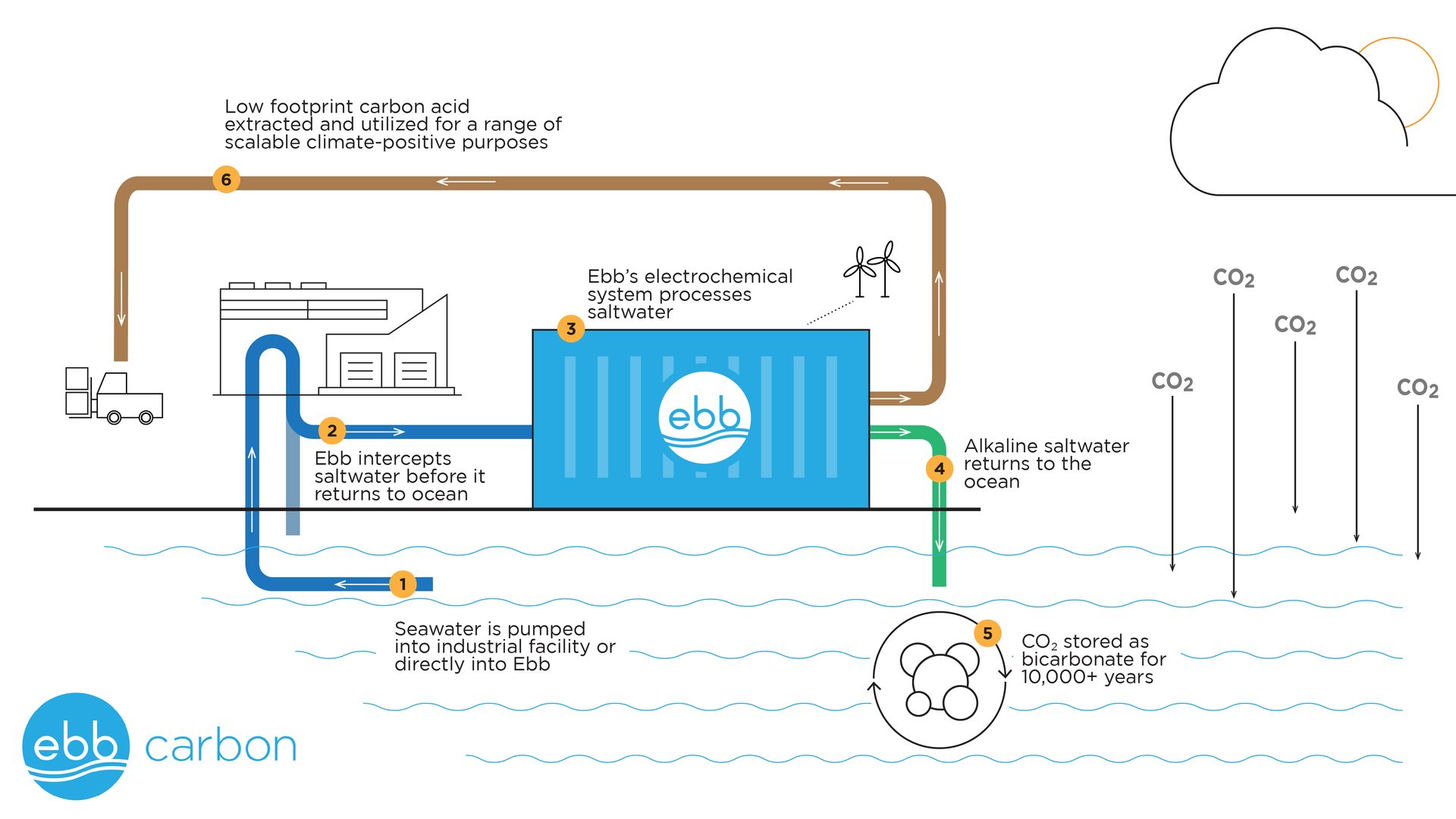
Image courtesy of Ebb Carbon
Who knows if this tech could ever scale, but an ocean-based carbon dioxide removal startup with big-time science partners has launched real-world testing in Washington State to help find out.
Driving the news: Ebb Carbon just announced deployment of its marine removal system at the Energy Department's Pacific Northwest National Laboratory branch in Sequim, Ben writes.
How it works: The system is designed to speed CO2 uptake, while making ocean waters less acidic.
- The test program will intercept seawater inflows from Sequim Bay and run it through membranes that de-acidify it.
- Remaining alkaline water is exposed to air and transformed into bicarbonate.
- "Much like alkalinity is extracted from rocks, it can also be extracted from seawater, in a fraction of the time, using electrochemistry," an Ebb Carbon explainer notes.
Of note: Ebb Carbon raised a $20 million series A round this year; several execs have long climate tech resumes.
- CEO and co-founder Ben Tarbell is a veteran of Google's innovation lab.
- Co-founder and VP of engineering Dave Hegeman spent almost a decade at Tesla working on battery tech.
Yes, but: This remains very much a test bed, with tiny anticipated removal amounts.
- Treated seawater, before being released to the ocean, will be held in tanks for researching CO2 sequestration, de-acidification and biology.
- Ebb is working with DOE, NOAA, and the University of Washington. The project has funding support from those agencies and the ClimateWorks Foundation
The bottom line: With ocean-based removal startups proliferating, finding out what might work at scale is important. This is one to watch.
4. Catch up fast on policy: Solar tariffs and minerals

Illustration: Sarah Grillo/Axios
☀️ ICYMI, The Commerce Department announced its final conclusion that several Chinese manufacturers are skirting U.S. import duties on solar equipment by routing them through Southeast Asia, Ben writes.
- Why it matters: The finding, after a long and politically contentious probe that followed a petition from U.S. manufacturer Auxin, could bring steep new import tariffs after a White House waiver expires in mid-2024.
The intrigue: The probe put the Biden administration in an awkward position, setting "two key constituencies against one another: renewable developers/clean energy lobby vs domestic manufacturing interests," John Miller of the TD Cowen Washington Research Group said in a note.
- What they're saying: The Solar Energy Industries Association bashed the decision, saying it creates problems for new U.S. projects. They note the climate law-backed ramp-up of domestic manufacturing takes years.
- Go deeper: CNN has more.
⛏️ President Biden's meeting Friday with leaders of Japan and Korea brought plans to deepen collaboration on key mineral supply chains, the White House said.
- Driving the news: They announced a "Supply Chain Early Warning System (EWS) Pilot." "They will identify priority products and materials—such as critical minerals, and rechargeable batteries—and establish mechanisms to rapidly share information on disruptions to crucial supply chains," a White House summary states.
5. Cargo ship with giant sails heads out on voyage
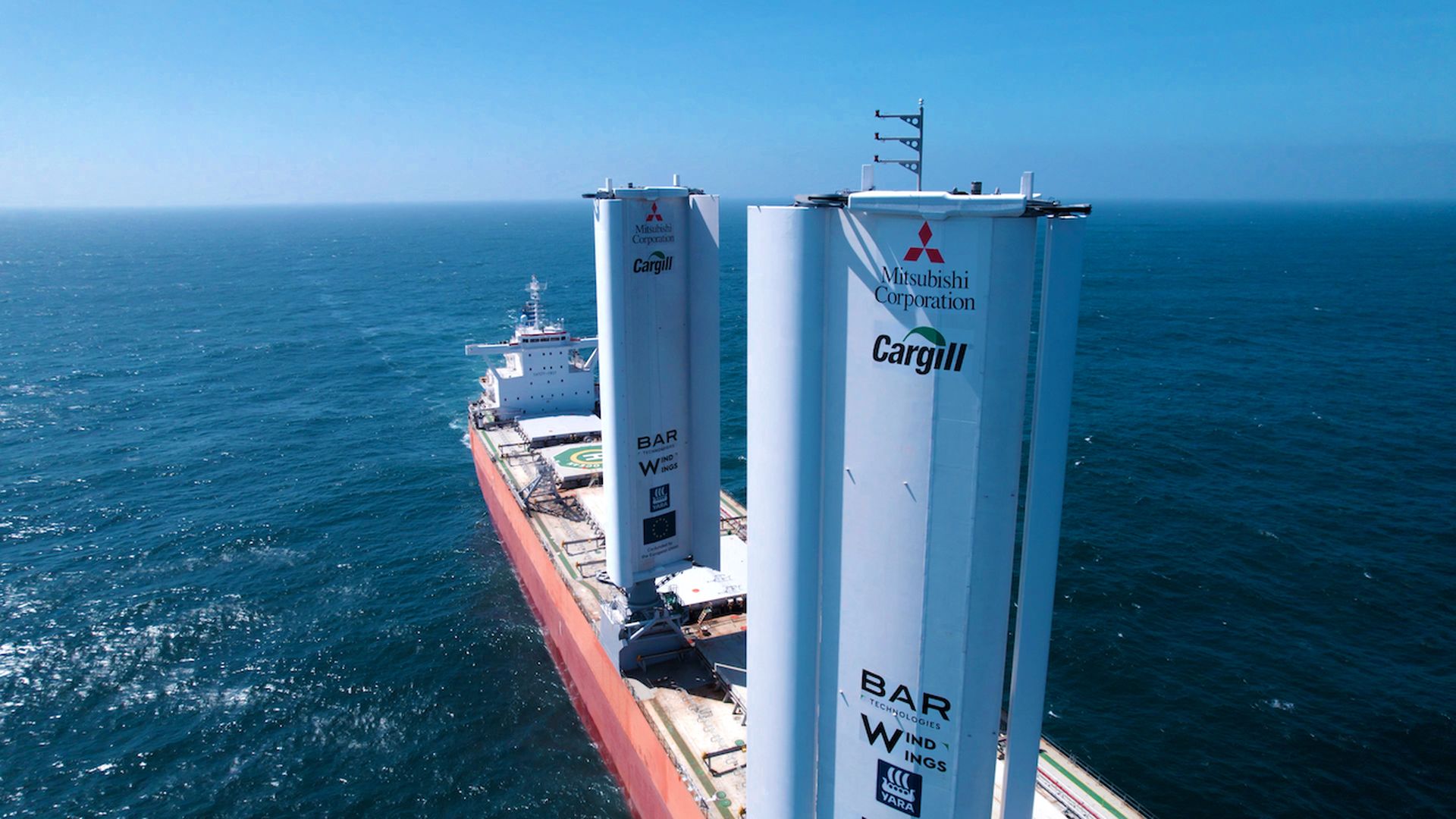
Picture of a cargo ship outfitted with sails. Image: Cargill
Sea tests are now underway to try to decarbonize cargo vessels by outfitting them with giant sails, Andrew reports.
Driving the news: A partnership between Cargill, BAR Technologies, Mitsubishi Corp. and Yara Marine Technologies holds the potential to cut emissions from cargo vessels significantly, according to Cargill.
- A cargo ship outfitted with two giant, high-tech sails, called "WindWings," is now being tested on ocean routes.
- Mitsubishi's Pyxis Ocean vessel, which Cargill has chartered, has been modified with two large sails measuring more than 100 feet tall. The vessel is currently making a cargo run from Singapore to Brazil, Cargill said.
Zoom in: The goal is to achieve average fuel savings of up to 30% or more on new vessels, which could be combined with other emissions cuts from using alternative fuels like methanol instead of greenhouse gas-intensive heavy fuel oil.
- "Zero carbon fuel ships are coming into the market earlier than expected, we may consider putting WindWings on new builds rather than retrofitting," Jan Dieleman, president of Cargill's Ocean transportation business, told Axios in a statement.
6. One tech thing to go
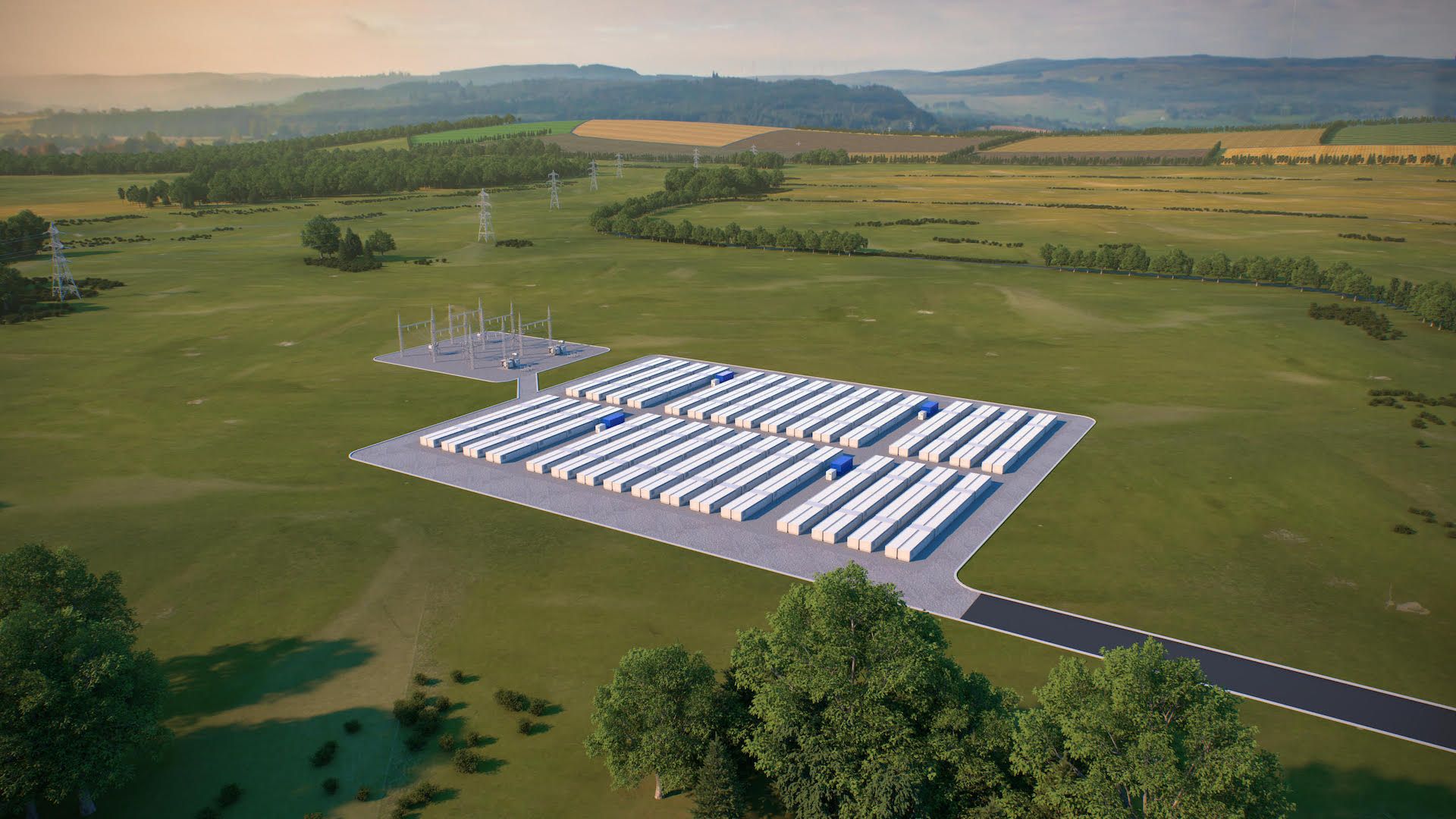
Image courtesy of Form Energy
Storage startup Form Energy will install a 10 megawatt, iron-air battery system in New York state, aided by a $12 million grant state officials announced late last week, Ben writes.
Why it matters: It's the only multiday storage project in the Empire State thus far, Form said.
- Long-duration storage can help enable high levels of intermittent renewables on power grids.
What's next: The award "sets the path for us to deliver further multi-day storage projects in the state in the future," Form CEO Mateo Jaramillo said in a statement.
- State officials are hoping for lots of industry deployment growth — their goal is six gigawatts deployed by 2030.
📬 Did someone forward you this newsletter? Welcome and please sign up.
🙏 Thanks to Chris Speckhard and Javier E. David for edits to today's edition, along with the talented Axios Visuals team.
Sign up for Axios Generate
Untangle the energy industry’s biggest news stories