Axios Generate

November 21, 2023
🕺 Let's do this! Today's newsletter has a Smart Brevity count of 1,132 words, 4.5 minutes.
🎶 This week marks 45 years since genius funk aliens Parliament dropped "Motor Booty Affair," which provides today's intro tune...
1 big thing: Kerry, UN boss show more COP28 cards

Photo illustration: Allie Carl/Axios. Photo: Sean Gallup/Getty Images
Two pivotal figures in climate diplomacy are offering more information about what they want from COP28 and beyond, Ben and Andrew write.
Driving the news: United Nations Secretary-General António Guterres wants aggressive country plans that "plot a course for ending fossil fuels," he said Monday.
- Other asks for these plans include "clear 2030 and 2035 targets" and alignment with long-shot Paris goal of limiting warming to 1.5°C degrees, he said Monday.
Why it matters: The remarks signal what the UN boss hopes will follow the first "global stocktake" under the Paris Agreement at COP28.
- That's the formal process to gauge where the world stands in the fight against climate change — and how to course correct.
Quick take: He's planting another flag ahead of expected battles at COP28 over whether the summit should endorse a phaseout of fossil fuels.
Catch up fast: Guterres spoke at the rollout of UN projections that Earth will warm catastrophically beyond Paris targets under nations' current pledges.
- These non-binding targets, called "nationally determined contributions," are central to the Paris Agreement's architecture.
What's next: He's heading to Antarctica in a pre-COP trip to see climate impacts up close as the UN tries to underscore the summit's stakes.
Meanwhile, U.S. climate envoy John Kerry revealed Monday that the U.S. will unveil a global strategy for advancing nuclear fusion at COP28, Axios' Alan Neuhauser reports.
State of play: It follows recent advances by the Energy Department and startups.
- Kerry called it an "emerging climate solution" in a statement alongside his visit to Massachusetts startup Commonwealth Fusion Systems yesterday.
Reality check: In theory, fusion could mean almost limitless carbon-free power without the dangerous waste from traditional fission reactors.
- But there's a long and uncertain scientific, technical and financial road to commercializing this long-elusive holy grail.
The intrigue: Guterres wants a path to ending fossil fuels. Kerry is more cautious and wants oil and gas companies to work toward capturing their emissions and heading toward net zero.
The bottom line: With nine days to go until COP28, we're learning more about what to expect — and where the fault lines lie.
2. A "hard, but achievable" COP28 goal
Sick of pie-in-the-sky climate pledges? Take heart — a goal likely headed for endorsement at COP28 is both consequential and achievable, Ben writes.
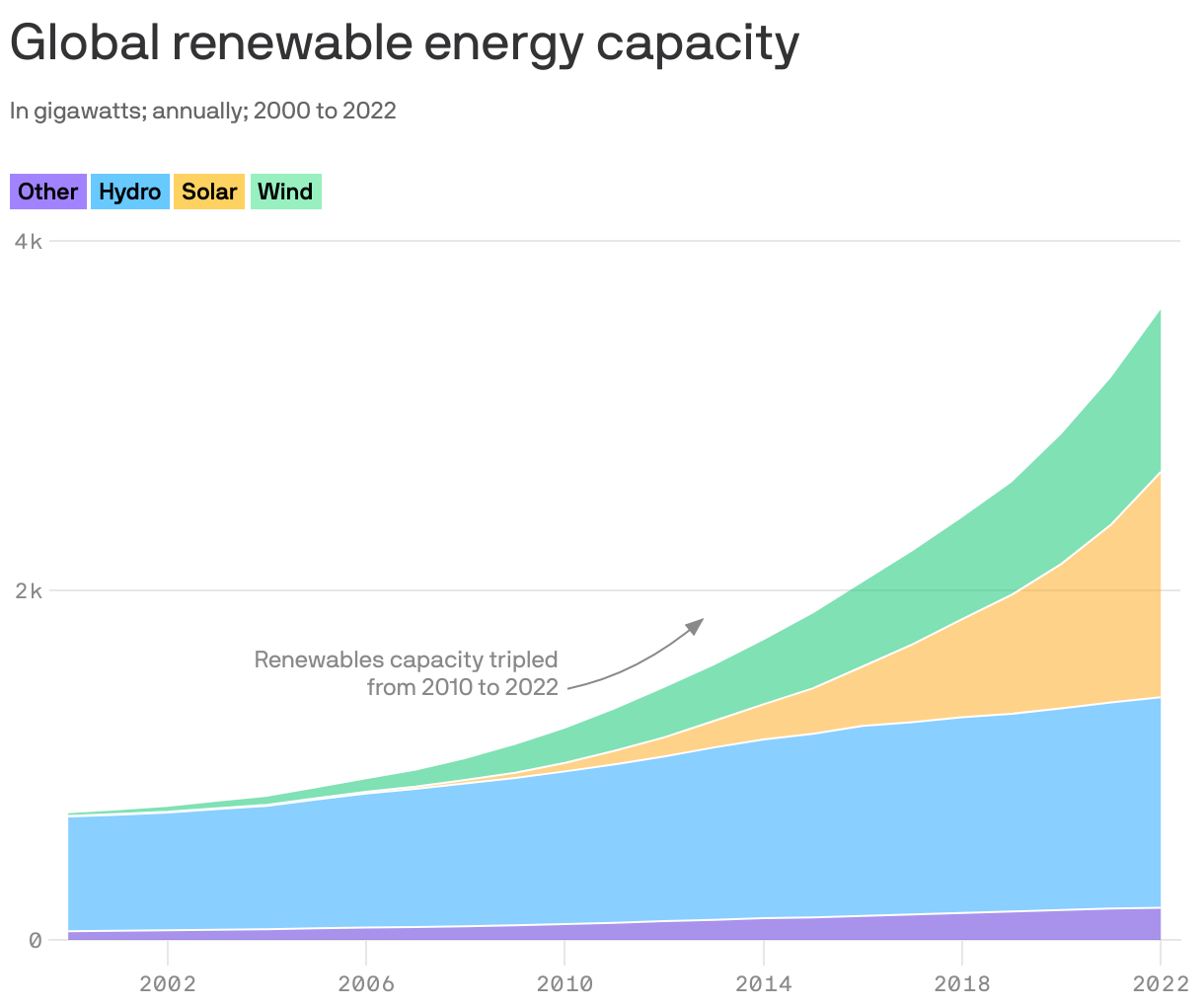
Driving the news: Two new analyses find tripling global renewables capacity by 2030 is possible with stronger investment and policy support.
Why it matters: Analysts call that metric vital because it helps displace coal and gas even amid rising overall power demand.
- Tripling is endorsed by, among others, COP28 head Sultan Ahmed al-Jaber of the United Arab Emirates.
State of play: BloombergNEF notes the last tripling took 12 years (see above), but that market changes make doing it again in eight "hard, but achievable."
- "Wind and solar are now the cheapest sources of new generation in most countries, making such a goal more feasible than ever," the firm notes.
- Meanwhile, a separate analysis from climate think tank Ember reaches largely the same conclusion.
Yes, but: A lot has to break right.
- BloombergNEF estimates investment needs at over $1 trillion annually — roughly double last year's levels. And big grid investments are needed too.
- Ember notes that governments are already on a path to doubling capacity by 2030 but that national targets should become more ambitious.
The intrigue: BloombergNEF warns that solar, which is booming, shouldn't shoulder too much of the weight, due to low capacity factors and seasonal variations.
- Tripling while relying too much on solar "will not see the same impact on electricity generation, nor emissions reductions, as one with a more diverse fleet of renewables."
3. 👀 Battery player claims breakthrough and more tech notes
Illustration: Annelise Capossela/Axios
🔋 Swedish battery producer Northvolt says it has developed a sodium-ion product that's free of lithium, nickel, cobalt and graphite, Ben writes.
- Why it matters: Battery firms are seeking chemistries that reduce their exposure to volatile and competitive markets for several key minerals.
- The intrigue: CEO Peter Carlsson tells the FT it means "we are not that dependent on a number of these strategic supply chains that China has created in a very efficient way."
- State of play: Northvolt said the battery is initially aimed at stationary storage markets. It said lower costs and safety at high temperatures makes it a good fit for markets in India, the Middle East and Africa.
🤝 Direct air capture firm Climeworks and carbon removal developer Deep Sky this morning announced a partnership aimed at building large-scale projects in Canada.
- Why it matters: Climeworks is among the companies furthest along in the nascent DAC sector, while the young firm Deep Sky has been increasingly active in fundraising and working with removal startups.
💵 Via the Wall Street Journal, "Australian iron-ore titan Fortescue Metals Group approved a $550 million green hydrogen project in Arizona, the centerpiece of an initial slate of projects aimed at recasting the company founded by billionaire Andrew Forrest as a clean energy giant."
4. News you can use: holiday EV rentals
Illustration: Sarah Grillo/Axios
Thousands of travelers could find themselves behind the wheel of a rented electric vehicle for the first time this holiday season — whether they chose to rent one or not, Axios' Joann Muller reports.
Why it matters: Companies like Hertz and Avis have beefed up their EV fleets and are offering substantial discounts over traditional models.
- Even if you bypassed the EV offerings for a traditional sedan or SUV when booking, you might get to the counter and find EVs are all that's left.
Be smart: Renting an EV can be a great way to try before you buy. But EVs can be quirky if you're not prepared — think different starting systems, doors and more.
What's next: Some stress avoidance tips...
🧠 Get familiar with the car before leaving the rental lot. Ask questions; rental agents don't often provide much instruction.
🔋 Know the battery range and consider the weather where you're going (cold temps can lower range).
🔌 Explore charging options ahead of time. Some — but not all — cars' navigation systems will suggest locations along your route.
- But you can prepare early by downloading Tesla's app or other route-planning apps, like A Better Route Planner, PlugShare or Chargeway.
🛌 Some hotels have chargers, but call ahead to verify.
5. 🥃 1 fun thing: Green distilleries
Eight distilleries have earned the Environmental Protection Agency's "Energy Star" certification for efficiency and emissions performance, Ben writes.
Why it matters: A tasty pour requires real juice. Big distilleries, on average, consume as much annual power as 7,000 homes, per EPA.
State of play: Here are the facilities scoring 75 or higher on the "energy performance indicator."
- Bardstown Bourbon Company Distillery, Bardstown, Ky.
- Brown Forman's Jack Daniel Distillery, Lynchburg, Tenn.
- Rabbit Hole Distillery, Louisville, Ky.
- Heaven Hill's Bernheim Distillery, Louisville, Ky.
- Heaven Hill's Deep Eddy Vodka Distillery, Buda, Texas
- MGP/Lux Row Distillery, Bardstown, Ky.
- Heaven's Door Distillery, Pleasureville, Ky.
- Westland Whiskey Distillery, Seattle
📬 Did a friend send you this newsletter? Welcome, please sign up.
🙏 Thanks to Chris Speckhard and Javier David for edits to today's edition, along with the talented Axios Visuals team.


