
Axios Generate

July 03, 2024

🍩 Good morning. We're sprinting into the holiday with 1,267 words, 5 minutes.
🇺🇸 We're off tomorrow for July Fourth. See you Friday!
🎸 In honor of Axios visuals assassin Dani Alberti's chops, Santana and Rob Thomas (of Matchbox Twenty fame) have today's intro tune...
1 big thing: Hurricane Beryl's ties to 2005 and 1933


Hurricane Beryl, the most intense hurricane on record anywhere in the Atlantic Ocean so early, is only gradually weakening as it hits Jamaica with "devastating winds," heavy rain and storm surge flooding.
Why it matters: The storm's characteristics — including where it formed and rapidly intensified — offer clues as to how the rest of the season may play out.
Zoom in: Early storm activity doesn't normally correlate well with an active year, said Colorado State University scientist Phil Klotzbach, who specializes in seasonal hurricane forecasting.
- But this one is likely to be an exception.
- He said that when early storms, such as Beryl, form well to the south, in the deep tropics, and east of about 75° West longitude, "it tends to be a harbinger of a very busy season."
- "That predictor has worked out pretty well most years," Klotzbach told Axios via email. He noted an exception for 2013, when early, weaker storms didn't successfully predict an active season.
- "It's a whole different story when we're getting Category 5 hurricanes" right away, he said. "Unfortunately, Beryl is breaking records that were set in 1933 and 2005 — two of the busiest Atlantic hurricane seasons on record."
Between the lines: Klotzbach said early storm activity in that region seems to matter for seasonal forecasting because "it shows that environmental conditions are far more conducive than normal," with Atlantic sea surface temperatures running at record to near-record highs.
- Typically, early storms in the deep tropics, east of 75°W, face obstacles like cool sea surface temperatures, dust blown across the ocean from Africa, dry air and more, he said.
What's next: The storm appears to be a greater threat to the western Gulf Coast than earlier projections showed.
- Beryl's ultimate path will depend on two key factors: Its structure when it emerges off the north coast of the Yucatan Peninsula, and the intensity of a high pressure area across the Southeast.
- The storm is likely to round the western edge of the high pressure area and curve northward.
- This could bring it ashore as a tropical storm or hurricane this weekend in coastal Texas or Louisiana.
After Beryl, Klotzbach expects a break in Atlantic hurricane activity for a couple of weeks, until late July and early August, when large-scale weather patterns are better aligned.
- "I am quite worried what we'll have in store" at that time, he said.
2. What they're saying about Tesla's sales report


This chart ☝️ is a Rorschach test on the health of Tesla, showing deliveries rebounded sharply from last quarter's drop but remain lower than Q2 of 2023.
Why it matters: The wider EV transition is intertwined with the world's top seller of battery-powered cars.
State of play: Tesla reported roughly 444,000 deliveries, a proxy for sales, in the April-June period.
The company's stock jumped 10% as shipments beat Wall Street expectations, following Q1's surprisingly steep decline. But it remains down this year.
The intrigue: Analysts had mixed takes in comments to reporters.
- "The better-than-expected Q2 deliveries are not only a breath of fresh air for Tesla's margins but also for the EV market as a whole," Investing.com's Thomas Monteiro said.
But Edmunds' Jessica Caldwell said Tesla has exhausted its "bag of tricks."
- "[M]any EV competitors have also been generous with incentives, and the company's haphazard price cuts and incentives have become less effective in capturing the attention of shoppers the more frequently they're leveraged," she notes.
What's next: All eyes turn to Tesla's Q2 earnings report July 23 and its robotaxi event Aug. 8.
3. Historic heat is enveloping California

The heat wave that began yesterday in California is looking more intense and longer-lasting than previously expected, potentially pushing it into all-time record territory.
Why it matters: Up to two weeks of record-breaking heat is on tap across much of California, Oregon and portions of Nevada.
- Already, damaging wildfires have broken out, and the heat itself will be "life-threatening," according to the National Weather Service.
Zoom in: The Thompson Fire in Oroville, fueled by 100-degree-plus temperatures and strong winds, burned homes overnight.
Context: Human-caused climate change is increasing the likelihood, severity and duration of heat waves.
Threat level: This heat wave, with highs in the 110s°F in many inland areas, will be highly unusual for its duration and intensity.
- Dozens of daily, monthly and even some all-time records may fall.
- "I'm not so sure that really any of us will have seen this many days at this sustained level of heat, both daytime and most importantly nighttime heat," said UCLA climate scientist Daniel Swain in a video briefing yesterday evening.
- Many locations won't go below 70°F, or even 80°F, for more than a week, making cooling access paramount.
- "It cannot be stressed enough that this is an exceptionally
dangerous and lethal situation," the NWS office in San Francisco stated early today.
Between the lines: The heat will rapidly dry out vegetation, making it susceptible to wildfires.
- The Thompson Fire, which occurred on day one of the event, may be a preview of more destructive fires to come.
4. Bonus: U.S. cities swelter more often now
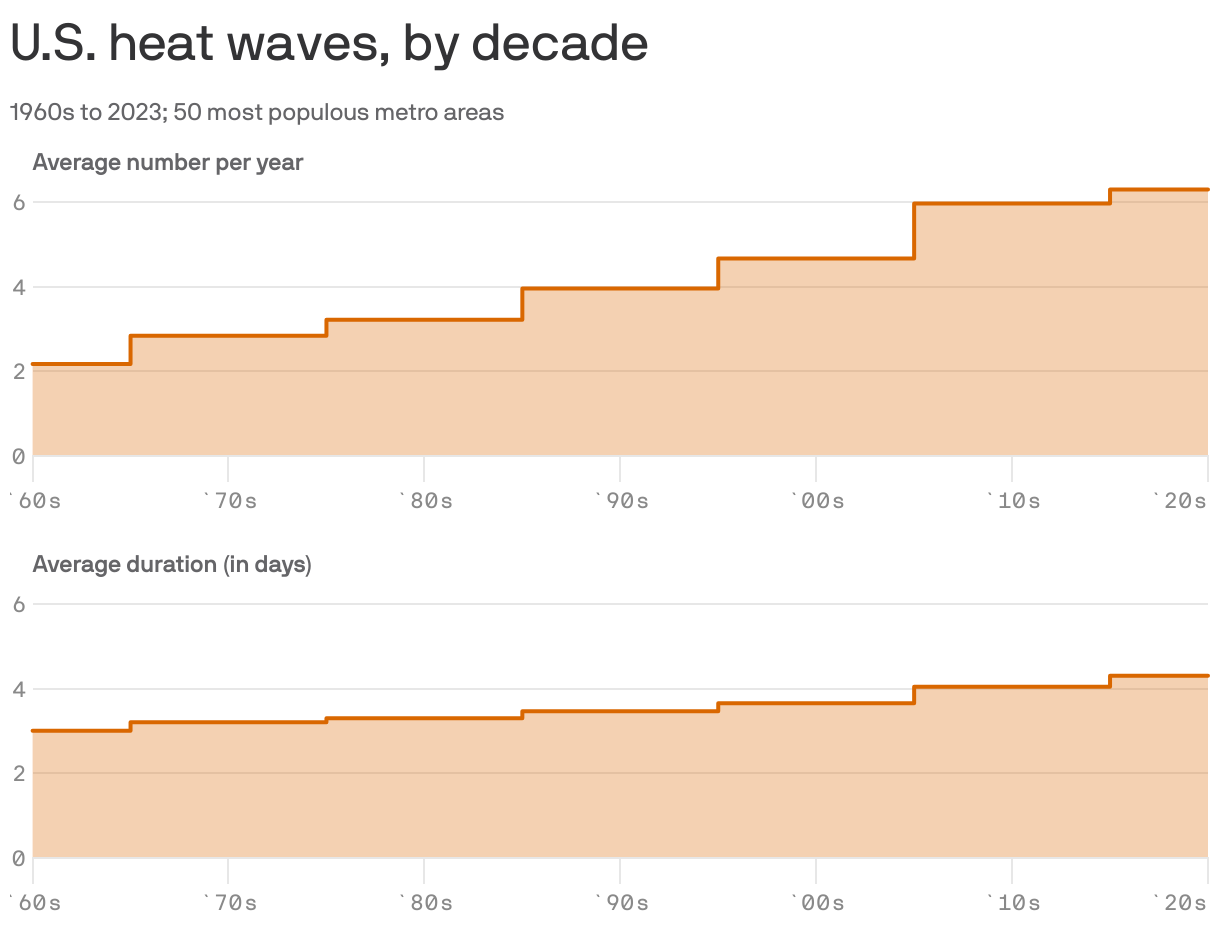
Updated data shows the upward march of heat waves in the U.S.
The big picture: The EPA info, part of a wider new report on climate metrics, shows heat trends in the 50 largest U.S. metro areas.
- Heat waves are becoming longer, more frequent, and more intense.
How it works: EPA tracked events of two or more consecutive days when daily, humidity-adjusted temps topped the 85th percentile of historical July-August temps in 1981-2010.

5. On my screen: cutting cement emissions
Energy analyst Hannah Ritchie's got a beautifully lucid new post explaining why CO2 emissions from cement production are so huge — and how to tackle them.
Why it matters: Lots of startups are pioneering ways to make it cleaner, with some methods closer to scale than others.
- "It's tempting to pick a 'favourite' or go all-in on one concept. That would be a mistake," she writes.
Threat level: The world's roughly 4 billion annual tons of cement production create around 7% of global fossil CO2 emissions.
- Roughly 40% comes from fuels used to heat limestone to very high temps.
- The balance comes from separating out calcium oxide, which leaves CO2 as a by-product.
What's next: Ritchie explores the promise and problems with several methods.
- Carbon capture is known tech, but very expensive — especially absent carbon pricing.
- Some concrete mixes rely on less cement and hence produce less emissions, but construction regs and building codes need updating.
- And there are limestone replacements that don't create CO2. Ritchie sees promise and cost advantages here, but getting from lab to scale and removing regulatory barriers isn't easy.
The bottom line: "Hand-picking one solution is a luxury we just don't have."
6. AI pushes Google emissions upward
Google is bullish about AI helping to fight global warming, but it's also candid about the energy-thirsty tech driving up the company's own emissions for now.
Why it matters: This climate yin-yang is on display in the tech giant's latest environmental report.
- Google's corporate emissions rose another 13% last year and are up 48% compared to their 2019 baseline.
- That's partly because data centers serving AI and other applications are using more power.
State of play: Last year's CO2 growth reflects the "challenge of reducing emissions while compute intensity increases and we grow our technical infrastructure investment to support this AI transition," the report states.
- But it also highlights ways they're moving to make AI infrastructure far more efficient.
- And outside their own operations, the report touts Google's AI products that cut CO2, such as tools that cities use to improve traffic.
What's next: Google faces a tough climb to reach its 2030 net-zero goal.
📨 Did a friend, colleague or even a frenemy send you this newsletter? Welcome, please sign up.
🙏 Thanks to Chris Speckhard and Chuck McCutcheon for edits to today's edition, along with the brilliant Axios Visuals team.
Sign up for Axios Generate