Western heat wave to break records, raise wildfire risks

Add Axios as your preferred source to
see more of our stories on Google.
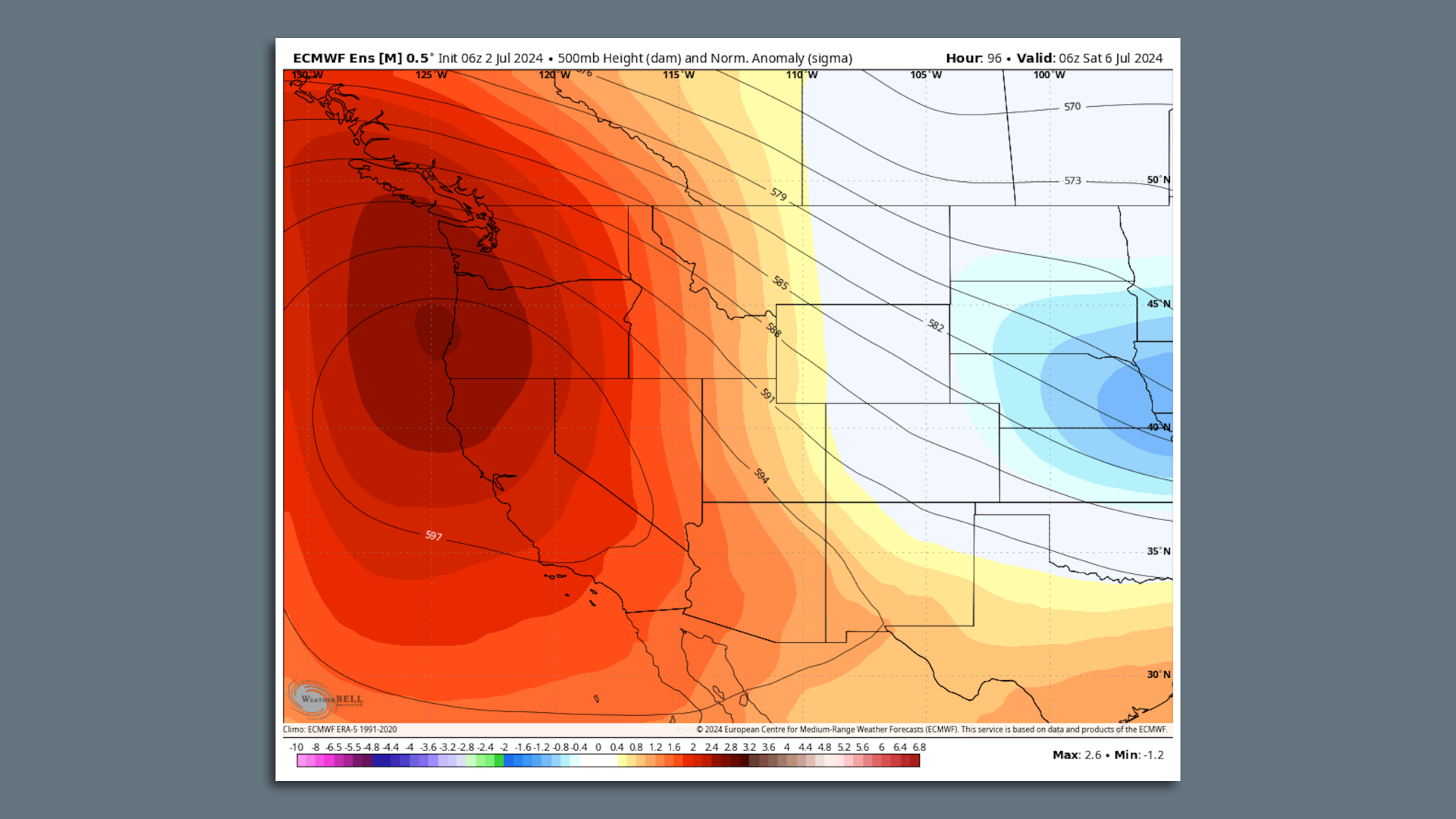
Computer model projection showing a powerful heat dome across the West Coast on July 6. Image: Weatherbell.com
California, along with a broader slice of the West, is set to experience a dangerous, long duration and intense heat wave beginning Tuesday and likely lasting well into next week.
Why it matters: Numerous daily record highs are likely to be set, along with monthly milestones for warm overnight minimum temperatures and the most prolonged heat streaks.
- "The duration of this heat wave is concerning," the NWS stated Tuesday morning.
Threat level: The National Weather Service has issued excessive heat warnings, advisories and watches for much of the Golden State from today through Monday. Highs are forecast to climb well into the 100s°F in inland areas, and 90-degree-plus readings will encroach on coastal areas at times.
- The intense heat and wildfire threat will extend from Washington State to Arizona.
- July records for streaks of 100°F and 110°F or hotter days could break longstanding records for locations in California and Oregon.
Heat risk levels are likely to reach the "extreme" category, or level 4 out of 4 on the NWS/CDC scale.
- "For people without effective cooling, this level of heat can be deadly," the NWS office in Sacramento warns.
How it works: The heat will result from a strong area of high pressure, colloquially known as a heat dome, moving in from the Pacific. It will become stronger and broader as time goes on.
- Heat domes cause air to sink and dry out, squelching cloud cover and leading to extremely hot temperatures.
Context: Human-caused climate change is making heat waves more likely, more intense and longer-lasting. It is also making days with extreme wildfire weather conditions more common.
By the numbers: The NWS is forecasting daily high temperatures at or above 110°F for Sacramento and Fresno into the weekend, while reliable computer models show such heat continuing through the end of next week.
Between the lines: After an unusually wet winter and a warmer-than-average June, abundant vegetation in the region is drying out.
- This will heighten wildfire risks.
- "Skip the fireworks this year. Wildfires will be easy to start and quick to spread," the NWS forecast office in San Francisco stated Tuesday morning in an online forecast discussion.
What they're saying: NWS forecasters in San Francisco noted the heat's staying power, with computer models showing it may go on for two weeks.
- "While we have all seen temperatures like this before, this event may end up approaching the upper end of what we`ve seen historically, in terms of longevity," they wrote.
- Forecasters there noted the record-breaking heat's persistence, and the absence of heat relief at night.
- This will exacerbate health risks, since it will deprive people without access to cooling of the chance for temporary relief.
- Meteorologists are recommending a range of heat safety measures, such as suspending outdoor activities between 10 a.m. and 7 p.m. on hot days, and seeking out cooling centers if air conditioning is lacking.
The intrigue: This heat wave comes as the Biden administration is working on finalizing worker heat protections through the Occupational Health and Safety Administration (OSHA).
- It is also arriving shortly after the California Insurance Commissioner issued a report tallying up the costs of seven severe heat waves there.
- The report found the extreme heat events, which occurred during the past decade, had a cumulative cost of $7.7 billion, including health care costs, lost wages and infrastructure damage.
- The heat waves also killed more people than wildfires did during this period, with 460 fatalities, though that is likely to be an undercount.
The bottom line: Once the life-threatening heat settles in across portions of the West, it'll be there to stay.
