Axios Generate

May 11, 2023

1 big thing: Biden's climate regulators attempt a power move


Here we go! The EPA just issued draft rules to slash CO2 from power plants, aiming to impose first-time standards after the 2016 election and the Supreme Court scuttled Obama-era efforts, Ben writes.
Why it matters: Electricity production is the country's second-largest source of heat-trapping gases after transportation.
- Cutting emissions from coal- and gas-fired power plants is crucial to meeting White House climate goals.
The big picture: Here's a few dynamics to watch — and we've got the basics about the plan on our website.
🥕 Carrots aren't enough for team Biden. The proposed emissions standards follow enactment of the climate law that has a suite of new and expanded incentives for zero-carbon power sources.
- But akin to recently floated climate standards for vehicles, Biden officials are pairing carrots with regulatory sticks to help cut emissions.
🤝🏼Regulators see harmony with the climate law. The power plant rules rely, in various ways, on future use of carbon capture and low-emissions hydrogen.
- The proposal, and comments from Biden officials, point to those incentives in claiming those technologies are commercially viable in the rule's timeframe.
- "EPA's proposal relies on proven, readily available technologies to limit carbon pollution and seizes the momentum already underway in the power sector to move toward a cleaner future," EPA Administrator Michael Regan said in a statement.
- However, carbon capture has to date failed to achieve much liftoff in the power sector.
🥊 Get ready for political and bureaucratic battles. Environmental groups generally cheered the rules. But Bloomberg notes some advocates say they're too lenient on certain gas plants, and coal units already slated to close over the next decade.
- They drew criticism from industry groups and Republicans. Sen. Shelley Moore Capito of West Virginia called it "the Biden administration’s most blatant attempt yet to close down power plants and kill American energy jobs."
- Capito, the top Republican on the Senate Environment and Public Works Committee, vowed to lead efforts on Capitol Hill to scuttle the regulation.
⚖️ Watch the courts (eventually). The rules will almost certainly be litigated once they're finalized.
- The Supreme Court last year ruled that Obama-era power plant rules, which never took effect, went beyond congressional authorization.
- The EPA crafted the current version very differently, focusing on emissions standards for specific plant categories, unlike the prior plan that sought a more system-wide push toward renewables.
- The high court recently agreed to hear a case that could further limit regulators' leeway. But the EPA signaled it does not see the rule as a novel interpretation of the Clean Air Act.
2. Charted: The power emissions problem
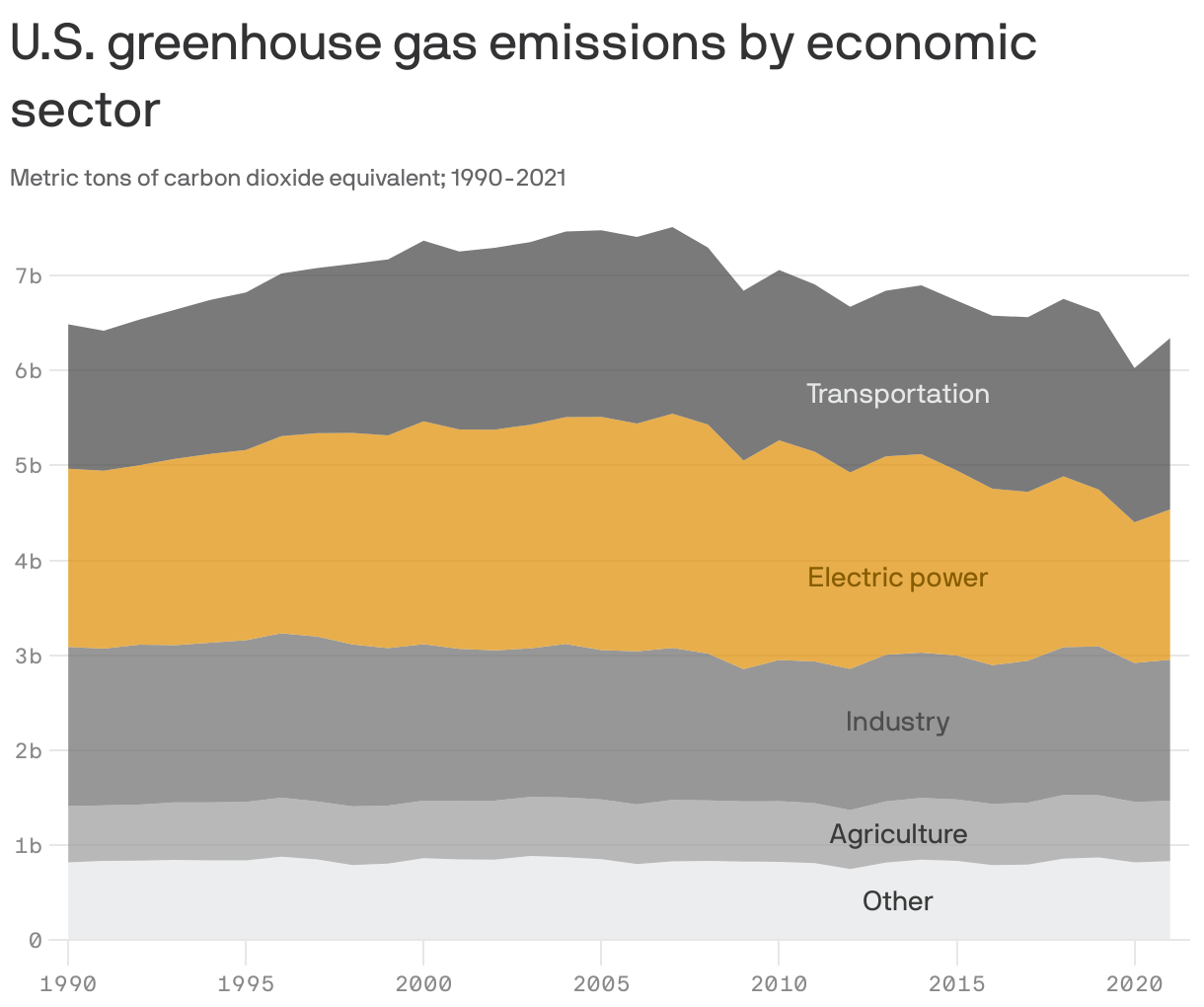
This chart illustrates why cutting power plant emissions is so crucial to meeting President Biden's various climate targets, Ben writes.
The big picture: The EPA estimates the standards for existing coal and new gas plants would avoid carbon emissions through 2042 that are equivalent to the annual CO2 from roughly half the passenger vehicles on U.S. roads today.
- Rules for current gas-fired plants will avoid additional CO2 as well, the EPA said.
The intrigue: Officials say the rules would bring big benefits by cutting not only CO2, but also fine particulates and other pollution that harms public health.
- The EPA projects that in 2030 alone, the rules will prevent roughly 1,300 premature deaths and over 300,000 asthma attacks.
3. NOAA's new El Niño outlook raises odds, intensity
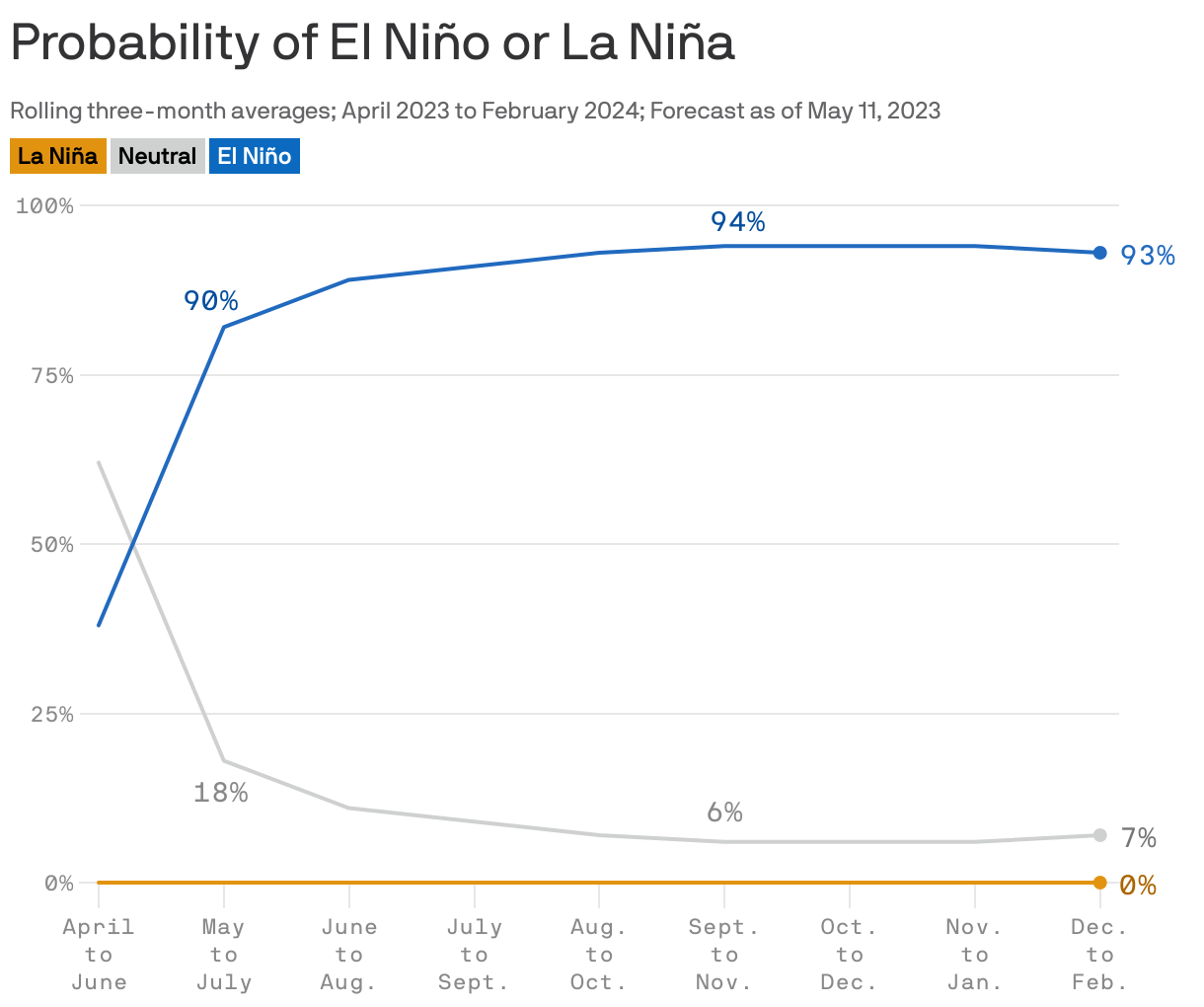
The NOAA markedly boosted the odds that an El Niño event will form in the tropical Pacific Ocean this summer, hastening climate change and altering global weather patterns, Andrew writes.
The big picture: El Niño could lead to the first year in which the global average surface temperatures bump up against the Paris Agreement's more stringent climate change target of 1.5°C (2.7°F) above preindustrial levels, Zeke Hausfather, climate research lead at payments company Stripe, told Axios.
By the numbers: The odds of El Niño forming through July and lasting into the Northern Hemisphere winter are now at 82%, with even higher odds later this summer, the NOAA found.
- This is up from just above 60% odds for the May through July period provided in April's outlook.
- The odds of at least a moderate El Niño at the end of the year are pegged at 80%, with about a 55% chance of a strong El Niño event.
Threat level: El Niño years tend to cause spikes in global average surface temperatures, on top of human-caused warming.
- With its elevated ocean temperatures, El Niño can cause global coral bleaching, among myriad other impacts.
- "Given that the last two major El Niño events — in 1998 and 2016 — each broke records for global-scale coral bleaching and mortality, this coming El Niño event poses a grave threat to coral reef ecosystems around the world," Kim Cobb, a climate scientist at Brown University, told Axios.
4. Between the lines: Biden's permitting play

Illustration: Aïda Amer/Axios
5. Dow selects site for small modular reactor project
Illustration: Annelise Capossela/Axios