Axios Generate
March 22, 2024

🍸 TGIF! We'll help you celebrate with a Smart Brevity count of 1,228 words, 4.5 minutes.
🚨 Situational awareness: "The U.S. has urged Ukraine to halt attacks on Russia's energy infrastructure, warning the drone strikes risk driving up global oil prices and provoking retaliation," the Financial Times reports.
- The White House did not provide comment to Axios, but officials have long noted they do not "encourage or enable" attacks inside Russia.
🎶 Ben's been reporting from Houston and we're honoring Texas artists all week, so blues great Lou Ann Barton has today's intro tune...
1 big thing: Big Oil failing on climate goals
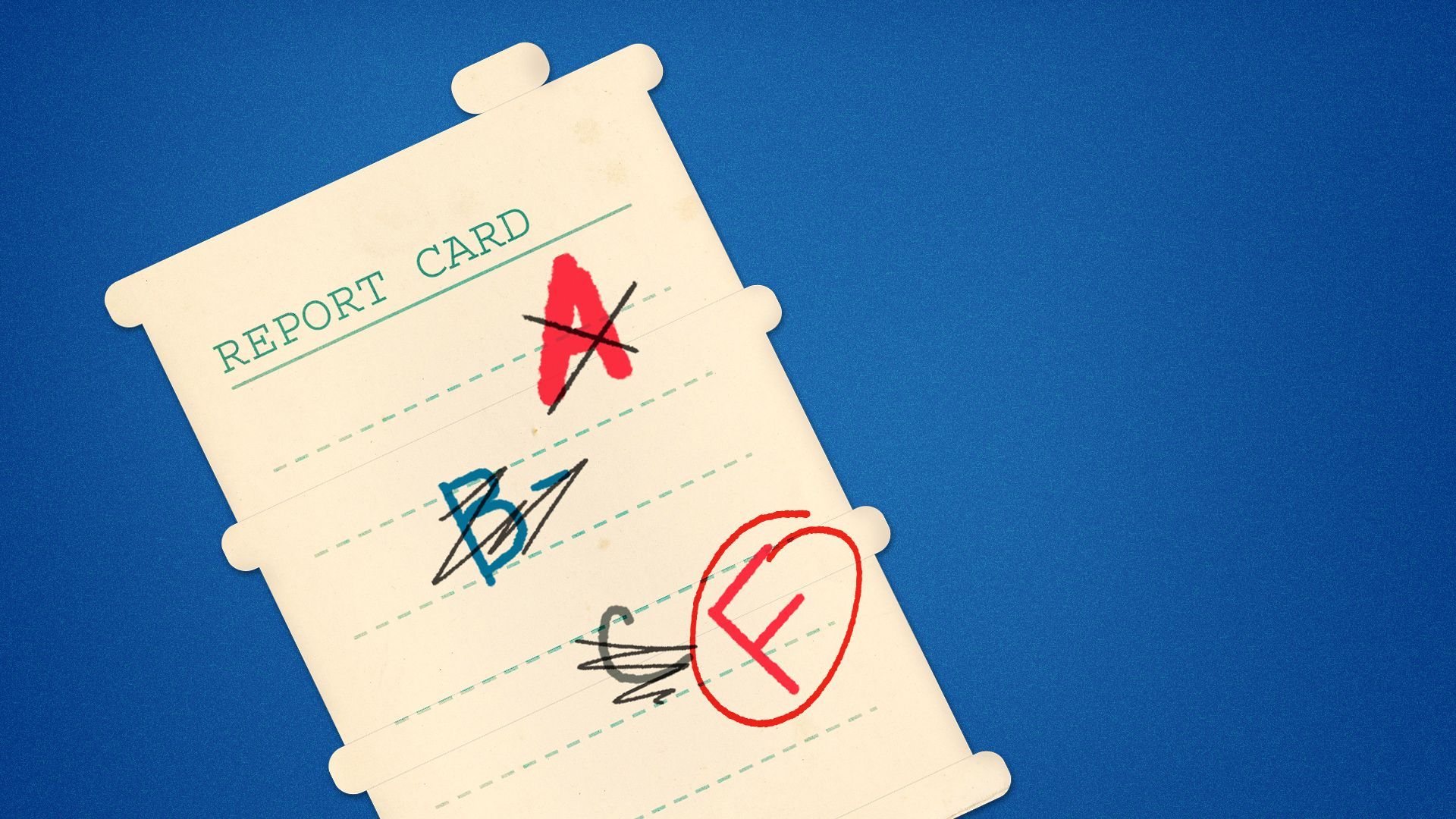
Illustration: Annelise Capossela/Axios
Major oil and gas companies are failing to align their business plans with the Paris Agreement's goals, a new report finds.
Why it matters: Financial climate think tank Carbon Tracker shows the expansive rift between fossil fuel companies and climate scientists, Andrew writes.
- Instead of pulling back, the sector is set to tap enough new oil and gas resources to send global average temperatures past 2°C by the end of the century.
The big picture: The findings also help explain the views expressed by oil and gas CEOs at the CERAWeek by S&P Global industry conference in Houston.
- "We should abandon the fantasy of phasing out oil and gas and instead invest in them adequately, reflecting realistic demand assumptions," said Saudi Aramco CEO Amin Nasser.
Zoom in: Carbon Tracker assigned grades to the 25 largest listed oil and gas companies, evaluating them on the extent to which they are aligned with Paris temperature targets.
- The conclusions are stark. None of the companies are deemed to be Paris compliant, based on metrics that include production plans, emissions targets, and investment options.
- This is despite the fact that 2023 was the world's warmest year on record, with 2024 trending even hotter; meanwhile, extreme weather and climate events conclusively tied to warming are worsening conditions in rich and poor countries alike.
Yes, but: The best score (the grades are given on a scale from 'A' through 'H') in this report is a 'D', given to BP.
- The lowest-ranked oil and gas company is ConocoPhillips. It earned an 'H', and was judged to be aligned with a global average temperature increase by 2100 of at least 2.4°C (4.32°F) above preindustrial levels.
What they're saying: "Companies worldwide are publicly stating they are supportive of the goals of the Paris-Agreement, and claim to be part of the solution in accelerating the energy transition," report author Maeve O'Connor said in a statement.
- "Unfortunately, however, we see that none are currently aligned with the goals of the Paris Agreement," she said.
2. On the record with startup shepherd Kevin Knobloch

Greentown CEO Kevin Knobloch. Illustration: Tiffany Herring/Axios; Photo: Courtesy of Greentown Labs
HOUSTON — Petro execs get the biggest spotlight, but startups are increasingly all over CERAWeek, Ben writes.
Why it matters: It signals climate tech's growth and intersection with legacy industries, something apparent when startup incubator Greentown Labs chose Houston as its second location in 2020.
- I chatted with Kevin Knobloch, who became Greentown CEO last September, on CERAWeek's sidelines.
The intrigue: Asked what's a below-radar topic, Knobloch said startups will help meet Energy Department efficiency rules issued under former President Obama for various kinds of appliances and equipment.
- "I'd like for us to recruit more companies in that space," said Knobloch, who was DOE's chief of staff during Obama's second term.
- Manufacturers "have to go back to the drawing board and come up with technology solutions."
- Elsewhere, he cited the need for more progress on difficult-to-decarbonize sectors — and talked up several Greentown Houston companies like Hertha Metals and Elemental Advanced Material.
The big picture: "It's a challenging time to be a startup in any sector, but certainly in the climate tech, clean energy sector ... because of high interest rates," he said.
- "Even if the Fed starts to moderate, it's going to take a long time to come back down. So the cost of debt financing is high."
What we're watching: The 2022 climate law provides a "direct pay" option for clean energy tax credits, which means companies that lack tax liability can still tap incentives.
- "As they get closer to graduating from the incubator stage, and/or if they partner with a corporate partner ... I do see them being able to step up and take advantage of those."
3. Red states sue to end Biden's LNG permit pause

Illustration: Shoshana Gordon/Axios
Fresh litigation marks the next phase in the fight over President Biden's pause on new liquefied natural gas export licenses, Ben writes.
Why it matters: A complaint from 16 states asks a Louisiana federal district court for a preliminary injunction that would allow the consideration of permits to resume.
The big picture: In a filing yesterday, GOP attorneys general from Texas, Louisiana and other states argued the pause violates administrative procedure law and the Natural Gas Act governing exports.
- They also claim it runs afoul of a 2022 Supreme Court holding that agencies need clear congressional blessing to regulate on "major questions."
Friction point: Louisiana AG Liz Murrill, in a statement, called the pause part of "attacks" on U.S. energy that "jeopardizes" thousands of jobs and millions in tax revenue.
Catch up quick: Biden officials in January froze new permitting to study the economic and climate effects of the U.S. export surge.
- But officials emphasize that U.S. exports — already the world's largest — will keep soaring this decade, via projects already approved and under construction.
- DOE did not provide comment on the new case.
The bottom line: An intense political and lobbying fight is now a legal one too.
4. Following up: IEA under scrutiny

Illustration: Annelise Capossela/Axios
The International Energy Agency is rebutting allegations it has strayed from its energy security mission, Ben writes.
Why it matters: Criticism of the agency — including claims it makes unrealistic assumptions about low-carbon transition — cranked up after senior Republicans released a letter yesterday demanding info about its work.
State of play: "Based on the mandates we have received from our member governments, the IEA is focused on helping countries in their efforts to maintain energy security and accelerate clean energy transitions," IEA said in a statement.
- IEA said it attaches "great importance" to dialogue with Congress, noting the agency regularly participates in hearings to provide testimony on a range of topics.
Inside the room: S&P Global Commodity Insights reports that "Republicans have been lobbied over the prospect of cutting federal funding to the IEA following the outcome of the U.S. elections later this year."
- "Another person familiar with discussions underway amongst Republican lawmakers said all aspects of U.S. engagement with the IEA will be scrutinized."
- Spokespersons for Sen. John Barrasso and Rep. Cathy McMorris Rodgers, who co-authored the letter to IEA, did not provide comment. The letter asks IEA detailed questions about uses of U.S. funding.
What's next: We're watching whether this becomes a broader cause among Republicans.
5. Two energy finance scoops: batteries and wind

Illustration: Aïda Amer/Axios
🍦Long-duration battery developer Form Energy has started meeting with investors as it prepares to raise up to $500 million this year, three sources familiar with the plans told Axios Pro's Alan Neuhauser.
- Why it matters: Form Energy says it's developed an inexpensive battery that can put energy onto the grid for days at a time, a capability that would be a linchpin of the clean energy transition.
- Catch up quick: Form Energy is one of the buzziest climate startups. Its "iron air" battery can provide over four days of energy, something that's eluded expensive short-term chemistries like lithium-ion.
🍦Radia is raising up to $300 million, the company tells Alan, as it races to make the world's biggest airplane, built for transporting massive wind turbine blades.
- Why it matters: The jumbo aircraft would enable energy developers to more efficiently install wind turbine blades too long to be shipped by road or rail.
🔓Unlock both stories — and a steady diet of scoops and smart analysis — by talking to our sales team about Axios Pro: Climate Deals.
6. ⚛️ Quote of the day
"In the long run fusion will be, almost certainly, the primary source of electricity on the planet."— Bill Gates, making a bold prediction at the CERAWeek by S&P Global conference in Houston
📬 Did a friend send you this newsletter? Welcome, please sign up.
🙏 Thanks to Chris Speckhard and Javier E. David for edits to today's edition, along with the brilliant Axios Visuals team.