Axios Generate

December 17, 2024

🐝 The news is swarming but we'll provide safe passage with just 1,362 words, 5 minutes.
🚨 Situational awareness: The Energy Department plans to offer power giant PG&E up to $15 billion in loan guarantees for a basket of projects spanning hydropower, storage, transmission upgrades and more.
- They intend to finalize it before Donald Trump takes office, per the WSJ, which notes it's the largest deal in the loan program's history.
🎵 At this moment in 2001, Usher was No. 1 on Billboard's Hot 100 with an R&B classic that's today's intro tune...
1 big thing: A climate Rorschach test, in stalled bill form

The fight over permitting in Congress laid bare a fault line in the climate and clean energy movements that will outlive the bill's apparent demise.
Catch up quick: The bipartisan Senate bill didn't make the final year-end spending deal.
- Senate environment chairman Tom Carper (D-Del.) and energy chairman Joe Manchin (I-W.Va.) blamed Republicans.
My thought bubble: A brief but important digression...
- Regardless of what killed it, months of tensions over the bill underscored competing visions in the wider Democratic coalition of what's needed for climate progress.
The big picture: Some backers say making it easier to build clean energy projects and transmission is key — even though the bill would have given a big lift to fossil projects, too.
- Count renewables trade groups and more centrist activists — who joined with oil and business lobbies to support the bill — in that camp.
- It's loosely associated with big concepts like an "abundance agenda" and "YIMBY." A recent NYT op-ed captures some of this posture.
The other side: A lot of enviro groups and other progressives said the legislation was too high a price to pay.
- They fear it enables enough added drilling, LNG and pipelines to be a net loss on climate — and would worsen environmental justice problems along the way.
Driving the news: With those deep thoughts aside, here's more on what went down yesterday evening, via my Axios Pro: Energy Policy colleagues.
- "By taking permitting off the table for this Congress, Speaker [Mike] Johnson and House Republican leadership have done a disservice to the incoming Trump administration," Manchin said in a statement.
- The catch-all spending bill was likely the last must-pass legislative vehicle that permitting could have ridden on.
Zoom in: Manchin's bipartisan Senate proposal with Republican John Barrasso aimed to build out long-range power lines, mandate lease sales and expedite NEPA reviews for energy projects.
- Rep. Bruce Westerman's GOP House counteroffer made deeper changes to NEPA that would ease the path for projects funded under the IRA, IIJA and CHIPS Act.
- Talks began to break down late last week with lawmakers at loggerheads over proposed changes to how environmental impact statements can be challenged in court.
What's next: This all leaves permitting talks in a rough spot next year, since Republicans have a narrow majority and Democrats will be less willing to strike a deal that makes changes to bedrock environmental laws.
2. 🗞️ What we know about Biden's looming LNG move
DOE's long-awaited LNG study alleges big risks if exports surge beyond the big increase looming from already-approved projects, the NYT scooped after obtaining Energy Secretary Jennifer Granholm's letter describing it.
Why it matters: "The conclusions ... could provide a legal argument for those seeking to sue to stop permits for export terminals in the future...senior administration officials said," the paper reports.
- That nugget is worth watching in light of Donald Trump's vow to quickly end Joe Biden's pause on new export licenses.
Yes, but: It's expected to "stop short of saying the approval of more shipments isn't in the public interest," Bloomberg notes.
State of play: The report on LNG's economic and climate effects finds, per the NYT reporting on Granholm's detailed letter...
- "Unfettered exports" could increase domestic wholesale gas prices by around 30%. (Critics of the DOE process note warnings about higher costs haven't previously borne out.)
- "Under a scenario in which more than the current level of gas exports was approved, the report finds that the additional emissions would be 1.5 gigatons per year by 2050," the paper summarizes.
- "Ms. Granholm noted that the study found increased L.N.G. exports would displace more wind, solar and other renewable energy than coal," the NYT reports, also noting the study finds pollution risks for Gulf Coast communities near LNG sites.
What we're watching: The report itself, which is expected any moment now.
3. 🌡️ Warm winter days surge across Europe, North America and Asia
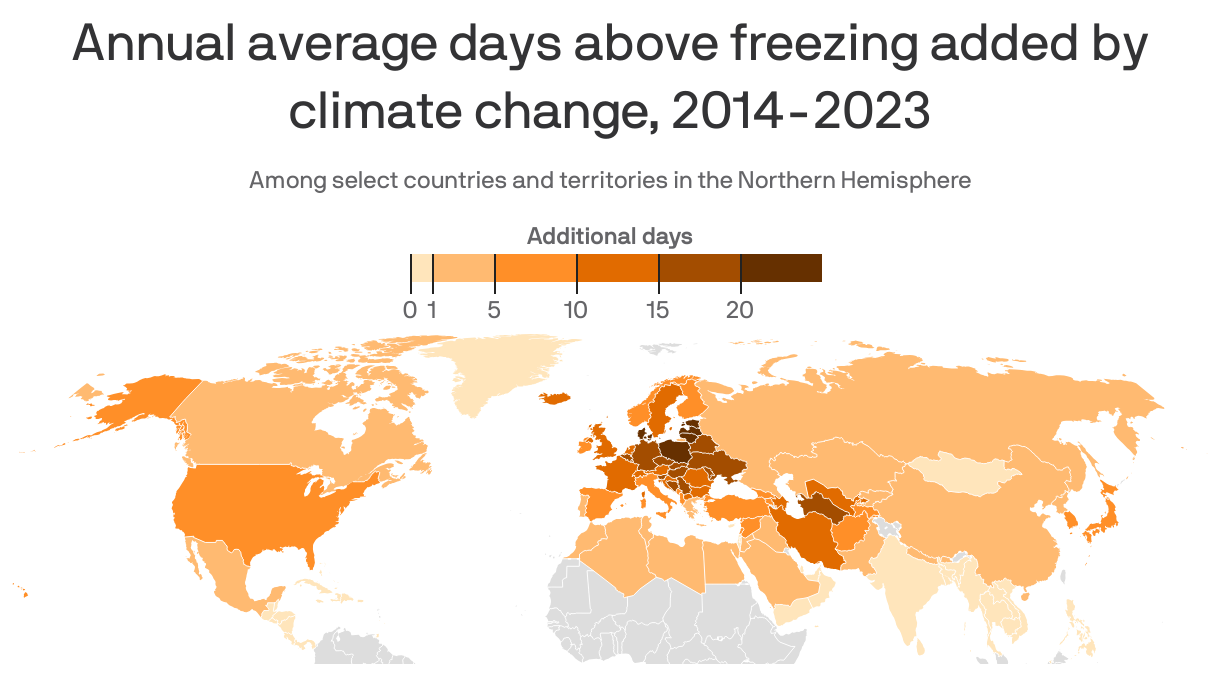
Winters are rapidly warming across the Northern Hemisphere because of human emissions of greenhouse gases from burning fossil fuels, a new report shows.
- That means many more days with temperatures above freezing.
Why it matters: More warm winter days means fewer opportunities for winter recreation and can have knock-on effects on water supplies during the following warm season.
The big picture: Climate change has added at least an additional week of winter days with temperatures above freezing each year during the past decade in more than one-third of 123 countries analyzed, researchers found.
- The analysis compares recent trends with what would be expected to occur in a world without increasing amounts of heat-trapping greenhouse gases.
Zoom in: The new work — from the climate science and communications group Climate Central — covers the entire Northern Hemisphere.
- It specifically zeroes in on the increase in the number of days during which temperatures remain above freezing during meteorological winter, which spans from December through February.
What's unique about this report is the attribution aspect.
- Rather than describing trends in the likelihood of outcomes, the authors used published research and an in-house tool known as the Climate Shift Index to pin the increase in warm winter days to climate change.
The intrigue: In the U.S., 28 states and 63% of cities analyzed experienced at least a week of what the group terms "lost winter days" each year during the past decade due to climate change.
- Washington, D.C., for example, has gained 11 winter days with above freezing temperatures annually during the past decade due to climate change, the report found.

4. 💻 On my screen: peering into the data center future
Wall Street giant BlackRock's new private markets outlook is the latest bid to understand the future of AI- and cloud-driven data center growth.
The big picture: It projects data center power demand rising 22% annually worldwide between now and 2030.
- It sees a "large-scale global effort to develop over 150GW of incremental capacity by 2030."
- It estimates total capital spending north of $1.5 trillion to build these out.
The intrigue: The combo of capital and complexity creates an "opportunity set ripe for experienced infrastructure investors across digital infrastructure and energy."
State of play: That brings me to this separate, new(ish) S&P Global look at U.S. power needs for data centers.
- It sees higher "near-term" outlooks for gas- and coal-fired power as demand growth outpaces new supply and transmission.
What's next: Overall, S&P does not see a "significant and sustained increase" in gas needs thanks to data centers, but it does challenge decarbonization.
- Obviously numbers out to 2040 need boulders of salt, but anyway: If its "high-end" estimate of data center-driven electricity use comes to pass, U.S. gas use would rise 8%.
- But it expects clean sources to meet most of the incremental energy needs over time, in which case that gas number is around 2%.
5. 🍰 Bonus policy notes: Oil and EVs
🛢️Trump 2.0 could be a split decision for Persian Gulf states' energy goals, oil analyst Ben Cahill writes in a new post.
- The big picture: "Trump will shed no tears if the United States keeps eroding OPEC+ market share — especially as substantial spare capacity keeps oil prices in check," Cahill writes via the Arab Gulf States Institute in Washington.
- Yes, but: The "saving grace" for the Saudis and other Gulf producers is Trump's plan to greatly toughen Iran sanctions enforcement. That could cut Iranian exports from 750,000 to 1 million barrels per day — boosting OPEC+ market power.
- What we're watching: Whether Trump's "drill, baby, drill" agenda will meaningfully change how fast U.S. production grows. Plenty of market watchers don't expect much effect anytime soon.
🚘 Reuters obtained a Trump transition document that puts meat on the bones of plans to roll back EV support.
- Driving the news: The plan "would redirect money now flowing to building charging stations and making EVs affordable into national-defense priorities." Those include "securing China-free" supplies of batteries and minerals for them, Reuters summarizes.
- State of play: It also calls for "tariffs on all battery materials globally" to support U.S. production, but "negotiating individual exemptions with allies."
6. ☀️ Number of the day: 62,000 acres
That's the amount of U.S. agrovoltaic acreage — sites combining solar and agriculture — as of last month, per a National Renewable Energy Laboratory primer.
Why it matters: U.S. agrovoltaic sites now have over 10 gigawatts of capacity, and there's been lots of growth.
- In 2020 the numbers were 27,000 acres and 4.5 GW, per NREL.
📨 Did a friend, colleague or even a frenemy send you this newsletter? Welcome, please sign up.
🙏 Thanks to Chris Speckhard and Chuck McCutcheon for edits to today's edition, along with the brilliant Axios Visuals team.
Sign up for Axios Generate