
Axios Generate

October 24, 2024

✅ Thursday. We've got 1,165 words, 4.5 minutes.
🚗 Situational awareness: Tesla stock is up over 14% pre-market after Q3 earnings beat expectations.
- Yes, but: Investors worry that CEO Elon Musk's highly public political foray is hurting sales, Axios' Hope King reports. Full story
🎶 This week in 1990, synth-pop geniuses Pet Shop Boys released the album "Behaviour," which provides today's intro tune...
1 big thing: AI, other new tools bolster tracking of deforestation
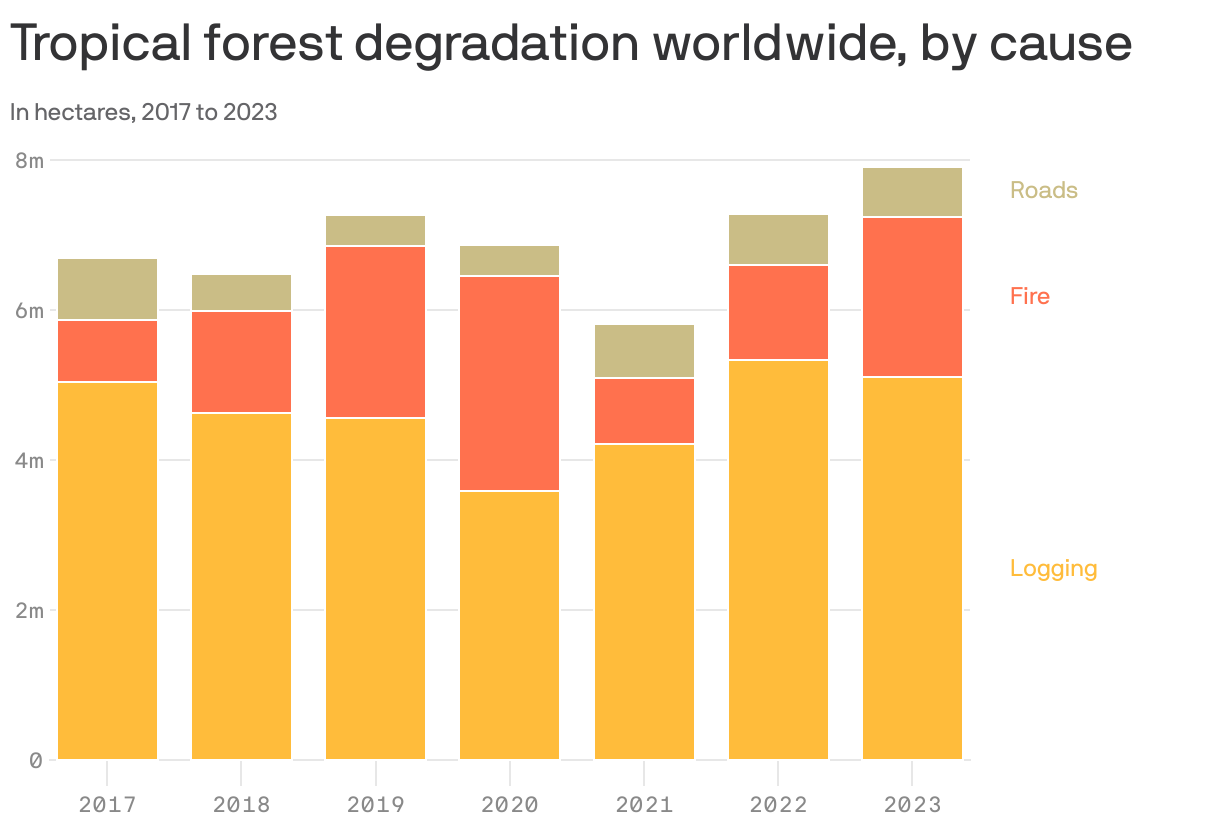
New technologies are providing unprecedented capabilities for combating deforestation around the globe, particularly in tropical forests.
Why it matters: The technologies, enabled by advances in Earth observing satellites and AI techniques, are in the spotlight as global biodiversity treaty talks take place in Cali, Colombia.
- They are aimed at monitoring and providing actionable intelligence for governments, activists and nonprofits to protect the forests that act as major carbon sinks.
Zoom in: The newest developments come from the nonprofit forest carbon tracking group CTrees, as well as the satellite company Planet Labs PBC.
- CTrees built an AI-driven platform to monitor forest degradation, which refers to the loss of trees, carbon and other ecosystem benefits. These lands have not been clear-cut, however.
- Degradation can result from a variety of human activities ranging from logging to construction of roadways into intact forests, or development at the edges of tropical forests that chip away at the total area.
A report released Tuesday shows the result of what the organization bills as the first pan-tropic data pinning changes in forest landscapes to logging, fires (most of which are human-caused) and road construction, among other contributors.
- Prior monitoring relied on the long-running but lower-resolution NASA and U.S. Geological Survey's Landsat imagery.
- But more detailed information for CTrees' product comes from the PlanetScope satellite constellation, which Planet Labs provides through Norway's International Climate and Forest Initiative.
The intrigue: In a sign of the tough work that delegates, nonprofit organizations and others have ahead of them in Cali and beyond, CTrees found that an average of 26,641 square miles of tropical forest are being degraded per year.
- That's equivalent to the size of Ireland, with a cumulative degraded area equal to nearly the size of California during the past six years.
Zoom out: In a separate but related development last month, Planet Labs unveiled a product that monitors forest carbon, tree height and tree cover to provide more precise measurements of forest carbon sinks.
- The product relies on machine-learning models that examine historical satellite observations as well as contemporary imagery, right down to near the level of individual trees.
- This data could be especially useful for ensuring that forest carbon credits — which many companies are already relying on to achieve sustainability targets — are measurable and verifiable.
Will Marshall, Planet's CEO, told Axios that he is bullish on AI's ability to glean new insights from large Earth observation data sets.
- "We've given ourselves some wicked problems with climate change and biodiversity loss, but we now have some wicked tools," he said.
2. 🚨 Breaking: Treasury's manufacturing move
The Treasury Department just unveiled final rules for tax breaks for making "clean" energy parts and mineral products used in climate-friendly tech.
Why it matters: These IRA subsidies are among the biggest White House attempts to marry climate and industrial policy.
The intrigue: Officials say they tweaked the rules, after industry complaints, to subsidize a wider range of mining and mineral project costs.
- One change enables processing projects to apply credits to domestic mineral extraction costs.
The big picture: The "45X" credit covers equipment like solar inverters, battery cells, wind blades and plenty more.
- One example is $35 per kilowatt hour of battery cells; another is 10% of production and processing costs for many "critical minerals."
State of play: Even before the final touches out today, the credit has been driving lots of new U.S. projects, Biden officials say.
- Corporate announcements totaling $126 billion — including $77B worth of battery projects and $19B in solar — have arrived since the IRA passed, Treasury said, citing MIT-Rhodium Group data.
What we're watching: Reaction from mining and mineral processing sectors to the changes.
3. Morgan Stanley strikes direct air capture deal...
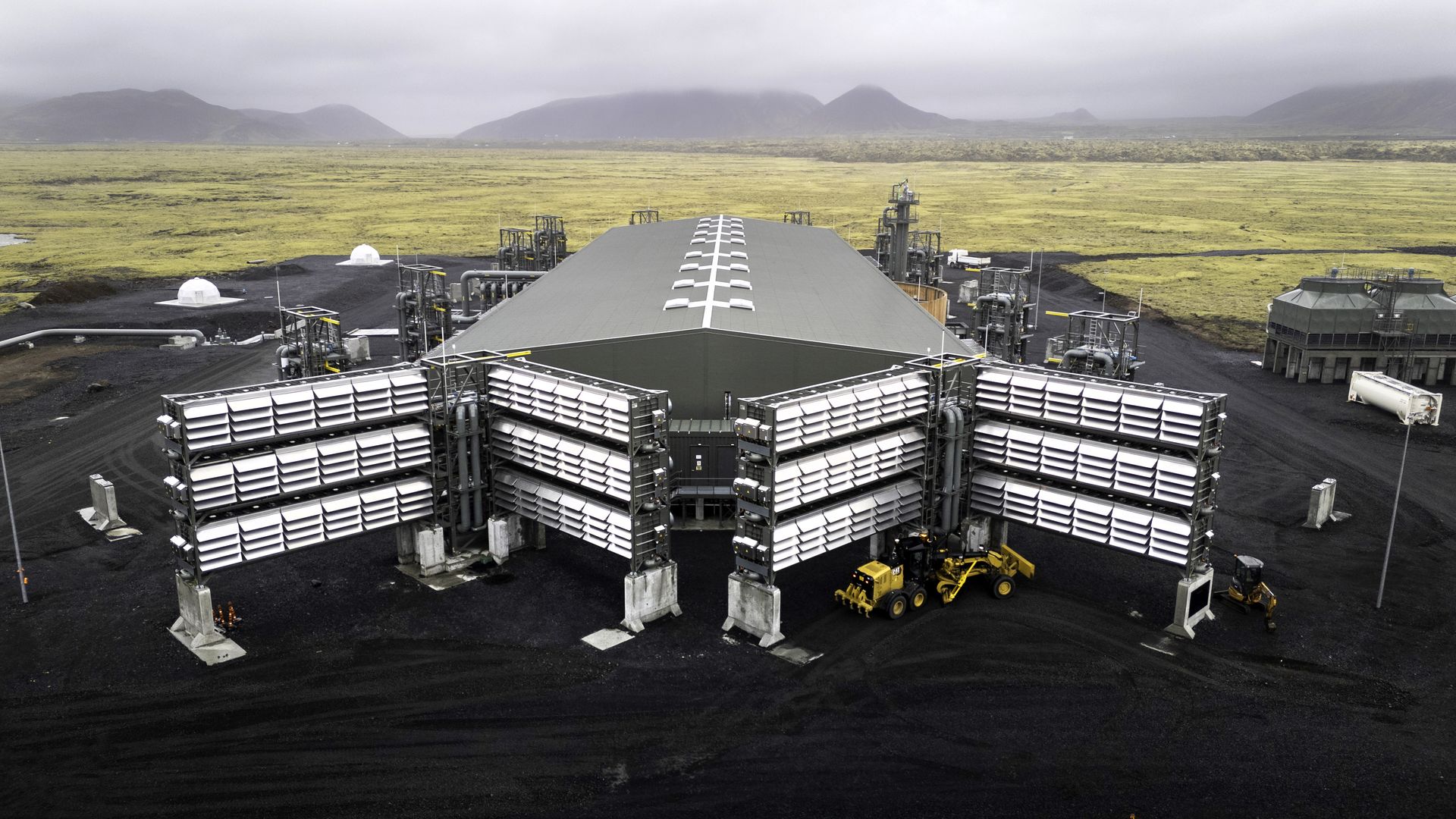
Morgan Stanley is investing in direct air capture of carbon dioxide through a partnership with the Swiss firm Climeworks, the companies announced this morning.
Why it matters: The deal demonstrates growing interest on Wall Street to tap into the fledgling carbon removal industry by buying carbon removal credits.
Zoom in: Morgan Stanley's agreement, for an undisclosed sum, follows Climeworks' approximately $20 million deal with JP Morgan last year.
- The new agreement is for the removal of 40,000 tons of carbon dioxide from the atmosphere in a partnership lasting until 2037.
- Climeworks, which opened the world's largest direct air capture plant earlier this year in Iceland, will use the funding to help scale up its new technology that aims to efficiently capture more CO2 from the ambient air.
- According to the company, the contract is Climeworks' second-largest to date. The company is a main technology partner for the Energy Department's Project Cypress Direct Air Capture Hub in Louisiana.
The intrigue: Morgan Stanley is adding direct air capture to its portfolio of investments aimed at achieving net-zero financed emissions by 2050 and providing $1 trillion in sustainable finance by 2030.
Yes, but: Forty thousand tons of CO2 is a small number when compared to emissions from cities, states and countries, and reflects the fledgling state of direct air capture.
- For example, that amount is equivalent to the annual emissions from about 9,000 conventionally powered cars in the U.S., according to the EPA.
What they're saying: "By securing access to high-quality carbon removals now, companies position themselves ahead of the curve of future regulatory changes and competitive pressures," said Christoph Gebald, co-founder and co-CEO of Climeworks, in a statement.
4. ...as Microsoft surfs a new carbon removal wave
Microsoft has a deal with marine removal startup Ebb Carbon for up to 350,000 tons of CO2 — but it's starting much smaller.
Why it matters: It signals growing interest in ocean-based removal methods.
Driving the news: The deal is initially for 1,333 tons, with options to purchase 350,000 over 10 years.
- Costs weren't disclosed. Initial volumes will come from a pilot plant Ebb is building near Port Angeles, Washington, Ebb spokesman Scott Coriell said.
- For the additional tons, "we're in discussions with a number of desalination and mining companies about hosting a larger Ebb facility," he said via email.
The intrigue: That kind of co-location is part of a trend — concepts envisioned to work alongside huge, incumbent industries.
How it works: Ebb's system is designed to speed marine CO2 uptake while making ocean waters less acidic.
- They run seawater through membranes that de-acidify it. Remaining alkaline water is exposed to air and transformed into bicarbonate.
- Ebb also counts Stripe as a customer.
The bottom line: Methods like Ebb's hold promise but face big questions about whether they'll ever remove large CO2 volumes.
Brian Marrs, Microsoft's senior director of energy & carbon removal, said in a statement the deal will "accelerate the scientific foundation" for ocean-based removal and "explore the potential" for scale.
5. 🧮 Number of the day: up to 6 billion cubic feet
Data centers could create 3 billion cubic feet per day to 6 bcf/d of additional U.S. natural gas demand by 2030, per new S&P Global Ratings estimates.
The big picture: The U.S. currently uses about 89 bcf/d.
The bottom line: For all the visions of zero-carbon power meeting AI's energy thirst, analysts see the data center boom as bullish for gas producers and distributors.
📨 Did a friend, colleague or even a frenemy send you this newsletter? Welcome, please sign up.
🙏 Thanks to Chris Speckhard and Chuck McCutcheon for edits to today's edition, along with the brilliant Axios Visuals team.
Sign up for Axios Generate


/2024/10/23/1729716761421.gif?w=3840)