Amazon wildfires hit new peaks despite deforestation pledges

Add Axios as your preferred source to
see more of our stories on Google.
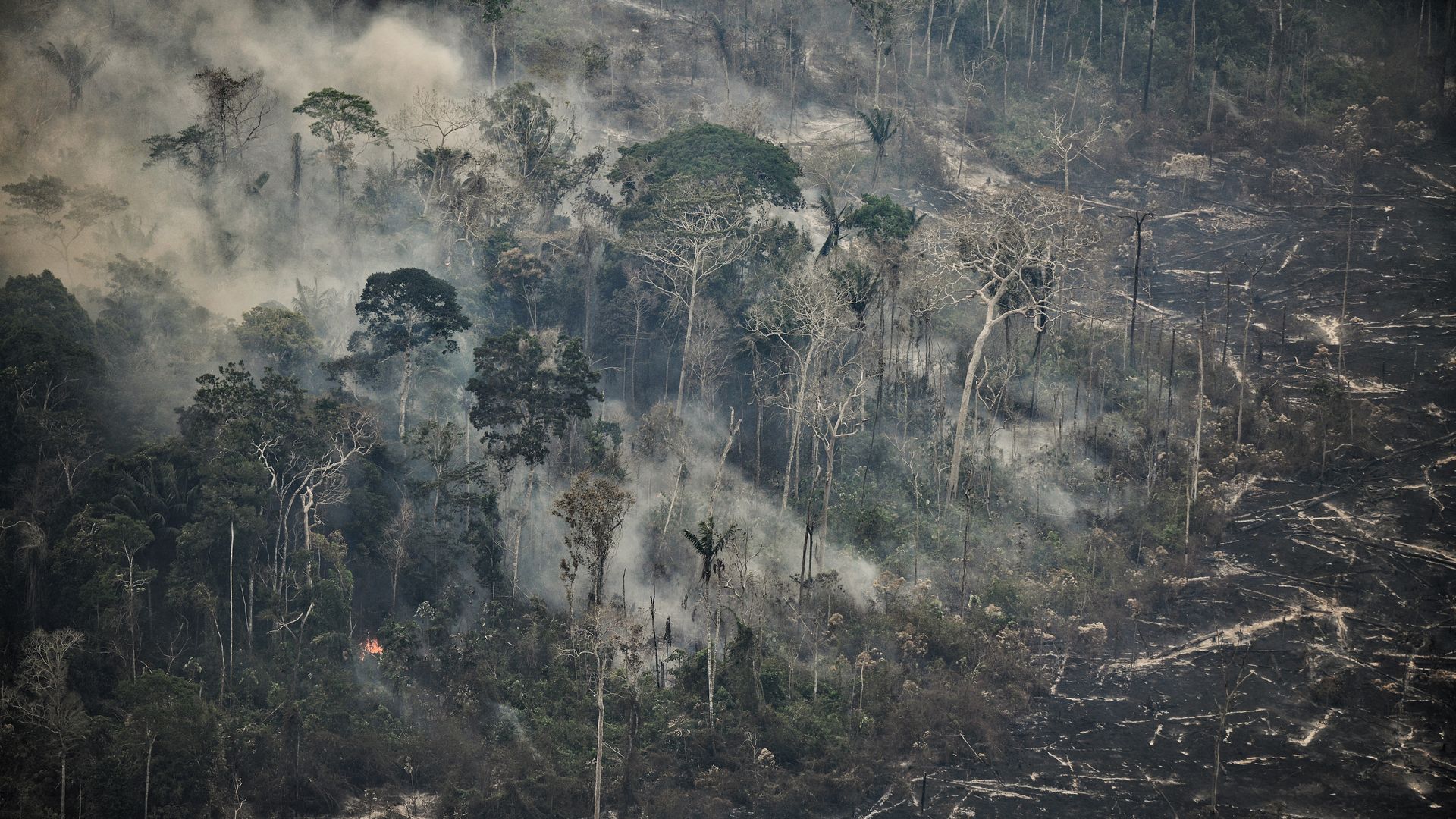
Aerial view of wildfires burning in the Amazon rainforest in Peru on Sept. 17. Photo: Hugo La Rosa/AFP via Getty Images
Wildfires have spiked to new highs across huge parts of South America, with large blazes burning deep in the Amazon rainforest, new reports show.
Why it matters: The fires are emitting record amounts of planet-warming greenhouse gases in a region that humanity counts on for being a net absorber of carbon dioxide.
- Most of the blazes are caused by humans clearing land for agriculture and other activities, and climate change is making them worse, studies show.
The big picture: The expansiveness and intensity of the ongoing blazes are another warning sign among a series of recent discoveries showing that the Amazon rainforest and Pantanal wetlands are under increasing pressure from a combination of human activities and extreme climate events.
- A severe drought and unprecedented heat this year have resulted in a rare case in which the deep, normally moist rainforest is prone to burning.
- According to Global Forest Watch, a platform used to keep tabs on tropical forest destruction, the number of fire alerts detected via satellites and other sources has been 79% higher than average for this time of year.
- The European Union's Copernicus Atmosphere Monitoring Service (CAMS) also is out with new insights showing unusually high wildfire-related carbon emissions across large parts of the region, with record-high emissions from rainforests located in Bolivia in particular.
By the numbers: Estimated emissions from the Brazilian Amazon have been well above average so far this year, with record-high emissions in two key northern states that contain large concentrations of the rainforest — Amazonas and Mato Grosso du Sul, according to CAMS information gleaned from satellite monitoring of wildfire activity.
- Bolivia's wildfire-induced carbon emissions so far this year are already at the highest cumulative annual total for that country in CAMS' 22-year data set, at 76 million tonnes of carbon. That beats out 2010, when annual emissions were 73 million tonnes of carbon.
- Much of these emissions — 32 million tonnes of carbon — occurred in September alone.
- The fires have been fouling air quality across large parts of Brazil and nearby countries, "stretching from Ecuador to São Paulo," CAMS researchers said.
- The annual cumulative emissions for the Brazilian Amazon are tracking toward record-setting levels, CAMS stated.
Between the lines: Destruction of the Amazon, which is happening across multiple countries, is occurring despite an ambitious but non-binding pledge more than 100 world leaders signed at the COP26 climate summit in Glasgow in 2021.
The intrigue: Typically, the Amazon sees wildfires during the July to September period. However, recent record-shattering high temperatures in South America, combined with a long-term drought, have likely supercharged this fire season, CAMS scientists said.
- According to the World Resources Institute, Amazon wildfires are now burning at least twice as much forest compared to 20 years ago.
- A study released earlier this year found that climate change made the heat and dry conditions that led to June wildfires in the Brazilian Pantanal, the world's largest wetlands, about 40% more severe and up to five times more likely to occur in today's climate compared to preindustrial conditions.
Other research concluded that climate change was the driving factor behind 2023's intense Amazon drought.
- "The fingerprints of climate change are all over the Amazon rainforest and Pantanal wildfires," Clair Barnes, a researcher at the Grantham Institute at Imperial College London, said in a statement.
Zoom out: Scientists have raised alarms in recent years that the Amazon could pass — or may have already passed — a tipping point toward a much drier ecosystem that would lack the same carbon-absorbing function as the rainforest.
- One study, published in 2021 and bolstered by more recent research, found this is already occurring in some portions of the Amazon.
- A key consequence of such a transition would be to remake the atmospheric circulation over South America, potentially leading to huge reductions in annual rainfall in some areas.
What they're saying: "Fires rarely occur naturally in the Amazon," James McCarthy, a researcher with WRI's Global Forest Watch, told Axios.
This year, wildfires have burned more than 42,000 square miles of the Brazilian Amazon, an area that is equivalent to the entire state of Pennsylvania, according to the ALARMES fire tracking tool.
