Axios Generate

April 05, 2024
🍹 Yes. Friday. We're cruising into the weekend with 1,193 words, 4.5 minutes.
⏸️ Situational awareness: The SEC has stayed its new climate disclosure rule while court battles play out.
🎸 This week in 2006, the Red Hot Chili Peppers dropped today's intro tune...
1 big thing: Stormy omens


Americans should prepare for a potentially expensive, damaging — and life-threatening — Atlantic hurricane season, Andrew writes.
Driving the news: Colorado State University meteorologists issued such a bullish initial seasonal forecast yesterday, calling for a staggering 23 named storms, 11 hurricanes, and 5 major hurricanes.
Why it matters: Seasons that feature some of the current elements have been among the busiest on record, but none have seen this potent a mix.
Stunning stat: According to Brian McNoldy, a meteorologist at the University of Miami, this will be the first year on record that the average temperature of the North Atlantic Ocean basin failed to fall below 20°C (68°F) for an entire year.
- And waters in the "Main Development Region" of the Atlantic, where many notorious storms form, are already at levels typically seen during July.
The big picture: Philip Klotzbach of CSU presented the new outlook at an annual hurricane conference in South Padre Island, Texas.
- Klotzbach showed that La Niña years have featured far more Category 3+ hurricanes that moved close to, or actually hit the U.S. and Caribbean, compared with El Niño years.
- A single landfalling storm, such as Hurricane Ian in 2022, can result in catastrophic losses for the insurance and reinsurance industry.
Threat level: Higher odds of landfalling storms raises the stakes for them, and for the many residents of coastal states.
- Many can no longer afford hurricane insurance, or may be relying on a state policy of last resort that would be overwhelmed by a significant storm.
Context: Climate change is partly, or possibly even mostly, responsible for the record warm Atlantic waters, scientists have said.
- And the ocean heat stands to exacerbate existing, human-driven trends in hurricanes that were already making them more destructive.
The bottom line: Coastal residents should not sleep on preparing for this hurricane season.
2. House GOP's IEA probe deepens

Illustration: Sarah Grillo/Axios
House Republicans are expanding oversight of U.S. participation in the International Energy Agency, Ben writes.
Why it matters: Fresh inquiries to IEA and Energy Secretary Jennifer Granholm seek data on U.S. funding for the international body, which produces influential analyses about the future of fossil fuels.
- And they imply sustained pressure, following a recent joint letter from top Republicans on the Senate and House energy panels.
Our thought bubble: Keep an eye on whether some Republicans will look to scale back U.S. support.
- Axios' Jael Holzman recently reported on GOP concerns about taxpayer dollars feeding the agency.
What's new: House energy committee GOP leaders wrote to Granholm asking for info on U.S. funding and the department's engagement with IEA studies.
- A new letter to IEA head Fatih Birol asks more questions about its work and money.
Catch up quick: GOP critics and some oil analysts allege the organization is:
- Offering overly rosy projections about the transition from fossil fuels — studies that influence policy and investment.
- Straying from its founding energy security mission.
The other side: The agency has repeatedly defended its work and says its energy security focus is unwavering.
3. A wonky-but-important dispatch
Illustration: Lindsey Bailey/Axios
Two major think tanks, plus a big grantmaker, just launched a research initiative on building economic resilience in fossil fuel-reliant communities, Ben writes.
What's new: Resources For the Future, Columbia's Center on Global Energy Policy and the Bezos Earth Fund are teaming up.
- It's a multiyear plan to fund research and "build a community of scholars, policymakers, and economic development practitioners."
- There's an "urgent need to develop tangible strategies" the groups said.
- One major goal is leveraging expertise and solutions from people in these regions.
Why it matters: The decision to assemble like Voltron underscores the topic's importance.
- Oil, gas and coal fund services, and sustain economies, in many regions. But climate policies are aimed at spurring transition from fossil fuels.
What we're watching: An initial report identifies areas where more analysis is needed.
4. Oil breaks out amid rising Mideast tensions
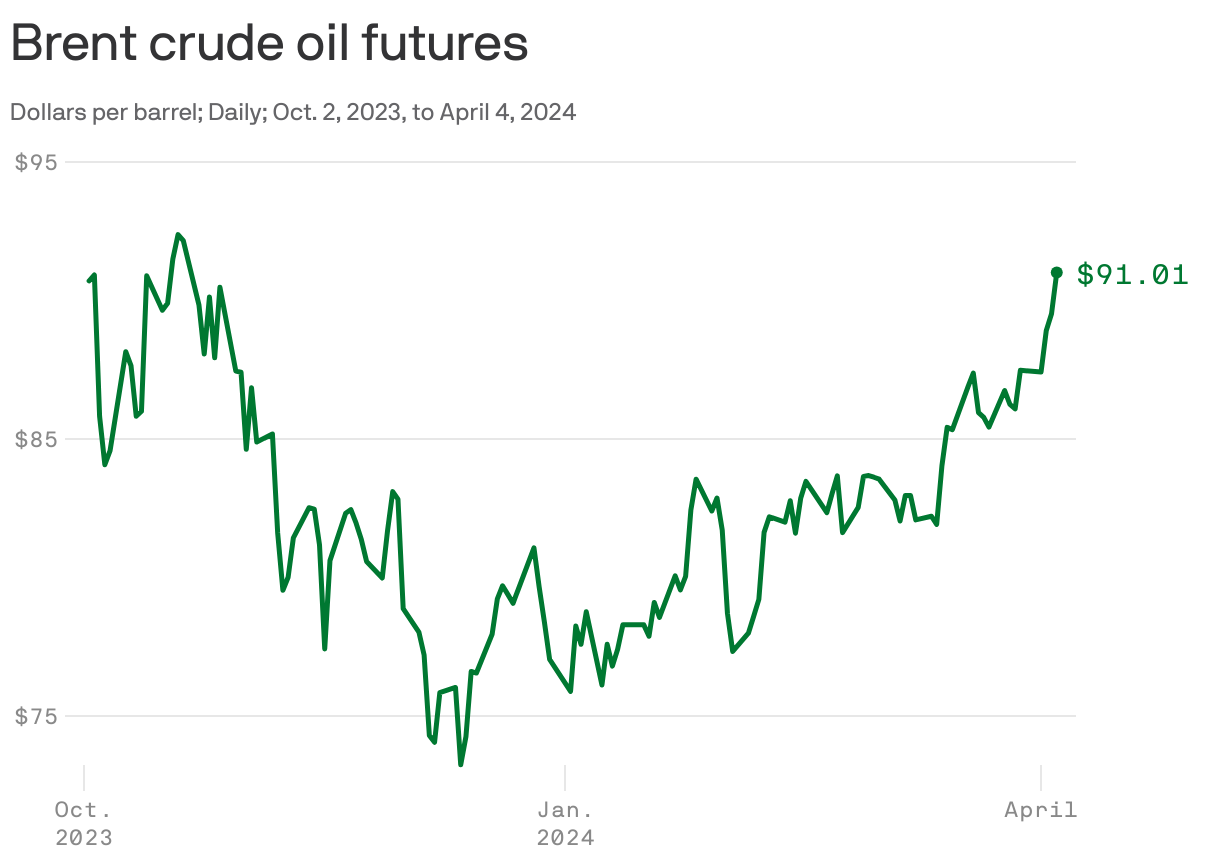
Brent crude oil prices reached around $91 per barrel yesterday, the highest since October 2023, with markets getting more anxious about increasing geopolitical risks, Axios' Deena Zaidi reports.
Why it matters: After months of being hemmed in by fears of soft global demand, the benchmark added nearly $2 per barrel during the session, inching closer to the psychologically charged $100 level.
- And when oil's market value rises, gasoline prices at the pump usually follow, posing yet another challenge to inflation-weary consumers and a president seeking reelection in November.
The big picture: Growing geopolitical tensions have only acted as a catalyst for market fluctuations.
- Ukraine's recent attacks on Russian refineries, a potential widening of the Middle East conflict after the Israeli recent attack on an Iranian diplomatic compound in Syria, and oil shipment delays suggest there's more upside in oil prices.
5. 🏃🏽♀️ Catch up quick on tech finance: carbon and cars

Illustration: Aïda Amer/Axios
🛢️ Chevron is the lead investor in carbon capture startup ION Clean Energy's $45 million Series A round, Ben writes.
- Why it matters: Carbon capture, while slow to advance commercially, is a key focus of U.S. majors' climate investments.
- The big picture: The companies said ION's liquid amine tech is well-suited to trapping carbon from hard-to-abate industrial sectors.
🚗 Maniv, a venture firm focused on decarbonizing transportation, closed its third fund at $140 million.
- Why it matters: The firm projected optimism about the space despite headwinds of late.
- State of play: "Despite individual company failures, and even entire business models not panning out, the inherent need to decarbonize and digitize the way people and things move remains — and innovation continues afoot," founder Michael Granoff writes. Go deeper.
6. Why the EV transition has gotten so messy

Illustration: Natalie Peeples/Axios
A dizzying array of choices — gas, hybrids, plug-in hybrids, EVs, even hydrogen — are confounding to the average consumer, Axios' Joann Muller writes.
Why it matters: This is what car-buying will be like for the foreseeable future amid the messy, multi-decade transition from gas to EVs.
The big picture: The EV shift was never going to be clean and swift, even though some companies (and investors) projected hockey stick-like growth — up and to the right — based on Tesla's meteoric rise.
- Now that the early adopter era is over, those expectations have met reality.
- Even Tesla is struggling: Its first-quarter deliveries fell 8.5% this year from the same period in 2023.
- Other carmakers' EV sales are still growing, however. Hyundai's rose 62% this past quarter compared to the previous year, for example, while Toyota and Ford reported strong sales of gas-electric hybrids.
State of play: Overall, EVs' first-quarter growth rate was a tepid 2.7% vs. last year's torrid 47%, while hybrids are becoming more popular.
The bottom line: The growth slowdown is real.
7. Bonus: Ford slows EV rollouts
Speaking of that messy transition, Ford is delaying launch of new three-row electric SUVs as auto giants recalibrate their plans.
Why it matters: Ford implicitly cited demand challenges, Ben writes.
- The extra time will "allow for the consumer market for three-row EVs to further develop and enable Ford to take advantage of emerging battery technology," it said.
State of play: Ford is now eyeing 2027 — not 2025 — for launching three-row EVs produced at its Oakville, Ontario plant.
- And it's targeting 2026, rather than late 2025, for a new electric pickup.
Yes, but: The company is continuing construction on new facilities that will build or design future EVs and components, Axios' Nathan Bomey notes.
📬 Did a friend send you this newsletter? Welcome, please sign up.
🙏 Thanks to Chris Speckhard and Javier E. David for edits to today's edition, along with the brilliant Axios Visuals team.