
Axios Generate

October 05, 2023
😲 Everything's in flux! Oil markets, the COP28 agenda, GOP leadership and more. We break it down with a Smart Brevity count of 1,180 words, 4.5 minutes.
🚨 Situational awareness: 2023 U.S. electric vehicle sales have already hit one million, the first time they've reached that mark in a year, preliminary BloombergNEF data shows.
🎶 Exactly 25 years ago, R&B great Monica was No. 1 on the Billboard Hot 100 with today's intro tune...
1 big thing: An electricity milestone looks near
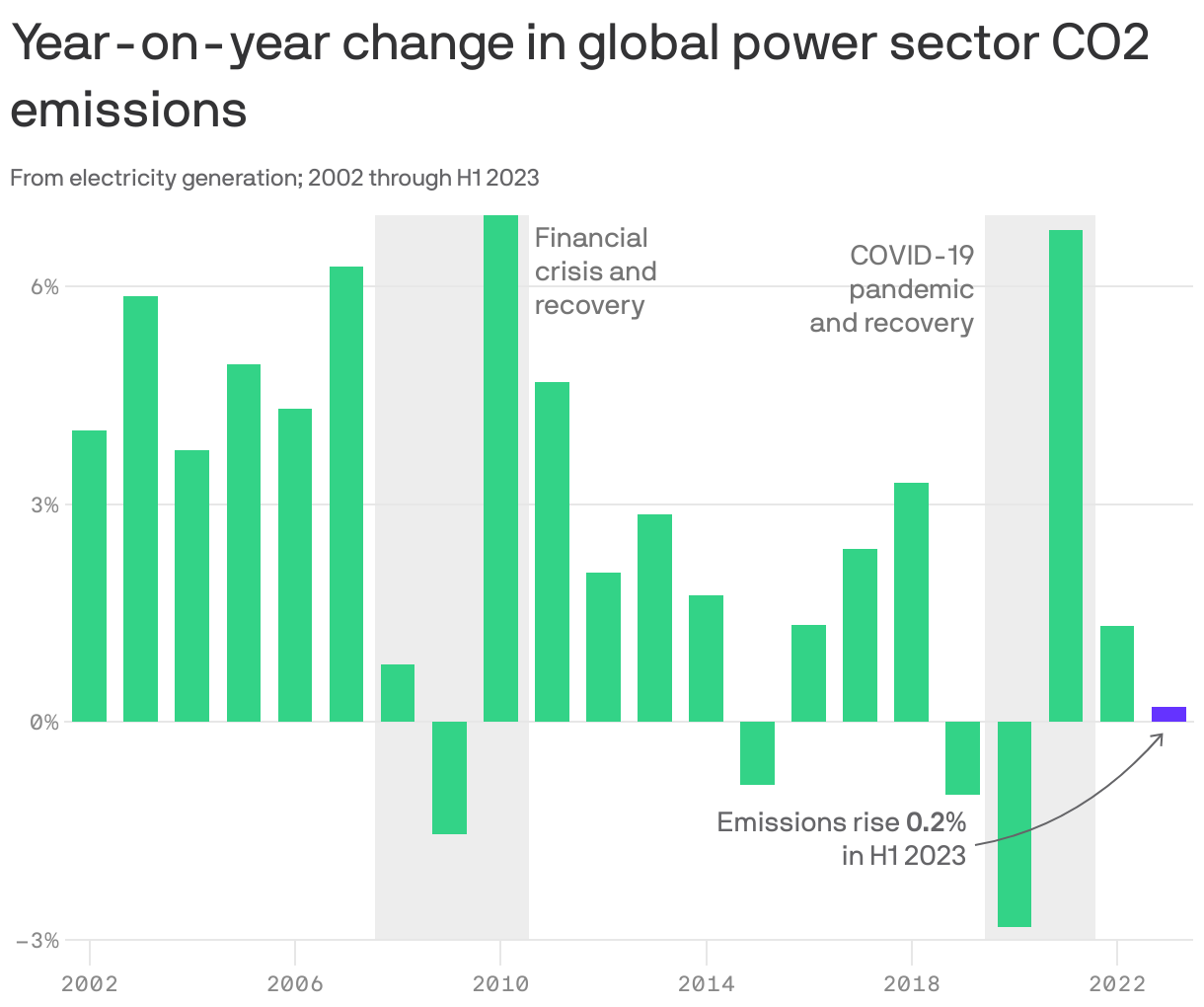
Global carbon emissions from power production essentially plateaued in the first half of 2023, Ben writes.
Driving the news: New analysis from the non-governmental organization Ember says 2023 may mark a turning point, with the sector's emissions having risen just 0.2% during H123.
- "[T]he world is nearing the point of falling power sector emissions," the NGO wrote.
Why it matters: Globally, the power sector is the biggest emitter of greenhouse gases, while clocking in at No. 2 in the U.S. Domestically, it accounts for over 3o% of energy-related CO2 emissions, according to Energy Information Administration data.
- Ember's research gives faint hopes that warming temperatures may not add materially to an already dour outlook for carbon emissions, with power output likely to rise.
The big picture: Electricity emissions would have fallen so far this year absent the big, drought-spurred hydropower decline centered in China. That boosted fossil output to compensate, Ember said.
- And it's still possible 2023 will be the first year with "structurally" falling emissions as renewable sources grow.
- "Before this point, power sector emissions have been structurally rising, and there have only ever been falls during global economic shocks such as the 2008 financial crisis or the 2020 Covid-19 pandemic," Ember reports.
Key stats: Global wind and solar generation rose 12% in the first half of this year, while fossil generation climbed just 0.1%. Hydro power fell 8.5%.
Yes, but: Any pathway to Paris Agreement goals envisions steep carbon dioxide cuts from electricity, the world's largest emissions source, not just a plateau.
- "Reaching 'peak' fossil emissions in the power sector is a crucial milestone in the global transition to a clean, electrified economy. But the most critical part is what happens next," the report states.
The bottom line: Still, squint just right, and it's a glass-half-full moment.
2. Why the oil rally went into reverse

Illustration: Aïda Amer/Axios
Let's chill on the $100-per-barrel oil predictions for a moment, Ben writes.
Driving the news: Crude prices have plunged by roughly $5 per barrel over the last day, and about $10 since Friday.
- Early Thursday, WTI hovered under $84 per barrel after surging to its highest levels of the year on Sept. 27.
The big picture: Overlapping economic signs and demand data are bearish for crude, including...
- U.S. gasoline inventories rose and demand fell over the last week, Energy Information Administration data showed.
- Meanwhile, "the current rates environment along with the [US dollar's] strength has only provided stronger headwinds to the market," ING analyst Warren Patterson said in a note.
The bottom line: "Until we start to see a shift in the 'higher for longer' narrative when it comes to rates, the oil market will likely struggle to push significantly higher," he said.
3. Changes in Washington — and impacts far beyond

Illustration: Sarah Grillo/Axios
Changing faces atop Capitol Hill GOP leadership and the top ranks of the Interior Department could bring shifts in posture, Ben writes.
Driving the news: Tommy Beaudreau is stepping down from the No. 2 role at Interior, which regulates energy development on huge swaths of public lands and waters.
Why it matters: He's seen as a relatively moderate voice on oil and gas who deeply understands the industry.
- Beaudreau was confirmed in a bipartisan, 88-9 Senate vote in 2021, and also spent years in senior roles in the Obama-era Interior.
What's next: While the White House holds sway on big decisions, watch how his absence may affect leasing, permitting and more.
Meanwhile, there are energy implications in the race to replace ousted House Speaker Kevin McCarthy.
State of play: Majority Leader Steve Scalise of Louisiana is a strong backer of oil and gas drilling — and made that clear in announcing he wants to replace McCarthy.
- His letter to colleagues touts this year's House passage of legislation to expand leasing and pare back Biden climate policies.
- His main competition for now is Judiciary Committee Chairman Jim Jordan, who's also very conservative but less of a known quantity on energy.
Quick take: Via my Axios Pro: Energy Policy colleagues, a major congressional permitting deal may now be even less likely.
Zoom in: A speaker tight with the oil and gas industry, like Scalise, could place even greater emphasis on changing environmental laws key to permitting.
Subscribe for Pro's deeper look at the post-McCarthy era and vital Capitol Hill coverage every week.
4. A preview of looming battles at COP28

Illustration: Sarah Grillo/Axios
A new United Nations report shows many countries' interest in more aggressive steps on climate change — and foreshadows fights at COP28, Ben writes.
Driving the news: It summarizes governments' and stakeholders' ideas for the "global stocktake" at the late-year summit.
- That's the formal process to gauge where the world stands in the fight against climate change (hint: not nearly far enough), and how to course correct.
What they found: The report is stuffed with ideas for national and collective policies and non-binding targets under the Paris Agreement, albeit with varying levels of support. Some of the dozens of concepts include:
- Tripling renewable energy capacity by 2030, which is a plank of COP28 president-designate Sultan Ahmed al-Jaber's agenda.
- Cutting methane emissions by 40% by 2035; global phaseout of "unabated" coal-fired power by 2040; having all new light-duty vehicle sales be zero-emissions by 2035 in "leading" markets and 2040 globally.
- Various goals for phasing out fossil fuel use and exploration. Climate Home News has a nice rundown.
Yes, but: Look for fights over specifics at the summit that require consensus among parties.
- For instance, the Financial Times noticed Russia's submission says the giant oil and gas producer opposes calls for a fossil fuel phaseout.
The bottom line: The UN's release Wednesday acknowledges "divergent views," but adds there's "broad agreement that past climate action has been insufficient."
5. New numbers and a prediction for 2023's ranking
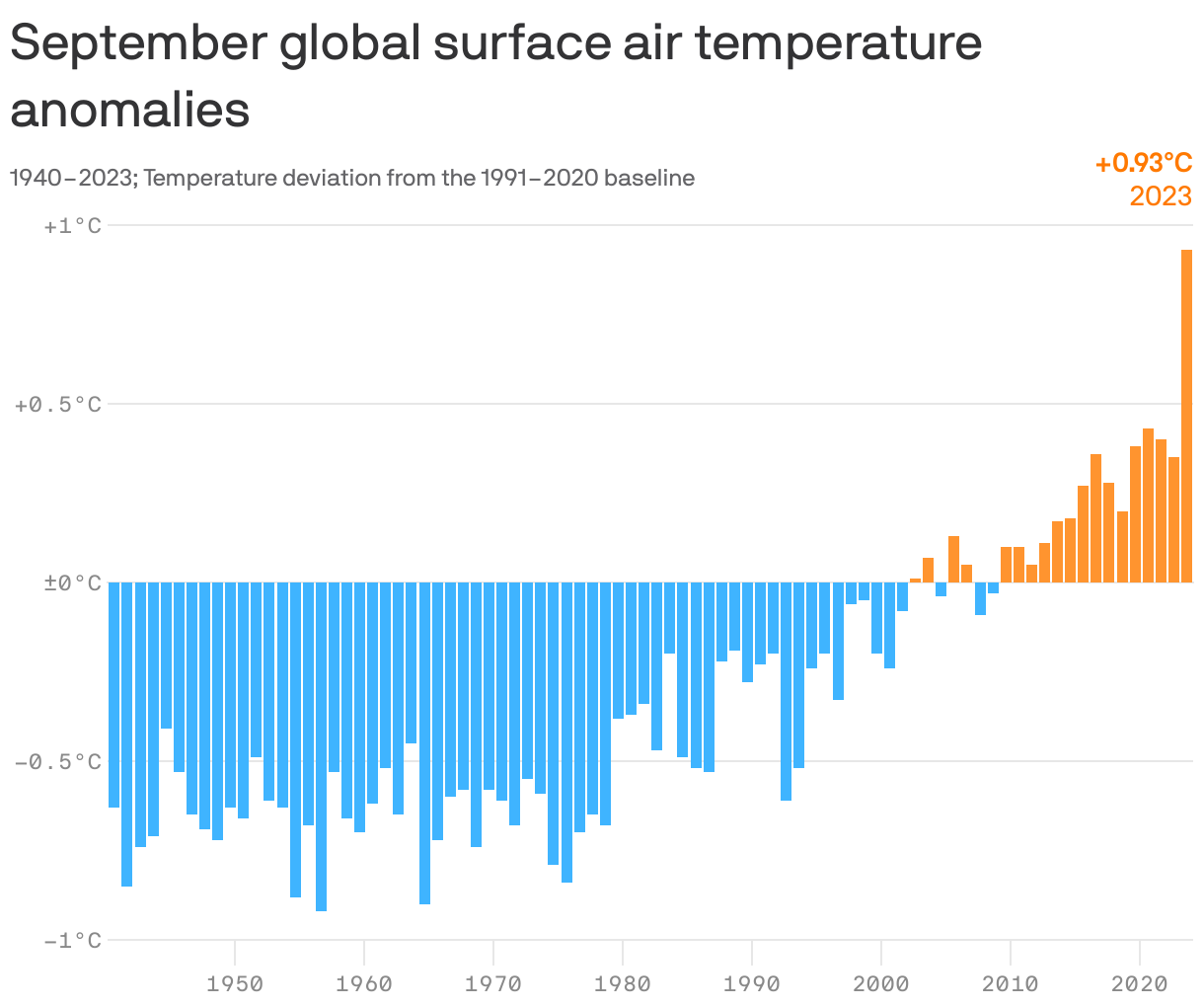
More data shows just how freakishly hot the planet was during September, Andrew writes.
The big picture: It indicates that the month had the largest temperature departure from record of any month since at least 1940, coming in at 0.93°C (1.67°F) above 1991-2020 levels.
Why it matters: The new data from the Copernicus Climate Change Service delves deeper than the information released on Tuesday and puts an official imprimatur on it.
By the numbers: Last month crushed the previous September milestone by a staggering 0.5°C (0.9°F), Copernicus found.
- According to the EU agency, enough evidence now exists to confidently predict 2023 will be the warmest year on record in its database.
- Similar predictions are likely soon from NOAA and NASA, joining the independent group Berkeley Earth.
- The global average temperature for the year so far shows temperatures are running 0.52°C (0.93°F) above the 1991-2020 average, which is 0.05°C (.09°F) higher than the same period during the record warm year of 2016.
What they're saying: "This extreme month has pushed 2023 into the dubious honor of first place — on track to be the warmest year and around 1.4°C (2.5°F) above preindustrial average temperatures," said Samantha Burgess, Copernicus' deputy director, in a statement.
- "Two months out from COP28 — the sense of urgency for ambitious climate action has never been more critical," she stated.
6. 🔋Number of the day: $3 billion
That's how much battery giant LG Energy Solution will invest to expand its Michigan plant to make cells and modules exclusively for Toyota, Ben writes.
Why it matters: The outlay, part of a new supply deal for U.S.-made Toyota EVs, adds to the surge of battery investments.
Did someone forward you this newsletter? Welcome, and please sign up.
🙏 Thanks to Chris Speckhard and Javier David for edits to today's edition, along with the talented Axios Visuals team.
Sign up for Axios Generate

Untangle the energy industry’s biggest news stories


