Axios Generate

January 08, 2025


🌄 Good morning! Today we have the latest on the California fires along with climate policy updates, all in a quick 1,345 words, 5 minutes.
🎸 Today's pick for an intro tune comes from Andrew's wife, Olga: the artist Phosphorescent's "Song for Zula".
1 big thing: SoCal wildfires driven by confluence of climate-related factors
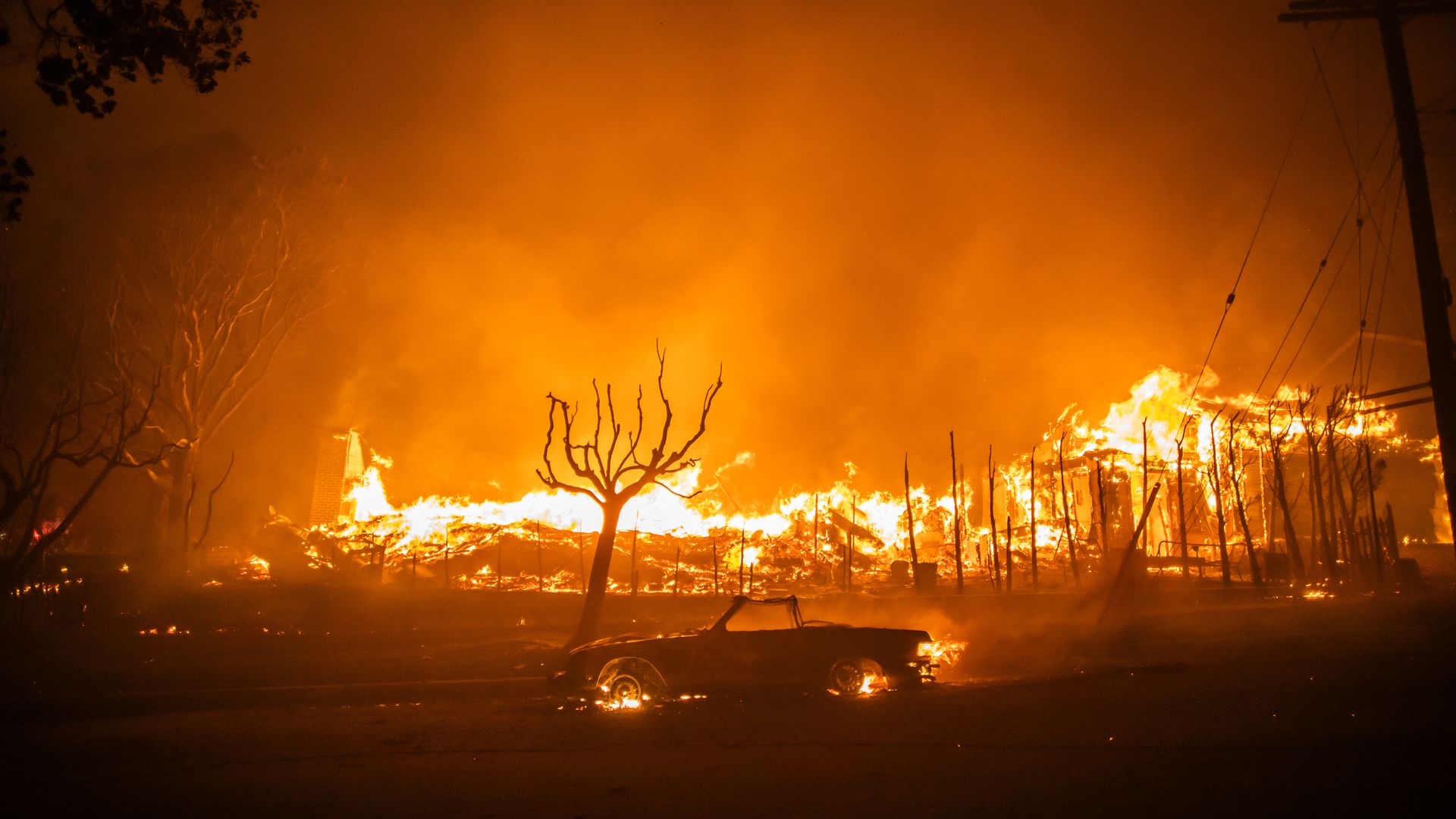
At least three fast-moving, destructive wildfires were burning in the Los Angeles metro area early this morning, with tens of thousands of people evacuated, some having run on foot to flee oncoming flames.
The big picture: The wildfires are the result of an unheard-of combination of factors at this time of year — the worst high wind event in Southern California since 2011, plus some of the driest conditions on record for early January.
- Downtown LA has received just 0.16 inches of rain since October, more than 4 inches below average and the sixth-driest such period on record. January is typically during the region's wet season.
- Bone dry conditions in Southern California contrast with the northern parts of the state, where atmospheric rivers have squelched fire risks.
- Even worse, the region had an unusually hot summer that dried out vegetation even further.
Threat level: Warnings for "particularly dangerous situation" red flag fire weather conditions and "extremely critical" risk continue across Southern California through late today as at least four significant fires burn in the LA metro area.
- Whipped by powerful Santa Ana winds gusting up to 99 mph, particularly in hilly terrain, the fires forced chaotic evacuations in parts of LA, particularly related to the Palisades Fire.
- High winds are affecting the wildfires, with gusts of 50 to 70 mph and higher in some lower elevations. Hollywood Burbank Airport, for example, gusted to 84 mph.
- UCLA climate scientist Daniel Swain referred to the high winds as an "atmospheric blow dryer" for its effects on trees and other vegetation.
Context: Climate change is intensifying hydroclimate extremes, both wet and dry, including weather whiplash events where California seesaws between the two.
- With dry conditions lasting later into the fall, that means Southern California is more vulnerable to dry high wind events, Swain noted.
- "Climate change is increasing the overlap between extremely dry vegetation conditions later in the season and the occurrence of these wind events," he said in an online briefing.
What they're saying: Alex Hall, also with UCLA, said the hydroclimate situation plus the strong winds have suddenly created a precarious situation.
- "Southern California has experienced a particularly hot summer, followed by almost no precipitation during what is normally our wet season," he said.
- "And all of this comes on the heels of two very rainy years, which means there is plenty of fuel for potential wildfires."
What's next: More wind-driven wildfires may yet erupt before this event is over.
2. 💨 The implosion of a climate pact matters

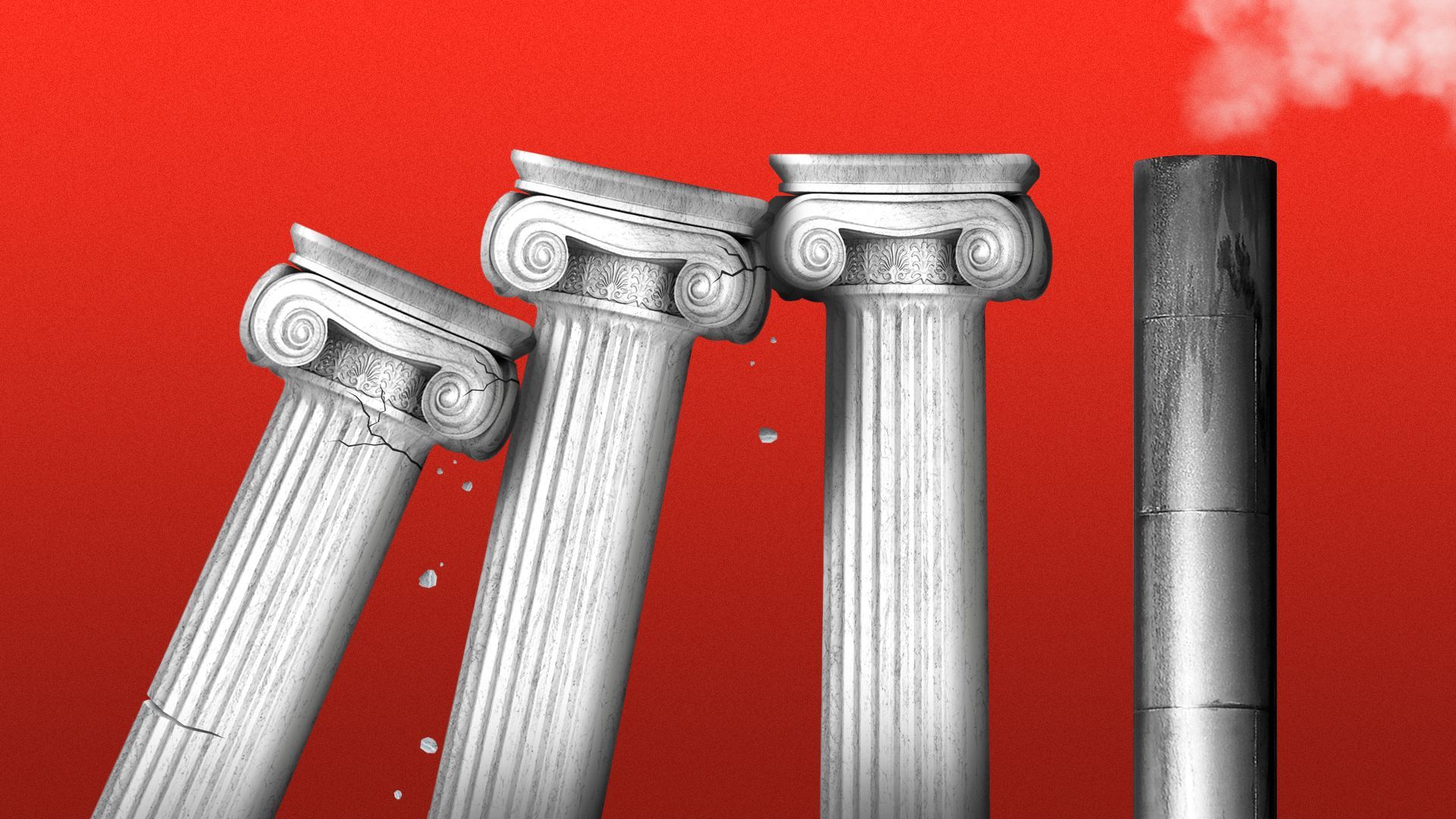
The Net-Zero Banking Alliance epitomizes everything the MAGA world hates about international banking.
- As such it's hardly a surprise that all of America's largest banks have now withdrawn from it.
Why it matters: Without U.S. banks on board, it becomes harder for NZBA to meet its goal of helping the world achieve net-zero carbon emissions by 2050.
Driving the news: JPMorgan Chase yesterday became the final U.S. megabank to withdraw from NZBA, joining Morgan Stanley, Citigroup, Bank of America, Wells Fargo and Goldman Sachs, all of which have also left in recent weeks.
The big picture: The idea behind NZBA is that any given dollar mobilized by a bank could go to financing the climate transition, thereby making the world greener — or it could finance the industrial activity that ends up emitting more carbon, thereby exacerbating the climate crisis.
- If the world's biggest banks all pledge to maximize the former and minimize the latter, NZBA becomes a positive-sum endeavor that broadly helps to put the global economy on its strongest possible future path.
Between the lines: Groups like NZBA tend to look like globalist cartels when viewed through a MAGA lens, so there's a strong incentive to find ways to achieve their goals without requiring formal membership.
- NZBA, along with its parent organization, the Glasgow Financial Alliance for Net Zero (GFANZ), have already developed the frameworks necessary for banks to know whether they're pacing to hit their targets.
- As such, remaining in the alliance might not be necessary, says Daniel Firger, managing partner at Great Circle Capital Advisors.
Where it stands: None of the big U.S. banks has — yet — retreated from the actual underlying net-zero commitments they made when they joined NZBA.
- It's therefore possible that nothing is going to change in practice and that the banks are engaging in so-called "greenhushing," where they privately stick with their climate agenda but don't say much about it in public.
- Conversely, says John Kostyack, a consultant working on climate-related financial risk, "the U.S. banks have shown that they want to be first in line for financing emitters. That's not going to change."
3. 🚗 All (EV) politics is local



Biden officials are confident that EV momentum spurred by their policies will outlive any Trump administration rollbacks.
Why it matters: Opposition to EVs was central to Republicans' campaign rhetoric. It shaped tossup races in states like Michigan and Pennsylvania that went for President-elect Trump.
- Tesla CEO Elon Musk, who as a Trump adviser has already shown outsized influence on Congress' spending packages, backs ending EV tax credits.
- Such a move could hurt other manufacturers more than Tesla, the largest global EV producer.
Driving the news: The DOE and DOT's joint office on EVs has made "remarkable progress" in advancing EVs by building out a charging network and manufacturing supply chain, deputy Energy secretary David Turk told Daniel.
- "When I get out of D.C., so much of this gets depoliticized, or, frankly, non-politicized — especially when it comes to jobs and manufacturing and battery facilities," Turk said, adding that consumers ultimately want options.
- The DOT has tailored discretionary grant programs and technical assistance to rural and low-income communities and people who may not have garages, added Polly Trottenberg, Deputy Secretary of Transportation.
Between the lines: EV manufacturers are trying desperately to defend all that spending — and the 30D vehicle tax credit, one of the top targets for GOP repeal.
- Key to that pitch is that 30D "is essentially a mineral and battery component credit," said Albert Gore, executive director of the Zero Emissions Transportation Association.
- As the reconciliation lobbying push kicks up, that means automakers will be arguing that the credit incentivized not just EV manufacturing in GOP districts, but also domestic mining and processing.
- "It's incumbent on the industry to demonstrate the degree to which these are really good federal investments," Gore said at a recent roundtable.
What's next: Turk said he and Secretary Jennifer Granholm plan to stress to Trump officials the importance of keeping the joint office.
- Trump transition officials didn't immediately respond to a request for comment.
Unlock the whole story, and if you need smart, quick intel on energy and climate policy for your job, get Axios Pro: Policy.
4. 💲Treasury issues tech-neutral energy tax credit rules
The Biden administration's final rules for technology-neutral energy tax credits won praise from renewable energy groups but criticism from fuel cell companies.
Why it matters: The Clean Electricity Investment and Production Tax Credits — known as 45Y and 48E — apply to projects beginning construction this year. The rules were issued yesterday.
- The tech-neutral credits, established by the IRA, cover wind, solar, hydropower, marine and hydrokinetic, geothermal, nuclear, and certain waste energy recovery property, the Treasury Department said in a news release.
What they're saying: Renewable energy and environmental groups urged Congress and the incoming Trump administration to maintain the credits.
- The credit "provides the long-term policy certainty companies need to invest in U.S. energy innovation," said Abigail Ross Hopper, president and CEO of the Solar Energy Industries Association, in a statement.
- "Attempts to revoke these rules will only make it easier for China to win the race for global solar market dominance while killing American jobs and much-needed economic opportunity," Hopper said.
Yes, but: The Fuel Cell and Hydrogen Energy Association, a hydrogen industry trade association, is "extremely concerned" with Treasury's treatment of fuel cell technologies.
- The rules block most, if not all, fuel cells from eligibility because they consider the technology combustion and gasification equipment, which is an "absurd classification," CEO Frank Wolak said.
- Wolak wants "a more thorough discussion of how this technology can drive economic growth and energy security with the new Congress."
Did a friend, colleague or a LinkedIn contact you don't really know send you this newsletter? Welcome, please sign up.
🙏 Thanks to Chris Speckhard and Chuck McCutcheon for edits to today's edition, along with the brilliant Axios Visuals team.