How MAGA wants jurists to reshape climate policy

Add Axios as your preferred source to
see more of our stories on Google.

Illustration: Aïda Amer/Axios
Three of the biggest investment firms in the world were sued by 11 states last week, in a case that not only could transform the way trillions of dollars is managed, but could also hobble global efforts to transition to a sustainable level of carbon emissions.
Why it matters: Texas attorney general Ken Paxton, along with 10 of his colleagues, is attempting to use the U.S. judicial system to forcibly derail the global consensus that investors can and must play an important role in the transition to a net-zero world.
The big picture: The case has been filed in the Eastern District of Texas, which in turn is overseen by the Fifth Circuit Court of Appeals — a court that has a reputation for politicized and idiosyncratic jurisprudence.
- Paxton might therefore be able to prevail despite the inherent issues with his case — especially since the conservative Supreme Court would be more ideologically inclined to let the Fifth Circuit's decision stand.
- From January, Paxton will also have the likely support of the Department of Justice and the Attorney General, whomever that might be.
Zoom in: The theory of the case is that the three investors — BlackRock, Vanguard and State Street — illegally colluded to force a group of public coal-mining companies to produce less coal.
- There's no evidence of collusion in the complaint, beyond the fact that all three of them had joined (and in some cases later left) one or both of a pair of climate-focused membership organizations, Climate Action 100+ and Net Zero Asset Managers.
- There's also no evidence that any of the asset managers pressured any companies to produce less coal, beyond the fact that those companies' coal production went down.
Zoom out: As BlackRock CEO Larry Fink has said, climate risk is investment risk. But for many Republicans, it's politically unacceptable for investors to want to be aware of — or agitate against — the degree to which the companies they own are contributing to and preparing for the climate crisis.
Fun fact: Among the remedies sought by Paxton is that the investors should divest from the carbon-heavy coal companies they own. That, ironically, is the same thing that climate activists have been demanding for years.
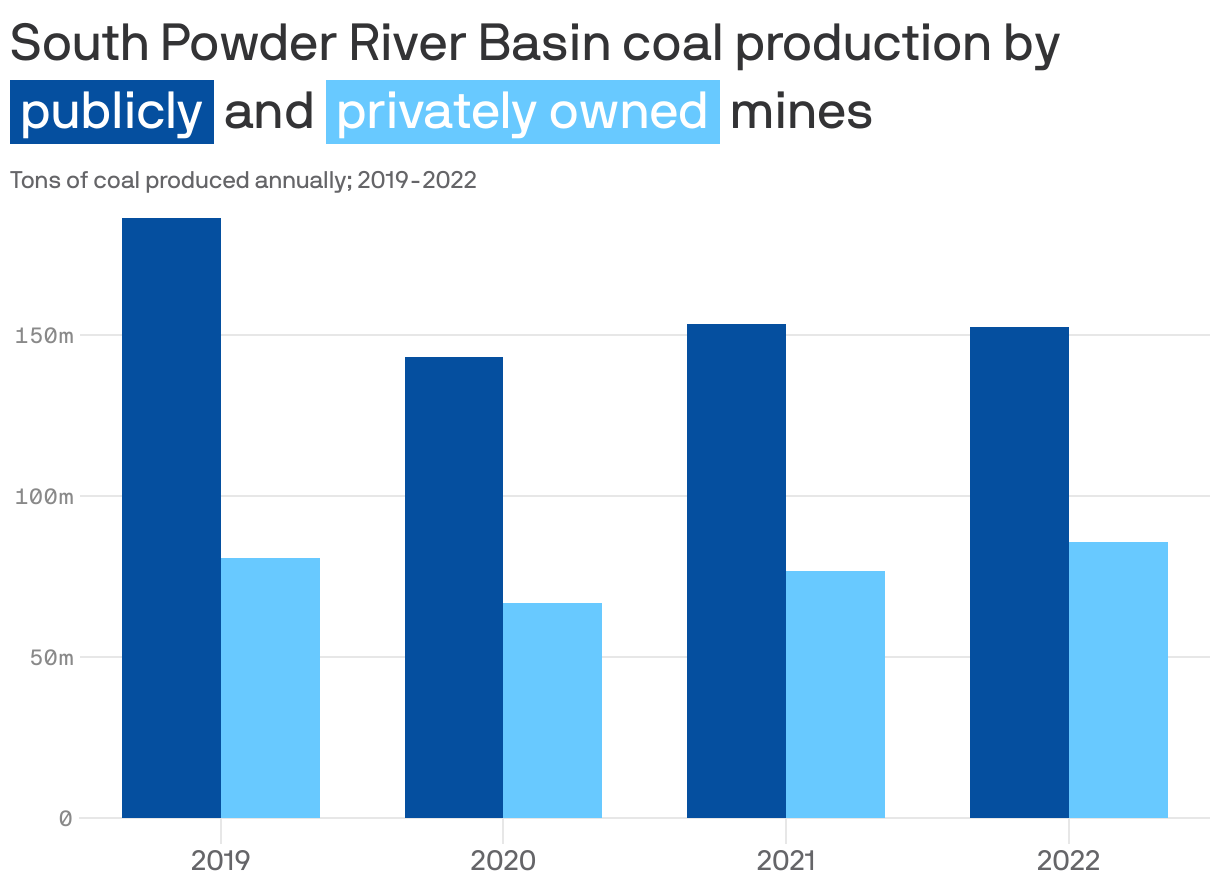
"The anticompetitive effects of Defendants' conduct has been pronounced and unmistakable," claims Paxton in his complaint, adding that "this dynamic is particularly clear" in the South Powder River Basin market.
Production of SPRB, a particular grade of coal mined principally in Wyoming, fell in 2020 when the pandemic hit electricity demand.
- Paxton's claim is that, the pandemic notwithstanding, public coal miners, pressured by their shareholders, reduced production even as private coal production went up.
Between the lines: What Paxton doesn't mention is that the reduction in coal production makes perfect sense given the decline in the number of coal-burning power plants. Without demand from those plants, there's no one for the miners to sell their coal to.
- In turn, the reduction in coal-fueled plants is mostly a function of the fact that natural gas is now a cheaper source of fuel than coal.
Paxton also claims that the decline in coal production ultimately affected "the price Americans pay for electricity."
- Coal-fueled plants, however, produce baseline electricity. They're not the marginal power producers that ultimately determine the market price.
- Readers can look at the chart above to judge for themselves whether it indeed shows "pronounced and unmistakable" evidence that public coal miners were cutting production while their private rivals were raising it.
The bottom line: As Aniket Shah, head of sustainability at Jefferies, says, "the future of climate and the future of energy will now be decided through the courts, not decided through legislation."
Editor's note: This story has been updated to clarify that BlackRock, Vanguard and State Street all joined either Climate Action 100+ or Net Zero Asset Managers, or both.
